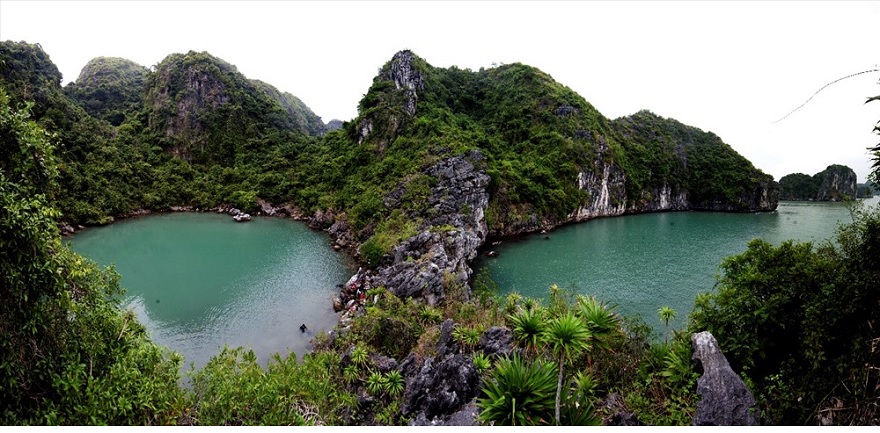
The Tung Ang Cong Do ecosystem is one of the most distinctive and captivating destinations in Ha Long Bay, a UNESCO World Heritage natural wonder. This unique ecosystem type is characteristic of limestone island regions formed within a marine environment, seamlessly blending biotic and abiotic elements to create a breathtaking and diverse landscape.
What is the Tung Ang Ecosystem?
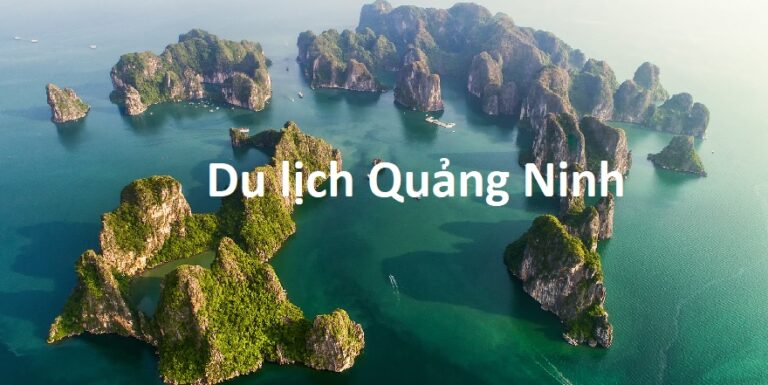
The Tung Ang ecosystem is a specialized ecological environment within the Ha Long Bay, Bai Tu Long Bay, and Cat Ba archipelago regions, nestled within the broader wetland ecosystem. It comprises pristine lagoons and marine basins formed through millions of years of natural weathering and erosion upon magnificent limestone islands. These ancient limestone formations have evolved into wondrous shapes reminiscent of dragons, phoenixes, birds, and fish. The “ang” and “tung” are tranquil, crystal-clear bodies of water cradled between limestone karsts. According to scientific definitions, an “ang” is a karst lake situated amidst island clusters, while a “tung” is a marine lagoon connected to the bay by a relatively broad opening, allowing water circulation while remaining sheltered, highly translucent, and calm with minimal waves. Scientific surveys indicate that the Ha Long Bay, Bai Tu Long Bay, and Cat Ba regions harbor a total of 62 “ang” and 57 “tung”, spanning a combined area of 289.4 hectares and 1,186.2 hectares respectively.
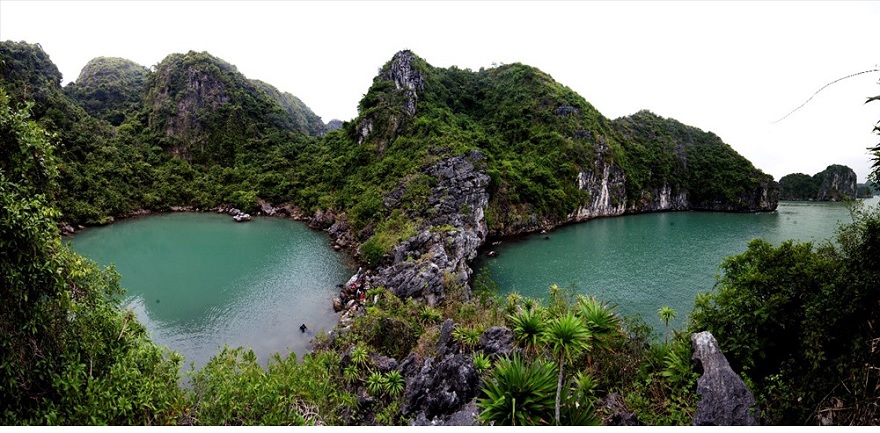
Tung Ang Ecosystem
The “ang” and “tung” support a remarkably rich and diverse range of marine life across the Ha Long – Cat Ba region. The “ang” feature depths ranging from 1.5 to 4 meters, with beds composed of sand, shell fragments, and fine gravel, rendering the water so transparent that the seabed is clearly visible. These lakes sustain 66 species of marine life, including 21 species of seaweed, 37 species of mollusks, 8 species of crustaceans, and various coral formations. Among them are rare and precious species such as pearl oysters, green mussels, razor clams, various scallops, and branching algae.
The “tung” lagoons feature firm seabeds and exceptional water clarity of up to 2 meters. Each lagoon hosts a distinct biological composition, primarily categorized into three groups: corals, benthic fauna, and macroalgae. These lagoons are renowned for specialty marine species such as geoduck clams, swimming crabs, blood cockles, hairy cockles, and pearl oysters. Furthermore, the “tung” harbor four rare and endangered species: the giant sundial snail, the female sundial snail, the black-lipped pearl oyster, and the razor clam. All four species are officially listed in the Red Data Book as priority conservation targets.
Beyond their ecological uniqueness, the “ang” and “tung” exhibit fascinating seasonal variations. The dominant species populations within these water bodies fluctuate over time, establishing a priceless natural laboratory for marine biological research and drawing intense interest from scholars and scientists worldwide.
How to Get to the Tung Ang Cong Do Ecological Area
The Tung Ang Cong Do Ecological Area is located along Ha Long Bay’s Tourism Route No. 4, approximately 23 km from Tuan Chau International Passenger Port and roughly 18 km from Ha Long International Cruise Port. Because Route No. 4 encompasses numerous destinations and requires an extended itinerary to fully appreciate, it is meticulously curated exclusively for overnight Ha Long Bay luxury cruises. Journeys along this route commence from either Ha Long International Cruise Port or Tuan Chau International Port.
The itinerary for Route No. 4 typically includes iconic landmarks such as Co Cave, Thay Cave, the Cong Do Island area, Cap La Cave, the Tung – Ang Cong Do Ecological Area, Hon Xep Park, and the Vung Vieng fishing village. Travelers generally explore the Tung Ang Cong Do ecosystem on the second day of their voyage.
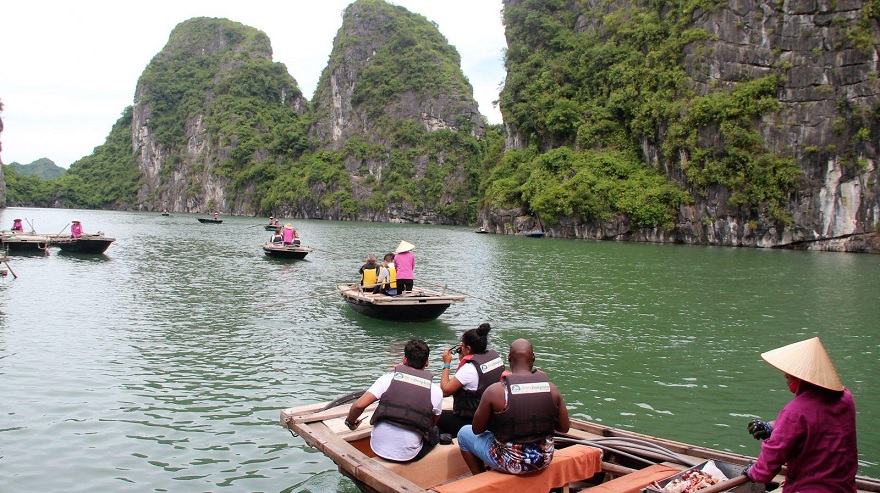
Experiencing and discovering Tung Ang Cong Do by bamboo rowing boat
This ecological zone comprises two primary lagoons—Ca Bong Lagoon and Cong Do Lagoon—alongside several smaller basins. Ca Bong Lagoon spans 1 hectare with shallow waters, serving as a natural sanctuary for goby fish. Accessing this lagoon involves an adventurous excursion: scaling limestone cliffs and traversing a steep, roughly 500-meter jungle path. Cong Do Lagoon covers 0.5 hectares, featuring a bed of sand, gravel, and lush seaweed. It is celebrated as the most pristine and tranquil lagoon in the area. Visitors have two distinct pathways to enter: paddling through the Cong Do Cave arch (during low tide when clearance is approximately 1.5 meters) or climbing over a majestic limestone cliff standing about 10 meters high.