Halong Bay, a UNESCO World Heritage natural wonder celebrated twice for its exceptional values, boasts over 1,900 majestic limestone islands and mystical caves. Among them, Tien Ong Cave stands out for its enchanting natural beauty and profound archaeological significance. This cavern once served as a dwelling for ancient Vietnamese of the Soi Nhụ culture 8,000 to 10,000 years ago. Tien Ong Cave is not only a captivating destination but also a gateway into the rich prehistoric heritage of early Vietnamese civilization, offering travelers a deeply enriching and unforgettable experience.
Location of Tien Ong Cave
Tien Ong Cave, also known as Cái Đục Cave (formerly referred to by the French as Grotte du Ciel), is one of the most magnificent and distinctive caves in Halong Bay (recognized by UNESCO as a World Heritage Site). Situated on Cái Tai Island within the Hang Trai island cluster, it lies approximately 5 kilometers from Cat Ba Island and about 18 kilometers from Tuan Chau International Cruise Port.
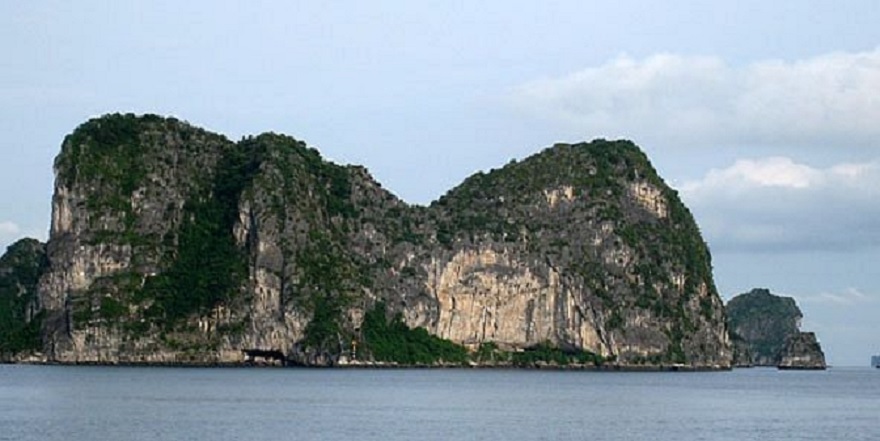
Cái Tai Island viewed from the west
Tien Ong Cave is a vital archaeological site belonging to the Soi Nhụ culture, one of the prehistoric civilizations of ancient Vietnamese in Halong Bay. This heritage site was first discovered in 1938 by the Swedish geologist and archaeologist J.G. Andersson during a geological survey in Bai Tu Long Bay. He named the cavern Đục Cave and opened three excavation pits—a large one near the cave entrance and two smaller ones further inside. He collected numerous artifacts such as stone tools, bone implements, and pottery shards, the majority of which were taken to Sweden for research, while several artifacts remain preserved at the Louis Finot Museum (now the National Museum of Vietnamese History). An intriguing detail noted by Andersson was the presence of a freshwater snail shell sediment layer inside the cave, the origin of which none of the local residents could explain. Andersson regarded this as an unsolved mystery waiting to be unraveled.
Following the departure of J.G. Andersson, the Tien Ong Cave archaeological site fell into obscurity for over half a century. In 1997, Quang Ninh archaeologist Hà Hữu Nga returned to Tien Ong Cave to resume excavations and research. However, due to shifting local place names over the years, Hà Hữu Nga did not realize that Tien Ong Cave was actually the Đục Cave previously excavated by J.G. Andersson. Believing it to be a newly discovered site, he recorded detailed notes regarding its location, dimensions, and morphology. He also uncovered additional artifacts, including elephant teeth, fish bones, and ceramics. After cross-referencing the artifacts from both expeditions, archaeologists officially confirmed that Tien Ong Cave and Đục Cave are one and the same historical site.
How to Get to Tien Ong Cave
To reach this destination, travelers must purchase sightseeing tickets at the Halong International Cruise Port or Tuan Chau Port. As Tien Ong Cave is a designated stop along Route 3 of the Halong Bay Cruise Tour, this itinerary primarily caters to overnight luxury cruises. There are currently no daily shared day-boats operating this route; therefore, visitors must book an overnight cruise experience or charter a private day-boat to visit.
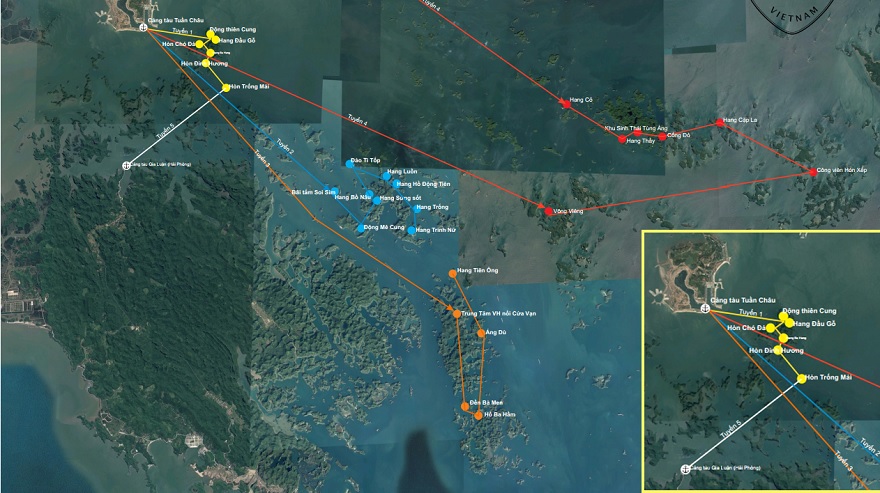
Halong Bay Route 3 Map
Chartering a Day-Boat to Explore the Bay
- Charter Fee: 4,000,000 VND / private 48-seat boat; 290,000 VND/person (entrance fee)
- Route 3 Itinerary: Cửa Vạn Floating Cultural Center (Cửa Vạn Fishing Village) – Bamboo Forest Area – Tien Ong Cave – Áng Dù – Ba Hầm Lake – Bà Men Temple
Overnight Luxury Cruises
Overnight cruises in Halong Bay offer an exquisite opportunity to explore a diverse array of stunning attractions, with itineraries ranging from 2 days 1 night to 5 days 4 nights. Cruise rates correspond directly to the tier and world-class amenities of the vessel.
| HALONG BAY CRUISE TARIFF TABLE | ||
|---|---|---|
| CRUISE TIER | CHARTER RATE (1 NIGHT) | CABIN RATE PER PERSON (1 NIGHT) |
| 3-Star | 29,000,000 – 65,000,000 VND | 1,900,000 – 2,300,000 VND |
| 4-Star | 45,000,000 – 85,000,000 VND | 2,950,000 – 3,500,000 VND |
| 5-Star | 65,000,000 – 120,000,000 VND | 3,500,000 – 5,000,000 VND |
| 6-Star | 120,000,000 – 200,000,000 VND | 5,000,000 – 8,000,000 VND |
View details: Halong Bay Cruises
Architecture of Tien Ong Cave
After traveling via a private Route 3 day-boat or an overnight luxury cruise to the Cái Tai Island area, guests will spot a directional sign indicating Tien Ong Cave. Following visits to other scenic highlights along the journey, travelers typically arrive here after approximately two hours.
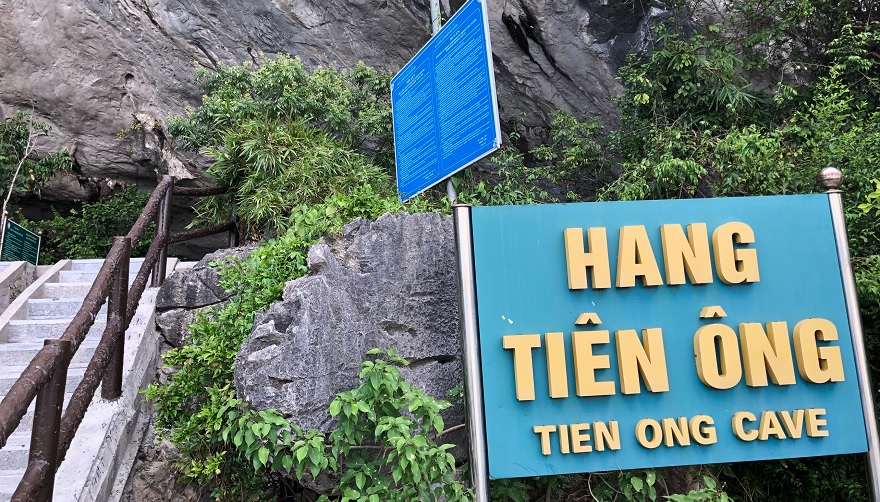
Directional sign leading to the entrance of Tien Ong Cave
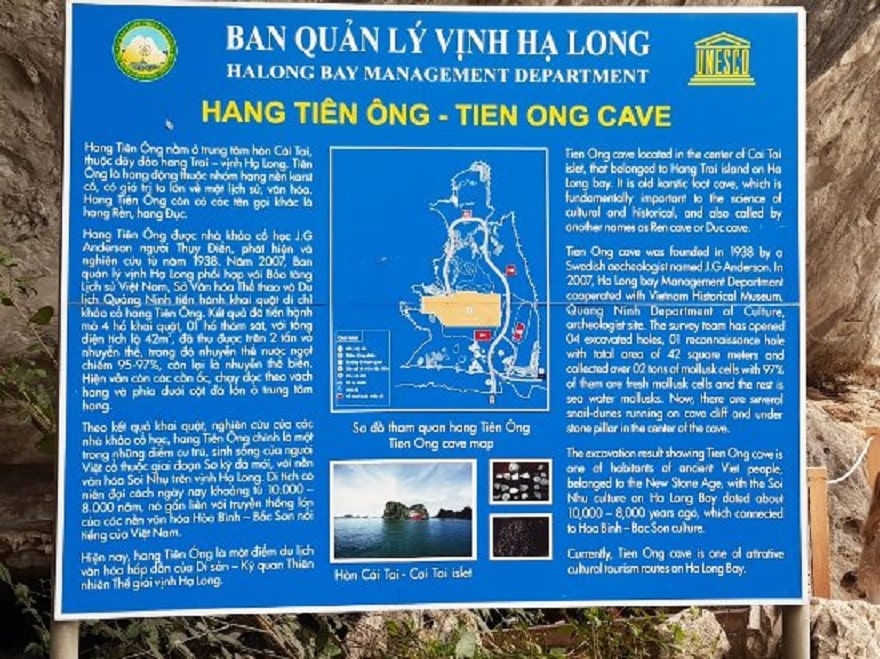
Introduction board and map of Tien Ong Cave
To enter the cave, visitors ascend roughly 5 meters via stone steps through a V-shaped, jaw-like cavern mouth spanning about 70 meters wide. This striking entrance was carved by millions of years of relentless marine wave erosion. Just outside the threshold, guests can observe numerous fallen stalactites—silent testaments to millions of years of natural geological transformation.
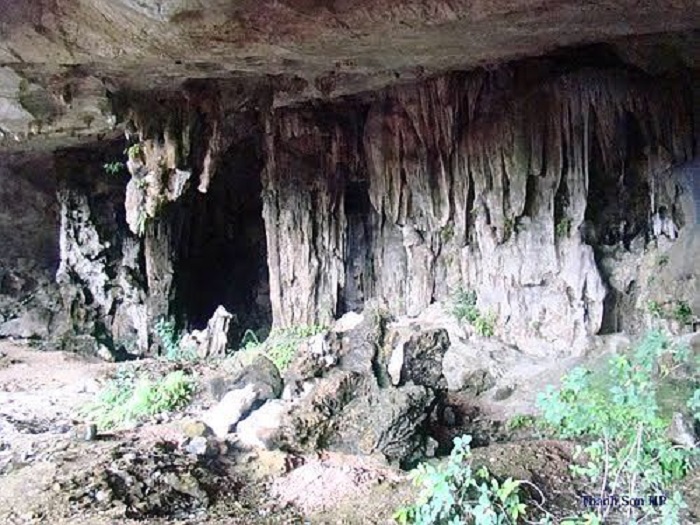
The cave entrance area where unconsolidated mollusk shell sediment is densely concentrated.
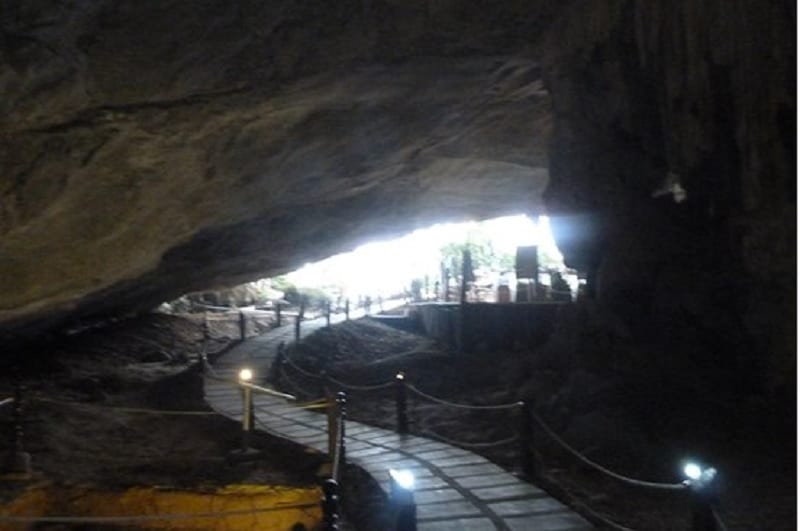
The cave mouth and pathway leading inside
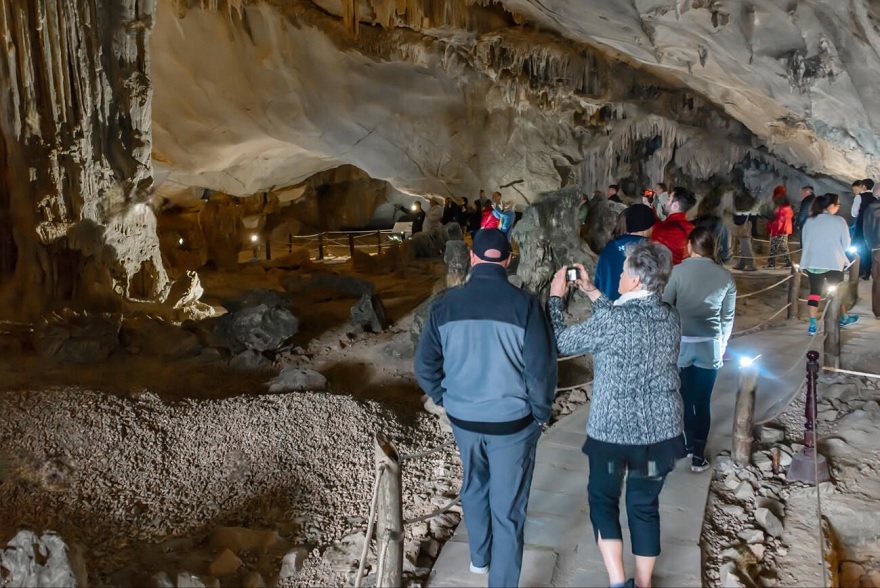
Tien Ong Cave extends approximately 156 meters in length, with an interior floor space spanning over 1,000 square meters. Geologically categorized into six main chambers, visitors typically perceive it as two distinct sections. The front section is roughly 50 meters long, 30 meters wide, and 10 meters high, adorned with whimsical stalagmite and stalactite formations. Notably, three prominent stalagmites resemble benevolent elderly sages with serene facial expressions and long beards and hair—inspiring local residents to name the cavern “Tien Ong” (Cave of the Immortal Old Man). The rear section stretches about 106 meters long, 40 meters wide, and 25 meters high, illuminated by natural sunlight streaming through a skylight in the ceiling. This chamber features delicate stalactites and smaller stalagmites forming breathtaking natural pillars and vaulted archways, while also serving as a repository for archaeological relics including stone artifacts, bone tools, and pottery.
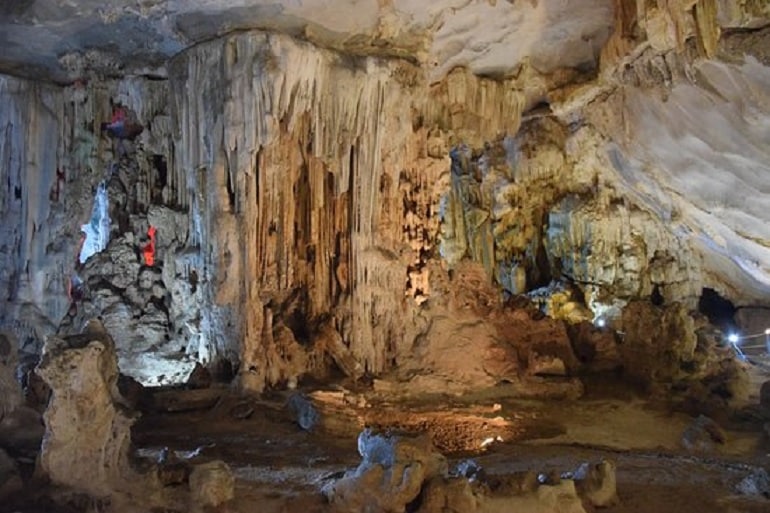
Stalactites inside Tien Ong Cave
Archaeological Relics at Tien Ong Cave
Tien Ong Cave is a momentous archaeological treasure trove containing pristine evidence of the Soi Nhụ culture dating back 8,000 to 10,000 years—one of the earliest prehistoric civilizations of ancient Vietnamese in Halong Bay. The archaeological vestiges within Tien Ong Cave have been meticulously unveiled by numerous domestic and international archaeologists through successive excavation and research campaigns.
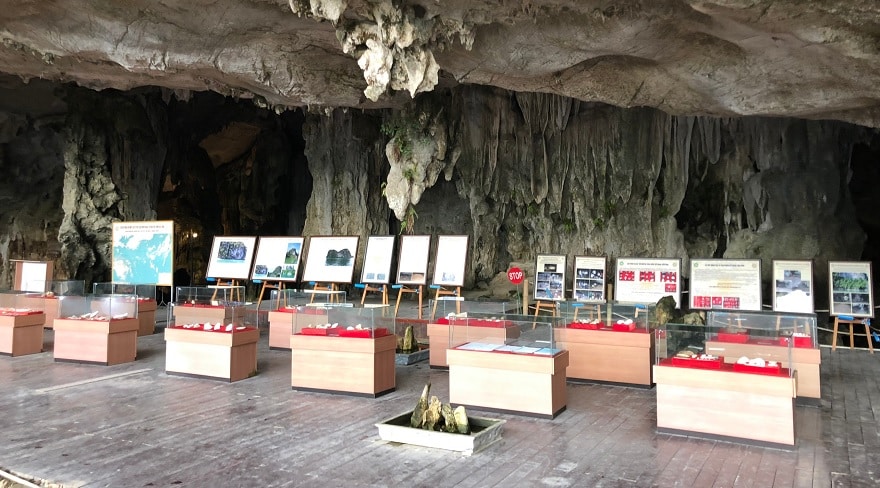
Artifact exhibition area at the entrance of Tien Ong Cave
In 1938, Swedish geologist and archaeologist J.G. Andersson excavated three pits inside the cave: a large pit spanning roughly 30 square meters near the middle of the cave entrance, and two smaller pits measuring about 2 square meters each—one positioned on the left side of the cave and another adjacent to the large pit. In his report, Andersson did not detail the stratification of the soil layers but merely hypothesized about the origin of the freshwater snail shell sediment. Although he gathered numerous artifacts, he took the majority back to Sweden, leaving behind only a modest collection (around 20 artifacts) to the Louis Finot Museum. The precise chronological dating of the site was also omitted from his report.
In 1997, archaeologist Hà Hữu Nga documented: “This cave is situated on a limestone island resembling the Đục Cave sketched in J.G. Andersson’s diagrams… The most fascinating and striking feature of this cave is the immense accumulation of Melania freshwater snail shells, reaching hundreds of cubic meters. However, a characteristic limitation of this site type is the scarcity of chipped stone tools. I recovered only 5 very primitive and ancient tools. They were crudely flaked, making their exact typology and technique difficult to determine. Among them are two tools resembling Sơn Vi pebble tools, flaked across two-thirds of a river pebble. The flaking technique involves unifacial percussion combined with pebble-breaking. One of the pebble tools functioned as an anvil. The freshwater snails are exceptionally large—likely the largest compared to freshwater shell assemblages in other caves—and all feature broken spires.” Hà Hữu Nga subsequently included Tien Ong Cave among the 25 official archaeological sites of the Soi Nhụ culture.

Archaeologists from the National Museum of Vietnamese History excavating sites at Tien Ong Cave in 2007
On November 17, 2007, archaeologists from the National Museum of Vietnamese History conducted excavations across several sectors of Tien Ong Cave following numerous exploratory surveys, covering a total excavation area of 60 square meters. They unearthed a collection of stone implements, including axes and knives, alongside pottery shards and mammalian bone fragments. The stone tools feature unifacial or bifacial flaking and are exceptionally primitive in design. Additionally, immense quantities of freshwater snail sediment (constituting 97%) were discovered, comprising land snails (Cyclophorus) and stream snails (Melania), alongside remnants of marine mollusks such as oysters and clams. Subsequent scientific reports confirmed that Tien Ong Cave served as a habitation and living site for ancient Halong residents dating back 10,000 to 8,000 years, corresponding to the Soi Nhụ cave site in Bai Tu Long Bay and belonging to the Hòa Bình – Bắc Sơn cultural epoch (Early Neolithic period).
The abundance of freshwater snail shells serves as enduring evidence of the diet of ancient Halong people within Tien Ong Cave. This indicates that approximately 10,000 years ago, this area was still part of the mainland. This conclusion by archaeologists aligns seamlessly with geological research regarding the evolutionary formation of Halong Bay. The ancient inhabitants of Tien Ong Cave shared cultural traits and a subsistence lifestyle typical of Early Neolithic ancient Vietnamese—primarily relying on gathering and hunting. They utilized natural food sources from rivers and streams while beginning to exploit marine resources, ultimately choosing Tien Ong Cave as their natural sanctuary.