Standing out brilliantly among the captivating caverns of Ha Long Bay, Dau Go Cave is renowned as one of the largest and most magnificent grottoes, drawing countless discerning travelers every year. It is often said that an itinerary to this heritage wonder is simply incomplete without experiencing this legendary cave. Read on for our ultimate guide to discovering the breathtaking beauty of Dau Go Cave.
Read more: Explore the Most Stunning Caves in Ha Long Bay and Their Geological History
Location and Origins of Dau Go Cave
Dau Go Cave is among the most exquisite grottos in Ha Long Bay, celebrated for its surreal and mystical limestone formations. Covering an area of approximately 5,000 square meters, the cave sits at an elevation of 27 meters above sea level within a limestone mountain on Dau Go Island, in Ha Long City, Quang Ninh Province. Compared to other grottoes in Ha Long Bay, Dau Go ranks as the third largest, following Sung Sot (Surprise) Cave and Thien Cung Grotto (located just 300 meters away). Acting like a colossal natural air conditioner, the cave maintains a warm embrace during winter, while offering a refreshing sanctuary of 20–22°C when the summer heat rises outside.
According to geologists, Dau Go Cave was formed approximately 2 million years ago—concurrently with Thien Cung Grotto—during the Late Pleistocene epoch. Throughout this prolonged process, relentless seawater erosion carved deep fractures into the limestone surface, while wind and rain further sculpted and widened the rock face. These cavities gradually expanded and interconnected, eventually forming expansive, profound caverns.
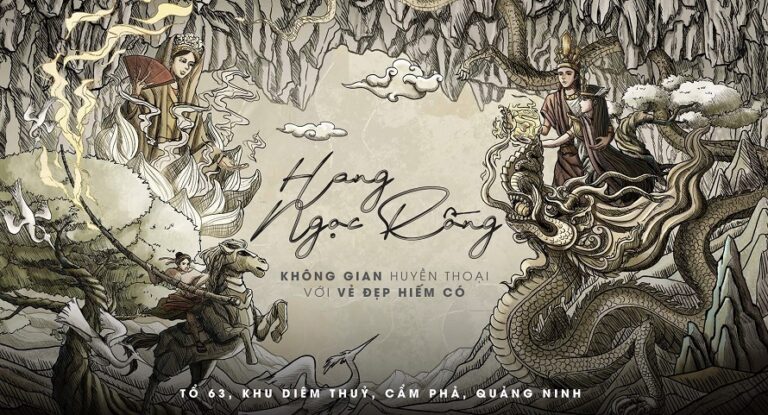
The name “Dau Go” (Wooden Stakes) has several fascinating interpretations, reflecting the rich history, culture, and natural lore of the region. One popular legend suggests that the cave was where the soldiers of the Tran Dynasty concealed wooden stakes to prepare a strategic battleground against the invading Mongol army in the 13th century. After their triumphant victory, the soldiers retrieved most of the timber, leaving only a few fragments behind in the cave. Consequently, it became known as “Giấu Gỗ” (Hiding Wood), which later evolved into “Dau Go”. However, folklore researcher Tong Khac Hai noted, “I recall around 1960, experts from the Archaeological Institute searched the cave with torches for any wooden remnants to verify the legendary stakes of Tran Hung Dao, but found nothing. Perhaps out of deep national pride and patriotism, people linked this romantic legend to the cave’s name.”

Folklore researcher Tong Khac Hai states that no physical traces of wooden stakes were found in Dau Go Cave
Mr. Tong Khac Hai suggests that the naming of Dau Go Cave aligns more closely with a second explanation: the very name of the mountain itself, Dau Go Mountain. Approaching from Cat Hai (Hai Phong), the mountain resembles a timber log pierced with two hollows, leading local fishermen to call it Dau Go Mountain, and the cave located within it simply Dau Go Cave.
A third explanation stems from the bow-shaped configuration of the Dau Go island range, which forms a sheltered, wind-protected lagoon right in front of the cave. In times past, fishermen would anchor here during fierce storms or gather after a fishing expedition to live, repair, and rebuild their wooden boats, leaving behind numerous timber remnants.
Historical Milestones of Dau Go Cave
In 1918, Emperor Khai Dinh and French Governor-General Albert Pierre Sarraut embarked on a leisure excursion across Ha Long Bay and visited Dau Go Cave. Captivated by the ethereal scenery, Emperor Khai Dinh composed a dedicated poem and prose preface praising the majestic landscapes of Ha Long and Dau Go Cave. The stone stele commemorating these poetic verses currently stands on the left side of the cave entrance. The stele is elegantly adorned with two dragons worshipping the sun on its crown and base, alongside flame-cloud motifs characteristic of Nguyen royal court aesthetics. In his preface, Emperor Khai Dinh poetically named Dau Go Cave “Ngu Sac Tuong Van” (Clouds of Five-Color Auspice), evoking a comparison between its resplendent beauty and the Tuong Van Pagoda in Hue, built in 1843.
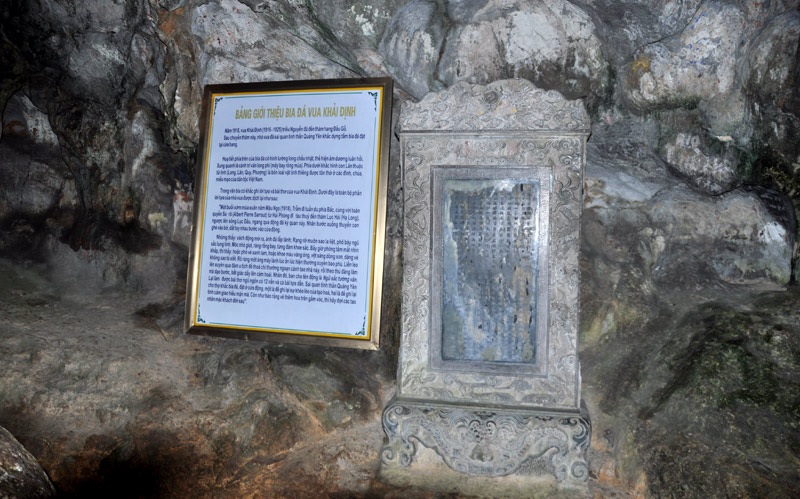
The stone stele of Emperor Khai Dinh inside Dau Go Cave today
On October 5, 1957, President Ho Chi Minh visited Ha Long Bay and toured Dau Go Cave. Upon reaching the cave entrance, he remarked to his companions, “You must be travelers enjoying the scenery just as I am; only then is it truly joyful. Such magnificent scenery cannot be appreciated by just one person sharing it alone. All of you must join me in savoring this wonder.”
In 1938, Dau Go Cave was featured for the first time in a French travel magazine titled *Merveille du Monde* (Wonders of the World). The article introduced the mystical, pristine beauty of the grotto, alongside its folklore and history. The writer eloquently praised Dau Go Cave as the *Grotte des Merveilles* (Cave of Wonders), sparking intense curiosity and allure among international travelers—particularly the French—toward Dau Go Cave and Ha Long Bay.
How to Get to Dau Go Cave
There are two primary ways to travel to Dau Go Cave:
- Option 1: Purchase a daily Ha Long Bay sightseeing ticket and choose Route 1, which includes destinations such as Thien Cung Grotto, Ba Hang Fishing Village, Fighting Cocks Islet (Hon Trong Mai), and Dau Go Cave. Tickets can be purchased at tourist ports such as Bai Chay or Tuan Chau. The ticket price for this route is 440,000 VND per person (inclusive of bay admission and boat fees). You can find and book Route 1 sightseeing tours here.
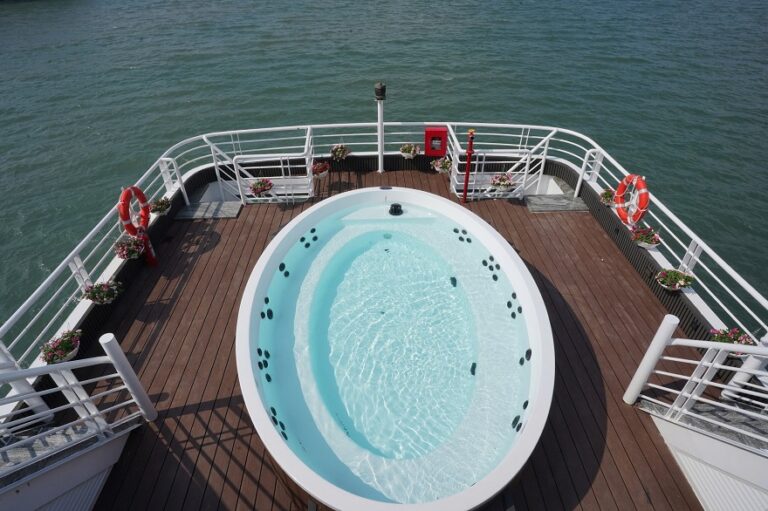
- Option 2: Book an overnight Ha Long Bay luxury cruise to indulge in a wealth of exquisite onboard activities, such as gourmet dining, overnight stays on the bay, squid fishing, kayaking, and more. Cruise packages typically range from 2 to 3 days, offering a variety of vessel types and price tiers. You can explore and book your dream cruise here.
Exploring Dau Go Cave
Departing from the tourist harbor, your cruise will bring you to Dau Go Cave after approximately a two-hour journey. Guests will disembark and take a short walk of a few hundred meters from the tender drop-off to the cave entrance. The path is well-paved and impeccably maintained; however, accessing the cave entrance requires climbing a flight of stone steps, so travelers with mobility challenges should take note beforehand.
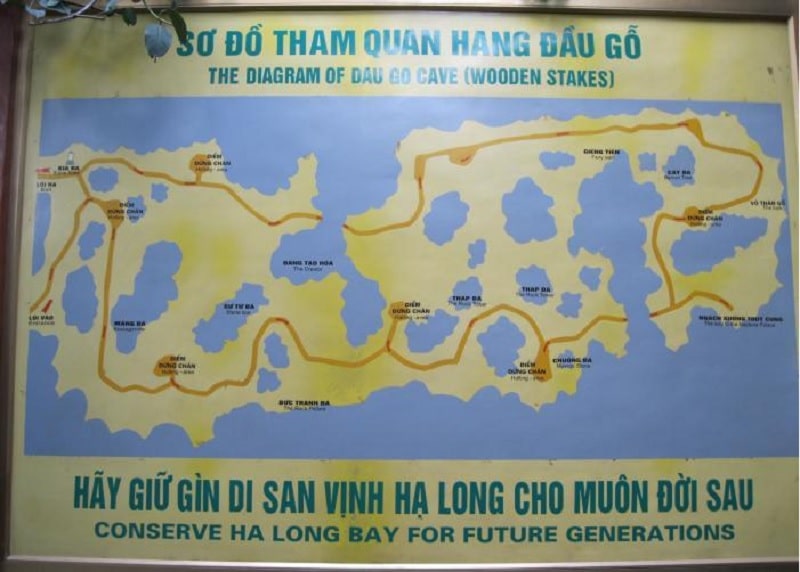
Tour map of Dau Go Cave
Dau Go Cave covers an area of roughly 5,000 square meters, featuring a magnificent entrance 17 meters wide and 12 meters high with distinctive, striking architecture that stands as a true masterpiece of nature. The interior is divided into three distinct chambers, each offering its own unique and alluring charm.
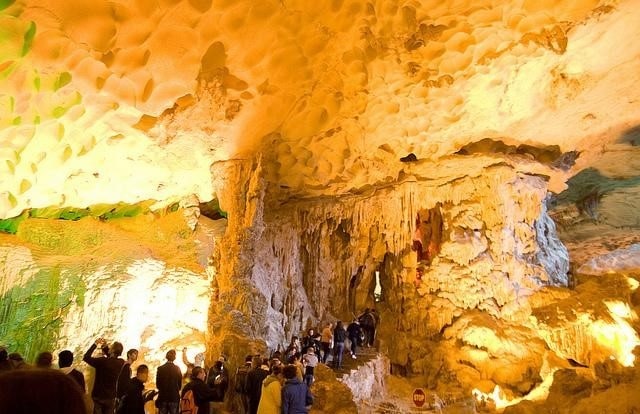
The First Chamber: This is the largest cavern, where natural sunlight streams inward to paint a breathtaking, dreamlike tableau. The vaulted ceiling resembles a gallery of wondrous imagery, inspiring endless imagination. At times, formations evoke elephants grazing; elsewhere, ferocious tigers, snow-white swans, or fluttering bees and butterflies. Ancient stalactites, sculpted over millennia by nature, take on diverse forms: some resemble towering palm fronds, others sharp swords or dense primordial forests, accompanied by the gentle trickle of water sounding like birdsong or gibbon calls. The ceiling is draped in a soft “velvety carpet,” shimmering with light from stalactitic “chandeliers” alongside stone statues of lions, pythons, tortoises, and fighting cocks—all vividly animated within a magical realm.
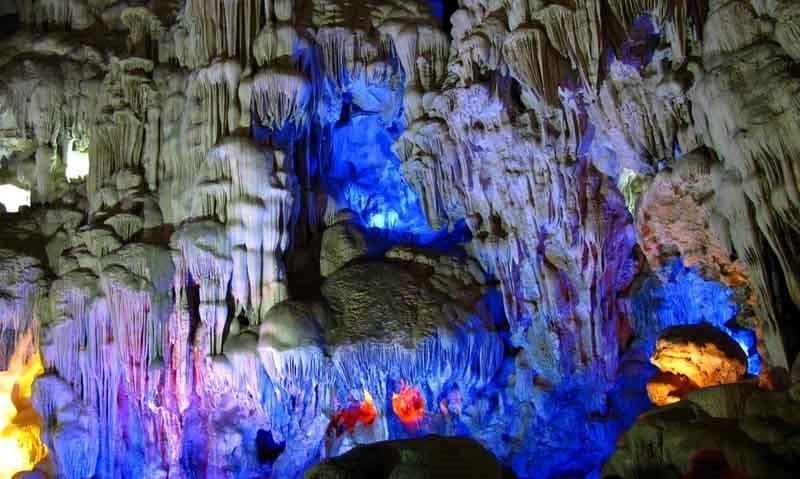
Extraordinary rock formations enhance the mystical allure of Dau Go Cave
The Second Chamber: This middle chamber is significantly dimmer yet remarkably striking due to its intricate crystal formations. When illuminated by artificial lighting, it transforms into a dazzling kaleidoscope that mesmerizes every visitor, awakening curiosity with picturesque imagery. The contours of undulating islets emerging across the waves are vividly etched into this natural canvas, evoking sheer wonder and awe at the peerless beauty of Ha Long Bay.
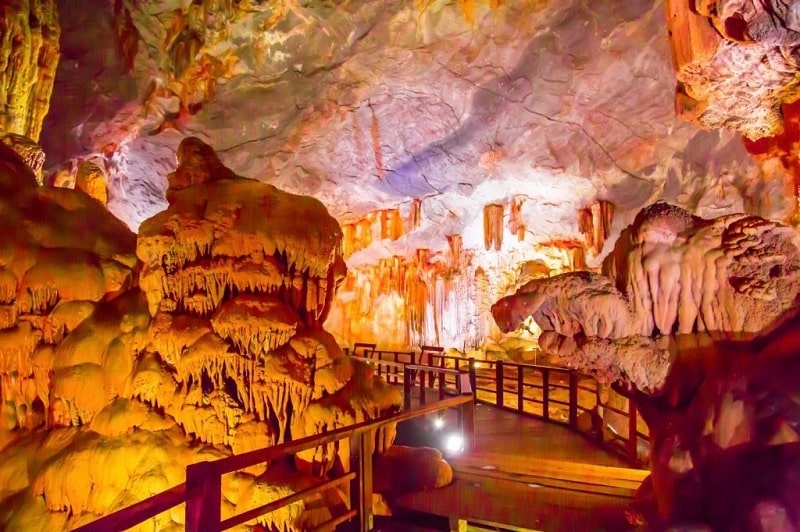
The pathway connecting the chambers within Dau Go Cave
The Third Chamber: Traversing a 1.4-meter-wide passage, visitors enter the innermost chamber, home to a colorful array of stalagmites and stalactites. This area also features numerous colossal stone pillars sculpted by nature—grand yet refined, graceful rather than rigid. These sublime formations imbue travelers with an overwhelming sense of artistic sophistication and elegance.
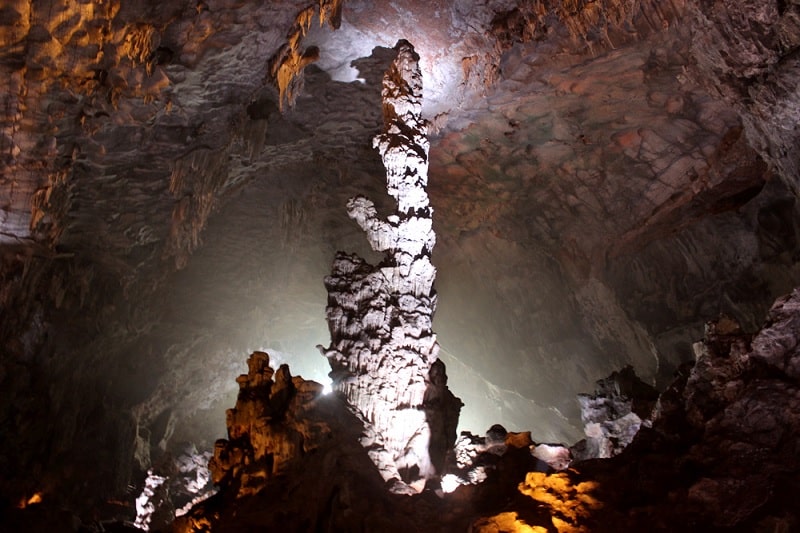
A colossal stone pillar inside Dau Go Cave
Dau Go Cave is a limestone cavern of exceptional scale and unique architecture within Ha Long Bay. Developing horizontally, the cave comprises multiple chambers characterized by striking shifts in color, illumination, and limestone contours. According to scientific research, Dau Go is among the most ancient grottoes in Ha Long Bay, originating concurrently with Thien Cung Grotto. It exudes an air of antique, pristine tranquility, adorned with slender, towering stalagmite columns reaching ambitiously toward the sky. These limestone sculptures are born from the crystallization of minerals dripping from the ceiling to the cave floor, beautifully augmented by the interplay of sunlight casting inward from the entrance.
Important Tips for Visiting Dau Go Cave
To ensure a delightful and enriching excursion, keep the following recommendations in mind:
- The ideal time to visit Dau Go Cave is from April to October, when the weather is pleasant, mild, and free of harsh cold or rain. We recommend avoiding peak periods such as weekends and national holidays to steer clear of crowds.
- Reaching the cave entrance requires climbing approximately 90 stone steps. Therefore, visitors utilizing wheelchairs will need dedicated personal assistance to navigate the steps and comfortably access the grotto.
- While exploring the interior, kindly adhere to the regulations set by the management board and your tour guide. Please refrain from littering, touching the delicate limestone formations, or generating excessive noise. Let us all help preserve the pristine beauty and respect the historical heritage of the cave.
This concludes our comprehensive guide to Dau Go Cave; we hope this article provides valuable insights for your journey. If you wish to charter a boat in Ha Long Bay to explore this magnificent destination, please contact us for further details.