Cap Tien Temple is a special national historical monument located in Van Don District. Steeped in history, it serves as a cornerstone of the region’s cultural heritage. Visiting Cap Tien Temple offers a wonderful opportunity to admire breathtaking landscapes while delving into the rich traditions, spiritual beliefs, and history of the area. This article will introduce you to the unique highlights and captivating legends surrounding Cap Tien Temple.
Read more: Top 9 Most Sacred Pagodas in Quang Ninh
Location and Origins of the Name “Cap Tien”
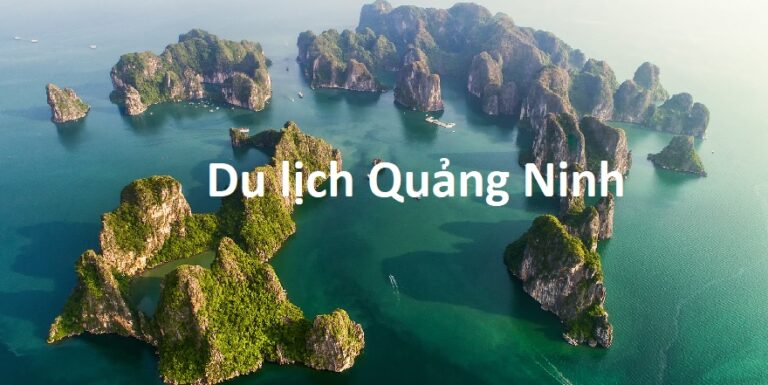
Cap Tien Temple, also known as Co Be Cua Suot Temple, is part of the Cua Ong Temple complex, which was recognized as a historical site in 1989. Situated at the gateway to Van Don District in Dong Xa Commune, about 2km from Cua Ong Temple, the site boasts a prime location. With its back against the mountain and its face overlooking the sea of Bai Tu Long Bay, it creates a serene, poetic, and spiritual atmosphere. Today, the temple is a celebrated spiritual and cultural tourism destination in Van Don, attracting numerous visitors who come to explore and offer prayers.
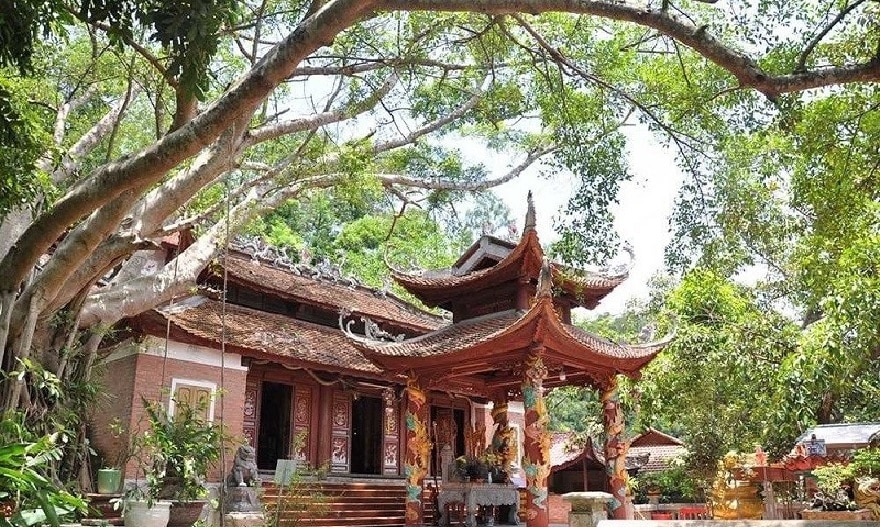
Cap Tien Temple
The name “Cap Tien” (Pair of Fairies) originates from ancient legends that describe this area as a charming, tranquil, and ethereal landscape. According to folklore, two immortals would often descend to this spot to play chess and admire the scenery. They were attended by two fairies, who would descend to the foot of the mountain to bathe and collect water to boil for the immortals’ tea. The spot where the fairies collected water is a small spring that never runs dry. The indentations left by the fairies’ footsteps are said to remain visible to this day. The spring, known as “Tien Well,” remains fresh even when the tide rises, defying the surrounding saltwater. This connection to the immortals is why many local landmarks bear the name “Tien” (Fairy), such as Tien Mountain, Tien Cove, and Cap Tien Village. Another legend suggests the temple is dedicated to the daughter of Hung Nhuong Vuong Tran Quoc Tan, the commander who guarded the coastal regions, hence the name “Co Be Cua Suot” (Young Maiden of Cua Suot).
Furthermore, during the Nguyen Dynasty, a local official (Quan Chanh) who oversaw the waterways in this region performed many virtuous deeds for the people. He also mobilized the community to contribute resources and labor to restore the temple. To honor his benevolence, the people enshrined him in the temple after his passing, which is why Cap Tien Temple is also affectionately called “Quan Chanh Temple.”
Recognition and Titles of Cap Tien Temple
- 1989: Cap Tien Temple, along with the Cua Ong Temple complex, was awarded a certificate as a Historical Monument by the Ministry of Culture and Information (now the Ministry of Culture, Sports and Tourism).
- August 18, 2006: The People’s Committee of Quang Ninh Province designated Cap Tien Temple as an Architectural and Artistic Monument and Scenic Landscape.
- December 25, 2017: Together with Cua Ong Temple (Cam Pha City), Cap Tien Temple was designated a Special National Monument by the Prime Minister.
Architecture of Cap Tien Temple
The road leading to Cap Tien Temple is well-paved and designed with two lanes. As visitors approach, they can immerse themselves in the stunning landscape, flanked by towering cliffs on one side and the azure sea dotted with islands on the other.
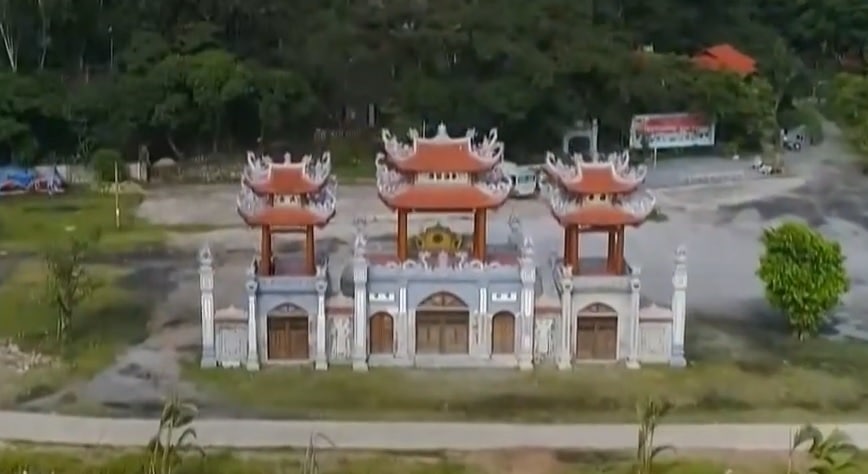
Cap Tien Temple Triple Gate
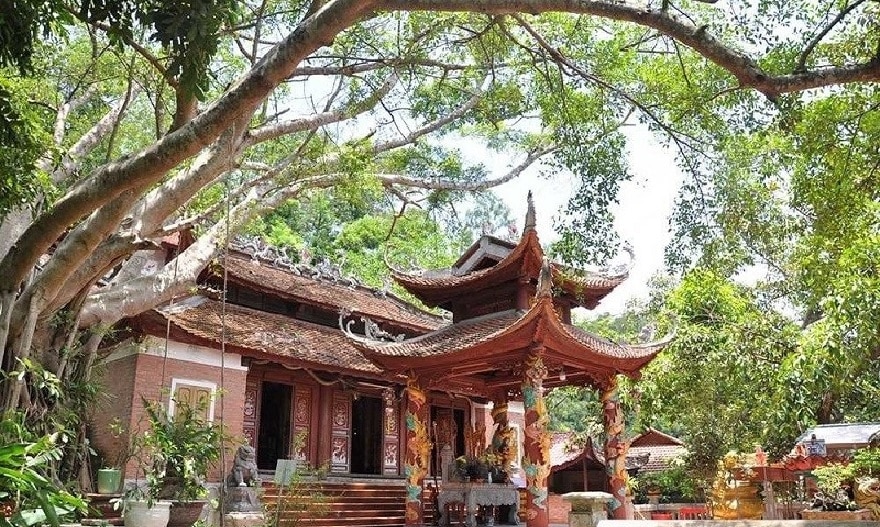
Initial impressions of Cap Tien Temple are often of a sanctuary hidden beneath ancient tree canopies, featuring an elegant curved bridge and a majestic triple-gated entrance (Tam Quan) that stands firm against the winds and waves of the sea. The beauty of Cap Tien Temple has even been captured in traditional folk poetry:
“When dusk falls upon Cap Tien wharf,
A pair of dragon boats arrive to collect water from the fairy well.”
Cap Tien Temple has a storied history dating back many years; while it saw minor spiritual developments during the Tran Dynasty, it flourished most significantly during the Nguyen Dynasty. The temple was reconstructed in 1996 and placed under the management of the Van Don district authorities, overseen directly by the local commune. In 2006, the temple underwent a comprehensive renovation, resulting in three distinct sections: the front hall, the middle sanctum, and the rear palace, covering a total area of 360 square meters.
Over the centuries, the original small structure suffered significant degradation. The 1996 reconstruction and the 2006 renovation successfully restored its grandeur while meticulously preserving the hallmark features of traditional Vietnamese architecture. Today, the temple complex comprises three main areas: the Main Temple, the Son Trang Cave, and the Fairy Well (Gieng Tien).
1. The Main Temple
Facing northeast, the temple is designed in the “Dinh” (丁) shape, consisting of a ceremonial hall and a rear palace spanning a total of 102 square meters. The roof truss architecture follows the traditional “chong ruong con nhi” style, with door columns crafted from durable “tau” wood. The beams are adorned with lacquered boards, while columns are inscribed with elegant parallel sentences. In the courtyard, a “phuong dinh” (square pavilion) stands with a two-tiered, eight-roof structure tiled with traditional “mui hai” scales and topped with leaf-shaped decorations. Within this pavilion sits a large bronze incense burner.
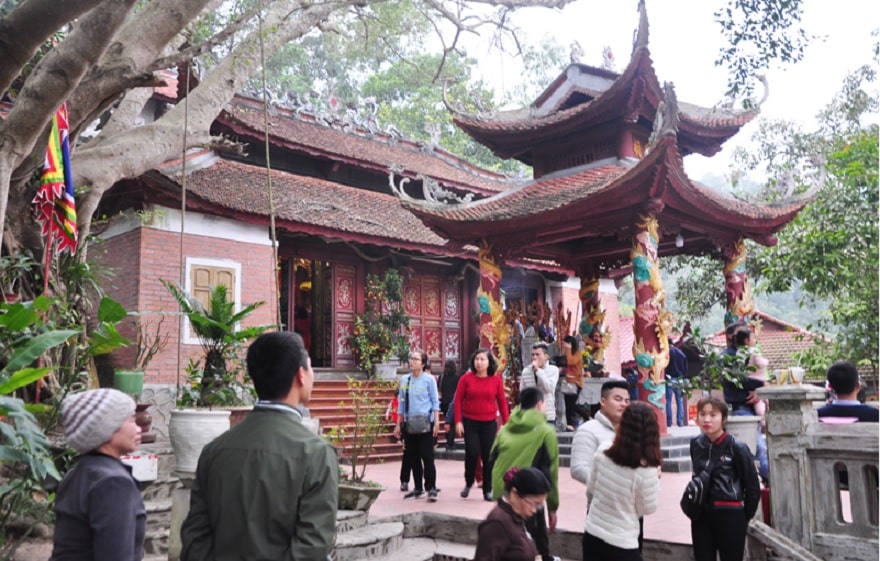
The main temple area
- The first hall houses the altar dedicated to the Young Lady of Cua Suot, known by the title “Tien Co Cua Suot.”
- The second hall is dedicated to the Great King of the East Sea, flanked by altars for the Five Great Lords (Ngu Vi Ton Ong), the Four Palace Commanders (Tu Phu Quan Hoang), and the Mother Goddesses (Phu Chau Ba).
- The innermost sanctuary is dedicated to the Three Holy Mothers (Tam Toa Thanh Mau).
2. Son Trang Cave
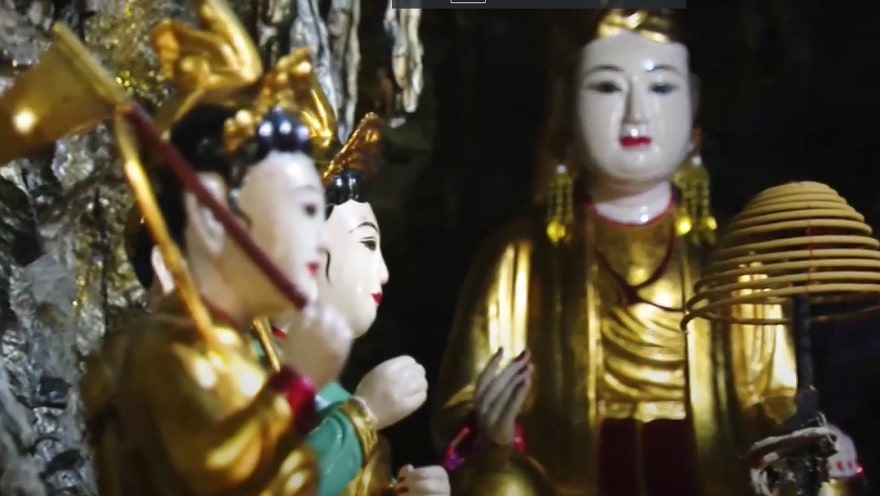
The altar within Son Trang Cave
Located in the northeastern section of the cave, the statues are harmoniously arranged throughout the rear sanctum, including the Second Mother of the Forest (Mau De Nhi Thuong Ngan), the two Queen Mothers, and the 12 Maidens of the Mountain (Son Trang). The cave is divided into two sections mirroring the temple’s architecture. The outer area is flat and serves as a space for rituals, while the inner area is sculpted to resemble rugged limestone mountains adorned with statues. Above the partition separating the ritual space from the shrine hangs a horizontal lacquered board inscribed with four Han characters meaning “The Sacred Community of Son Trang.” At the heart of the cave, another board is inscribed with “Nu Dong Son Trang.” To commemorate the female general honored at the temple, the following poetic parallel lines are displayed:
“Thich thi ve cung kim tu mieu
Sinh vi nu quoc tu vi than”
This translates to: “In life, a female warrior serving the state; in death, a goddess protecting the people, eternally worshipped at the historic Cap Tien shrine.”
3. The Fairy Well (Gieng Tien)
This remarkable freshwater well is situated right on the seashore. A true wonder of nature, the well is flooded by saltwater during high tide, yet it inexplicably returns to fresh water shortly thereafter. The well never runs dry throughout the year, making it a sacred and cherished water source for both local residents and seafarers.
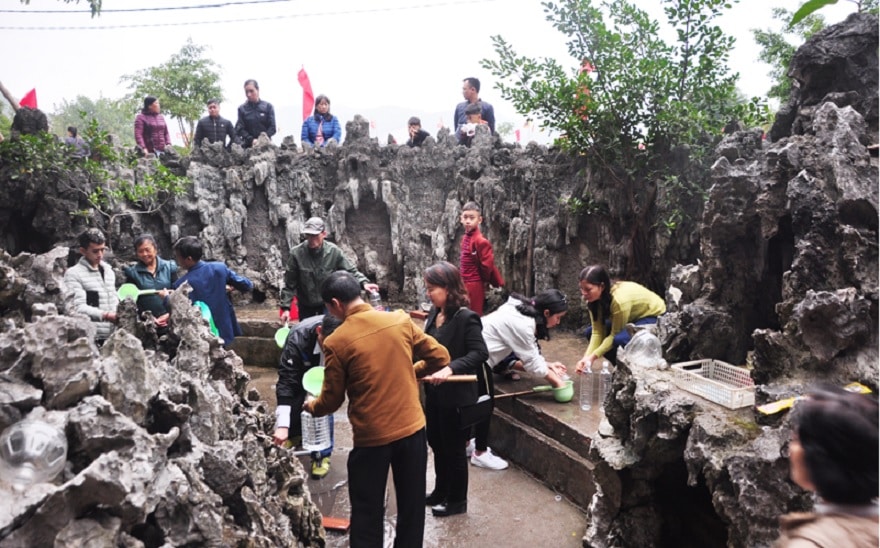
The Fairy Well area
According to Mr. Pham Thang Loi, Vice Head of the Cap Tien Temple Management Board, the Fairy Well possesses the unique characteristic of being warm in winter and refreshingly cool in summer. The drier the weather, the cooler the water becomes. Despite the surrounding hills being barren without large trees, the well maintains an inexhaustible supply of water.
Cap Tien Temple is not only a site of breathtaking natural beauty but also one of profound historical significance. It serves as a guardian of long-standing cultural traditions. Today, the temple is an essential stop on the Van Don travel itinerary, integrated into the district’s vibrant tourism circuit and attracting visitors from all corners of the country.