Biography of Tran Quoc Nghien
Tran Quoc Nghien was a royal prince of the Dai Viet Tran Dynasty, the eldest son of the legendary General Tran Hung Dao (Tran Quoc Tuan) and the elder brother of Hung Nhuong Vuong Tran Quoc Tang. King Tran Thanh Tong arranged his marriage to Princess Thien Thuy, the daughter of King Tran Nhan Tong. However, it was discovered that Princess Thien Thuy had previously engaged in an illicit affair with Nhan Hue Vuong Tran Khanh Du. Fearing he would offend Tran Quoc Tuan, the King ordered Tran Khanh Du to be beaten at West Lake, though he secretly instructed the guards not to strike with lethal force. Shortly thereafter, the King issued a decree stripping Khanh Du of all titles, positions, and assets. Because the Chi Linh region was the private property of High General Tran Pho Duyet, Khanh Du was able to retain it, where he retreated to live as a charcoal seller.
The sixth chapter of the “Dai Viet Su Ky Toan Thu” (Complete Annals of Dai Viet) recounts a famous anecdote: One day, Tran Quoc Tuan jokingly asked his eldest son, Hung Vu Vuong: “The ancients held the entire empire to pass down to their descendants; what are your thoughts?” Tran Quoc Nghien replied: “It would not be right even for those of different surnames, let alone those of the same kin.” Tran Quoc Tuan found this answer sound. Later, he posed the same question to his second son, Hung Nhuong Vuong Tran Quoc Tang. Tran Quoc Tang replied: “Emperor Taizu of Song was merely a farmer who seized the opportunity of the times to claim the empire” (implying support for his father to usurp the throne, following the oral will of his grandfather, An Sinh Vuong Tran Lieu, who had failed in his own rebellion to seize the crown). Upon hearing this, Tran Quoc Tuan drew his sword in fury, declaring, “A traitor is born from an unfilial son,” and prepared to kill him. Upon learning of this, Hung Vu Vuong rushed over in tears to plead for his brother’s life, and Tran Quoc Tuan eventually spared him. Afterward, he instructed his eldest son: “After I pass away, make sure my coffin lid is sealed before allowing Tran Quoc Tang to pay his respects.”
Tran Quoc Nghien is regarded as a talented general, accomplished in both literature and martial arts, as well as an exceptionally filial son and loyal servant to the crown. While his role in the three resistance wars against the Mongol Empire (1258–1288) was less documented than that of his younger brother, Hung Nhuong Vuong Tran Quoc Tang, his contributions during the third Battle of Bach Dang (Quang Ninh) in 1288 were instrumental. Alongside his father and other Tran Dynasty generals, he helped crush the Yuan-Mongol forces under Kublai Khan—a triumph recognized as one of the greatest military feats in world history.
Following the victory, the imperial court bestowed upon him the title of Khai Quoc Cong, and later, Hung Vu Vuong. He retired to the Chung My region, Thuy Duong district, Dong Trieu province, in the Tan Hung prefecture to recruit settlers and establish villages. He passed away on the 24th day of the fourth lunar month; the year of his death remains unknown.
To honor his contributions to pacifying the invaders in the northeastern region of the country, the people of Quang Ninh established a small temple at the foot of Poem Mountain (Nui Bai Tho). Known as the Duc Ong Temple, it is part of the Poem Mountain Monument Complex in Hong Gai Ward, Ha Long City. The temple was built around the end of the 13th century and was recognized as a National Historical Monument in 1993. Additionally, his younger brother, Hung Nhuong Dai Vuong Tran Quoc Tang, is worshipped at the Cua Ong Temple in modern-day Cam Pha City.
Duc Ong Tran Quoc Nghien Temple
The Duc Ong Tran Quoc Nghien Temple is a national historical site and scenic landmark located in Hong Gai Ward, Ha Long City. According to historical records, the temple was built at the end of the 13th century to commemorate the merits of Duc Ong Tran Quoc Nghien, the eldest son of Hung Dao Vuong Tran Quoc Tuan. Known by its formal name “Phuc Linh Tu” (Phuc Linh Temple), it features a traditional “Dinh” (nail-shaped) architectural style consisting of three front chambers and one rear sanctuary. The temple houses many ritual artifacts, ceremonial items, and treasures. The temple has undergone several restorations; according to inscriptions found on-site, boat owners funded a significant restoration in the year of the Water Ox (1913). In 2011, the Ha Long City People’s Committee expanded the total construction area of the Duc Ong Temple complex to 2,531.8m2, with further adjustments to 2,689.8m2 in 2013.
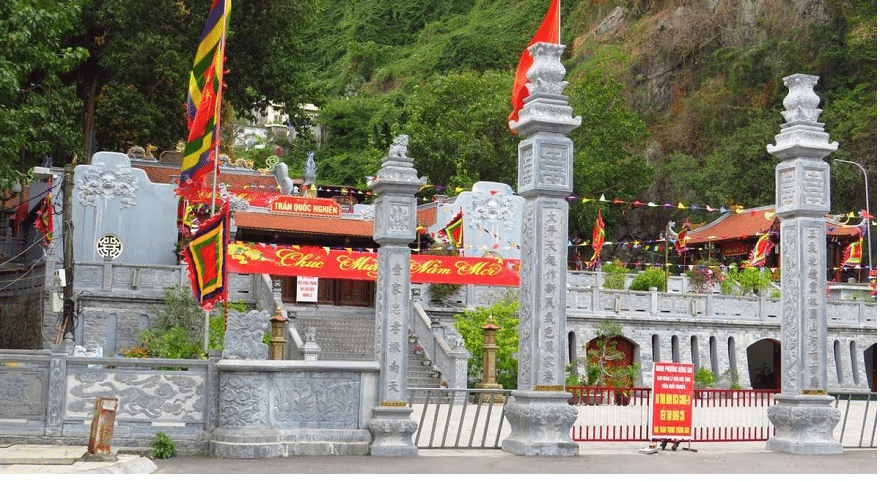
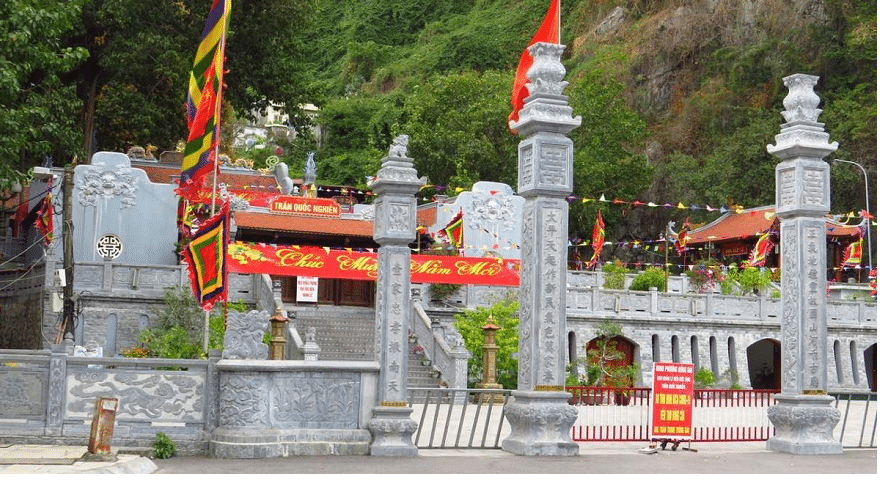
Temple of Duc Ong Tran Quoc Nghien at Bai Tho Bridge
The Temple of Duc Ong Tran Quoc Nghien enjoys a prime location at the eastern foot of Poem Mountain (Bai Tho Mountain). Built on elevated ground in the heart of the city, the temple faces the majestic Ha Long Bay. Its architecture is adorned with intricate carvings of pine, chrysanthemum, bamboo, and apricot trees stylized as dragons. Standing before the entrance, a centuries-old banyan tree provides eternal shade, serving as a testament to the enduring legacy of this historic site. At the base of this banyan tree lies a stele inscribed with the words: “Under the Witness of the Dong Hai Dai Vuong (the Great King of the East Sea) of the Tran Dynasty.” A stone stele carved in the Year of the Ox (1913) reflects the reverence of those who came before: “Upon observing this place (Poem Mountain), with its poetic landscape and magnificent temple, one realizes it is truly the most sacred site under heaven, deserving of everyone’s deepest respect. We, the boat owners who have traveled thousands of miles, overcoming countless storms and waves, owe our survival to the grace and protection of the Great King. Deeply moved by the sight of the ancient temple weathered by wind and rain, I have gathered my fellow sailors to join our efforts in restoring this sacred sanctuary so that worship may continue for generations to come.”
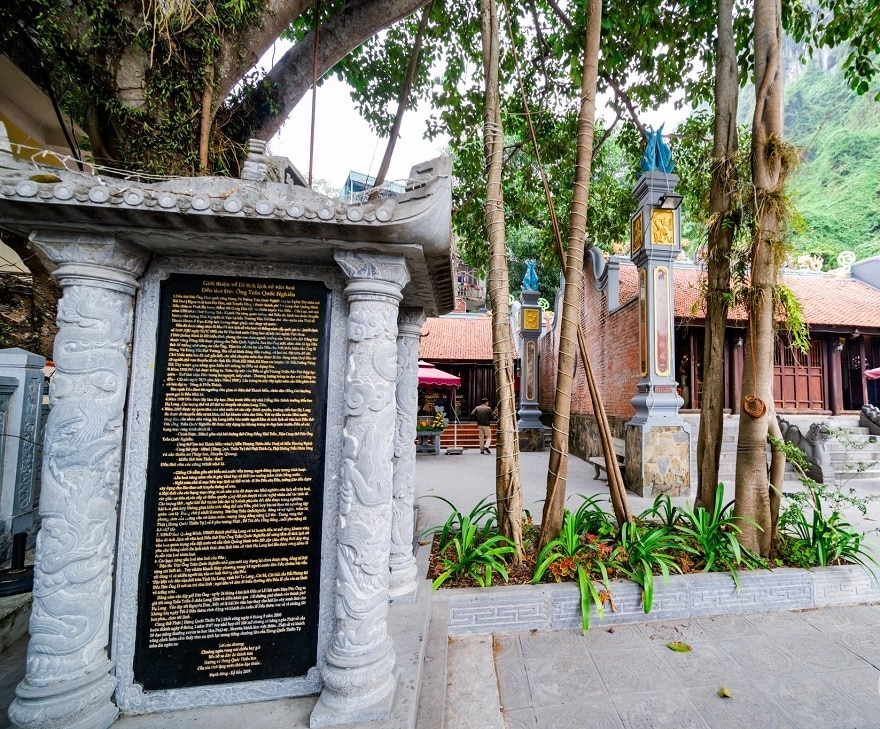
Stone stele at the foot of the banyan tree at the Temple of Duc Ong
Nearby are Poem Mountain and Long Tien Pagoda, both essential attractions within the complex designated as a National Historical and Cultural Relic in 1992. The Temple of Duc Ong Tran Quoc Nghien was not only a sanctuary where fishermen sought refuge but also a vital source of fresh water for their voyages. Within the temple grounds, there remains an ancient well known for its clear, sweet water, miraculously unaffected by its proximity to the sea. Today, the temple still preserves two ancient stone steles and five statues dating back to the 13th century, commissioned by early seafaring merchants.
Festivals at Duc Ong Temple
The Duc Ong Tran Quoc Nghien Temple Festival is a cherished cultural and spiritual event held annually on the 24th day of the third lunar month (the anniversary of his passing). Since 2008, the festival has been integrated into the Ha Long Tourism Week, typically taking place around April 29th and 30th. The celebration features two main segments: The ceremonial portion includes traditional rites such as the procession of Duc Ong, lion and dragon dances, prayer ceremonies, and the symbolic release of creatures. The festival portion is filled with vibrant folk games and artistic performances. A major highlight is the evening, which features a sacred torch procession and the release of floating lanterns onto the sea—a ritual symbolizing the Great King’s wisdom lighting the way for humanity. Furthermore, the floating lanterns serve as a prayer for the safety and peace of fishermen and coastal residents alike.
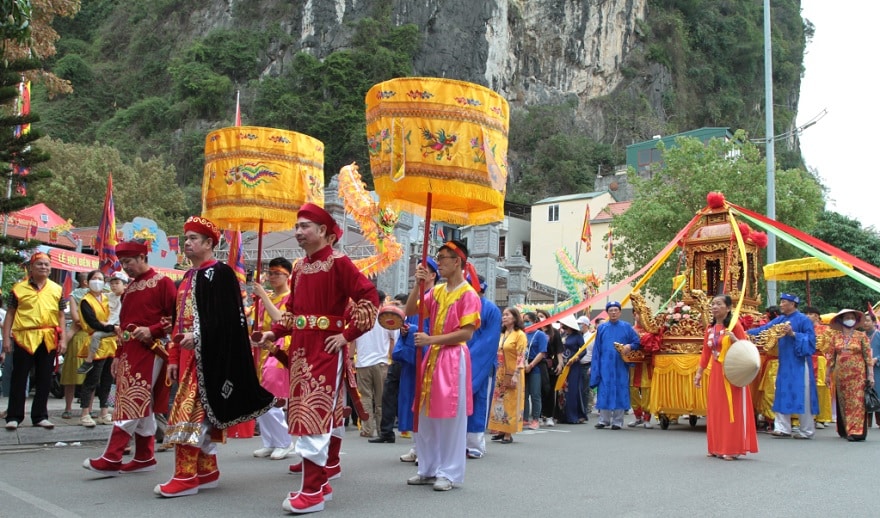
Palanquin procession festival at Duc Ong Temple held annually
The Duc Ong Tran Quoc Nghien Temple Festival serves as an opportunity for the community to honor a national hero, instill patriotism in the younger generation, and promote local tourism. The festival also aims to raise public awareness regarding the preservation and promotion of the historical and cultural values found within the national monument complex comprising Poem Mountain, Long Tien Pagoda, and the Temple of Duc Ong.
Read more: Famous travel destinations and experiences in Hon Gai