Connecting the two shores of Hon Gai and Bai Chay, the Bai Chay Bridge stretches proudly amidst the breathtaking scenery of Ha Long Bay, creating a radiant symbol for the coastal city of Ha Long, Quang Ninh. This modern cable-stayed bridge is not only a unique architectural highlight that enhances the poetic watercolor painting of the Bay, but also a testament to the remarkable economic and tourism development of this mining region.
I. Introduction to Bai Chay Bridge
Bai Chay Bridge, a modern cable-stayed bridge spanning the Cua Luc Bay, is a brilliant symbol connecting the two shores of Hon Gai and Bai Chay in Ha Long City, Quang Ninh. Completed on December 2, 2006, the bridge is not only a unique architectural accent that adorns the watercolor masterpiece of Ha Long Bay, but also a testament to the extraordinary economic and tourism growth of the mining region.
Bai Chay Bridge
Before the existence of the Bai Chay Bridge, traveling between Hon Gai and Bai Chay relied entirely on the ferry terminal. This inconvenience prompted the idea of constructing a modern bridge to connect the two areas, meeting the growing transportation demand and driving economic development for Quang Ninh province. This concept was conceived in the 1990s and officially approved by the Prime Minister in 1998.
The Bai Chay Bridge project, with a total investment of over VND 2,140 billion, received ODA capital assistance from the Japanese Government. The Japan Bridge and Structure Institute (JBSI) undertook the bridge design, with construction executed by the joint venture of Shimizu – Sumitomo Mitsui contractors. The construction process spanned over three years (2003-2006) and was fraught with challenges and trials. Engineers and workers had to overcome numerous geological and weather difficulties, applying the most advanced technologies to complete the bridge. Notable methods included the balanced cantilever technology, which allowed the bridge deck to extend out to sea from the main piers without disrupting boat traffic, and the pneumatic caisson foundation, ensuring the bridge’s stability under complex geological conditions.
Bai Chay Bridge impresses not only with its scale and construction techniques but also with its remarkable technical specifications: a total length of 903 meters, a width of 25.3 meters, comprising 5 spans, with the main span measuring 435 meters. With this main span length, Bai Chay Bridge established a world record for the longest main span for a single-plane cable-stayed bridge. This record was previously held by the Sunshine Skyway Bridge in the United States (400m).
Architecturally, Bai Chay Bridge exudes a modern and unique beauty that harmonizes with the majestic natural landscape of Ha Long Bay. Viewed from above, the bridge appears graceful and fluid, resembling a silk ribbon draped across Cua Luc Bay. The symmetrical stay-cable system creates overall balance and harmony for the entire structure. The towering pylons rise proudly, resembling wind-filled sails reaching out to the open sea.
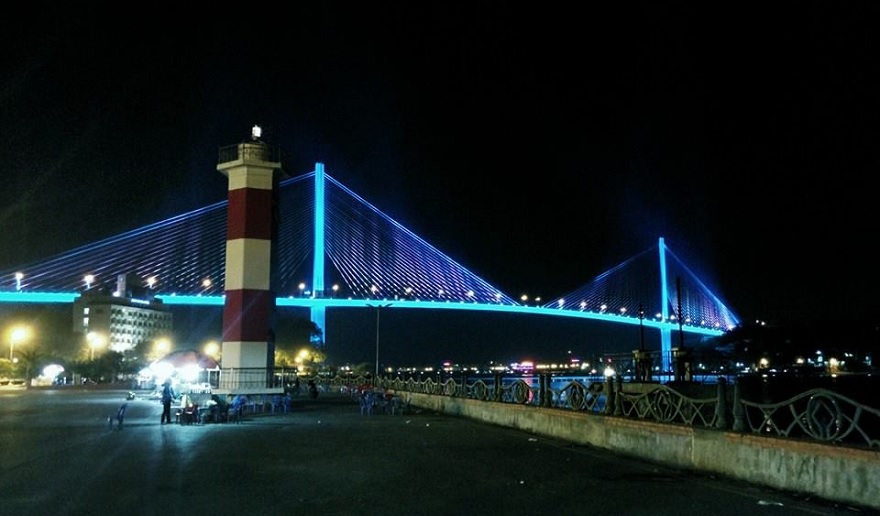
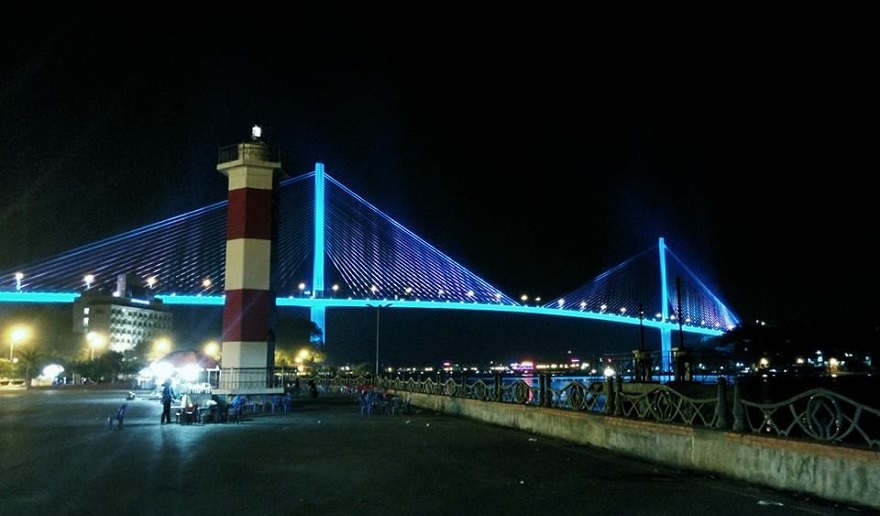
At night, Bai Chay Bridge dons a shimmering, mystical appearance thanks to its modern lighting system. Thousands of colorful LED lights installed along the bridge create stunning artistic lighting effects. This unique beauty has earned Bai Chay Bridge the moniker “The Musical Strings of Ha Long.” The image of taut stay cables resembling instrument strings, combined with the multi-colored LED lighting system, creates a symphony of light against the backdrop of legendary Ha Long Bay.
II. Rumors and Reality
However, alongside its magnificent beauty, this bridge is also associated with mysterious stories and haunting rumors of tragic suicides and wandering souls. Deep beneath its modern facade, is Bai Chay Bridge truly shrouded in the darkness of curses, or are these merely fabrications of people?
1. Tragic Tales
Sadly, the romantic Bai Chay Bridge has witnessed no shortage of life’s tragedies. According to statistics from the bridge security team, to date, 14 people have jumped from the bridge to commit suicide, alongside dozens of attempted suicides that were successfully prevented. On average, every two months, one person departs forever from this bridge. This alarming statistic casts a gloomy hue over Bai Chay Bridge, contrasting sharply with its inherent beauty.
These heartbreaking stories continue to unfold. A young girl, heartbroken and betrayed by her lover, plunged into the river. A woman, overwhelmed by family pressure and an unfaithful husband, sought escape through death. Another, crushed by mounting debts with no way out, chose to end their life on this bridge. Some departed in silence, leaving lingering grief for those left behind, while others sent a final, desperate farewell message to their loved ones before taking the leap.
It seems Bai Chay Bridge has become the final destination for desperate souls seeking release from life’s suffering. The causes behind these tragedies largely stem from emotional distress, family issues, and life pressures. Young people, with impulsive and immature mindsets, easily resort to death as a solution when faced with emotional shocks.
Each departure leaves unfillable voids and lingering sorrow in the hearts of family and friends. Bai Chay Bridge, originally a symbol of connection, has inadvertently become a witness to eternal separations.
2. Mysterious Rumors
Alongside heartbreaking suicide statistics, Bai Chay Bridge is veiled in a mystical fog of ghostly legends. Locals whisper chilling tales, making the bridge increasingly haunting in the eyes of many.
The Ghost of the Japanese Engineer
One of the most widespread rumors is the tale of an unfortunate Japanese engineer. Legend has it that during the construction of Bai Chay Bridge, a Japanese engineer suffered an accident and passed away. His soul could not find peace, wandering around the bridge and seeking to pull the living into the water to “atone for karma.”
This rumor was further reinforced when some claimed that during a requiem mass for victims who died at sea, the spirit of this engineer still refused to rest in peace. This coincidence led many to believe that the engineer’s ghost was responsible for the tragic suicides on Bai Chay Bridge.
Restless Souls Beneath Cua Luc
Cua Luc, the ocean current flowing beneath Bai Chay Bridge, is also woven with mysterious tales. People believe Cua Luc is a “water vortex,” a nexus between the netherworld and the living realm. The water deities here are said to constantly demand sacrifices, requiring a certain number of lives to “cross the boat” each year to calm the waves.
Before Bai Chay Bridge was built, the Cua Luc area had witnessed numerous tragic drownings. This only reinforced the belief that a supernatural force reigned here, bringing misfortune upon humanity.
The Abandoned Shrines
Another intriguing story surrounding Bai Chay Bridge is the presence of two shrines on either side of Cua Luc. One was destroyed, while the other remains cold and devoid of incense. It is believed that human negligence angered the deities, bringing disaster down upon Bai Chay Bridge.
While there is no concrete evidence for these rumors, they linger in people’s minds, casting a mystical, haunting veil over Bai Chay Bridge. Are these stories mere coincidences, or is there truly a hidden supernatural force at play?
3. Explanations from Authorities
Facing spiritual rumors concerning Bai Chay Bridge, local authorities have investigated and provided scientific explanations, debunking these unfounded notions.
The Ha Long City Police confirmed that the majority of suicides at Bai Chay Bridge stem from personal conflicts and psychological issues of the individuals involved, entirely unrelated to ghosts or curses. They noted that young people often possess impulsive thoughts and lack life experience, making them prone to despair, disorientation, and rash actions when facing crises in love, family, or life.
Bai Chay Bridge features a unique high-altitude structure with swift currents below, meaning that jumping off offers virtually no chance of survival. This unintentionally transforms the location into an “ideal” spot for those intending to end their lives.
Authorities have also dismissed rumors of wandering souls and water deities, emphasizing that these are merely fabricated tales lacking scientific basis. Believing in such rumors not only causes public panic but can also negatively impact the psychological well-being of citizens, particularly those facing life hardships.
4. The “Silent Heroes” on Bai Chay Bridge
Few know that alongside maintaining security and ensuring smooth traffic, the Bai Chay Bridge security team shoulders a special responsibility: preventing suicide tragedies. Forty individuals patrol day and night across the nearly 10-kilometer-long bridge, keeping a vigilant eye out to promptly detect unusual signs. They are the silent guardians of lives standing on the brink of the abyss.

List of suicide incidents at Bai Chay Bridge meticulously recorded by the security team
With their experience and acute awareness, these officers have saved countless lives. On quiet, late nights, they silently approach a solitary figure weeping bitterly by the bridge railing, offering kind words, encouragement, and guiding them back to life. On other occasions, they have raced against time, overcoming fear to firmly hold onto someone on the verge of casting themselves into the water.
Take Mr. Phan Van Hanh, a bridge security guard who once saved a young girl planning to commit suicide after being betrayed by her lover. Thanks to his persistent counseling and empathy, the girl abandoned her reckless intention and rediscovered faith in life. Or consider Mr. Tran Van Kiem, the head of the security team, who has directly rescued suicidal individuals multiple times. He shares that each time he saves a life, he feels deeply happy and proud to have preserved a precious existence.
These “silent heroes,” with their compassionate hearts, work tirelessly day and night to ensure that Bai Chay Bridge is no longer known as the “bridge of death,” but rather a symbol of life, faith, and hope.
How to Get to Bai Chay Bridge
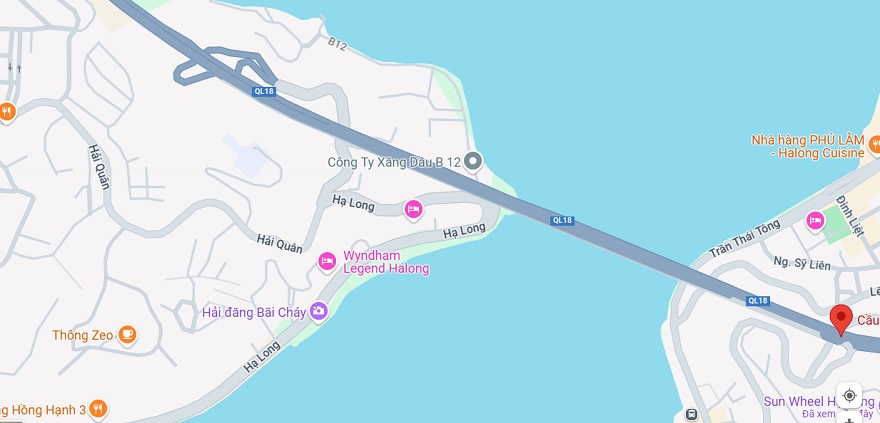
Location of Bai Chay Bridge on Google Maps
1. Traveling via National Highway 18:
This is the primary route to Bai Chay Bridge. If you depart from the center of Ha Long City, travel along National Highway 18 towards Bai Chay. The bridge is situated right along this route, easily recognizable by its unique architecture and prominent cable-stayed system.
2. Traveling via Ha Long Road:
If you are staying in the Bai Chay area, you can choose to travel via Ha Long Road. This coastal road runs alongside the Bai Chay shoreline and leads directly up to the bridge.
Note:
- Transportation: For convenience in sightseeing and enjoying the view from the bridge, motorbikes or walking are recommended. Stopping or parking cars on the bridge is strictly prohibited to ensure traffic safety.
- Particularly, if you are staying at a hotel in the Bai Chay area, you can head to the base of the bridge near the B12 gas station, where you can take a lift directly up to the bridge (a small tipping fee applies).