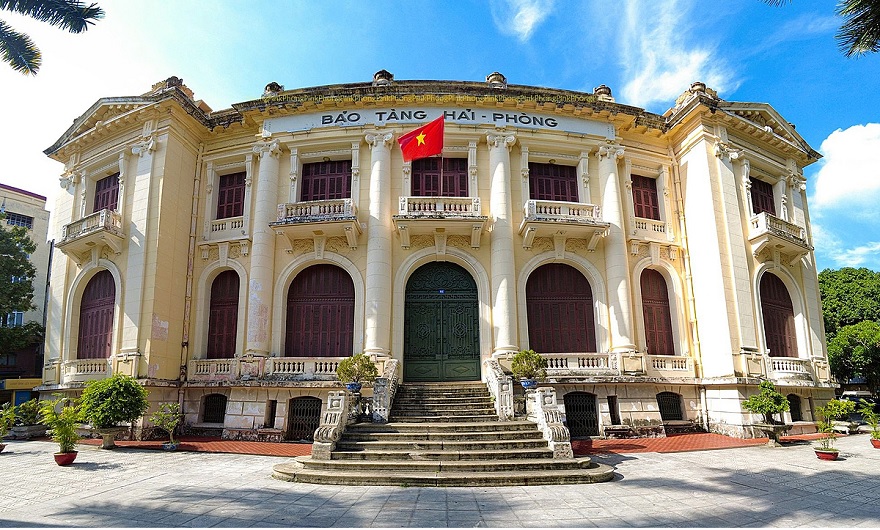
Featuring exquisite architecture dating back to late 1918, the Hai Phong Museum currently serves as a vibrant cultural center, a repository of precious artifacts, and a premier check-in destination for discerning travelers. In the article below, we share everything you need to know about this remarkable museum—let’s explore!
Read more: Hon Dau Lighthouse – The Oldest Lighthouse in Vietnam
Where is the Hai Phong Museum located?
The Hai Phong Museum is an unmissable cultural destination when visiting the bustling port city, preserving and reflecting the rich cultural, historical, and revolutionary heritage of this coastal municipality. Built in 1919 on a sprawling estate of approximately 1 hectare, the museum showcases European Gothic architectural splendor, highlighted by pointed domes, arched windows, and intricate decorative details. It is widely regarded as one of the earliest established local research museums in Vietnam.
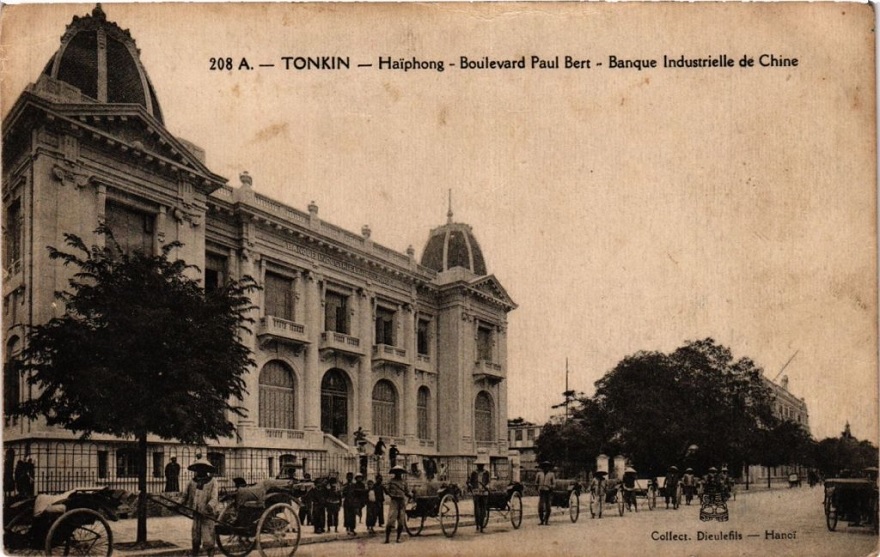
The original architecture of Hai Phong Museum
The Hai Phong Museum boasts a fascinating and distinctive history. Originally constructed in 1918 by a Hong Kong business conglomerate, the building was later sold to a French capitalist following financial difficulties. From around 1920, it became known as the Franco-Chinese Bank, standing as one of the most unique and valuable architectural landmarks of the colonial era. Following the liberation of Hai Phong (May 13, 1955), the structure served as the Banking College. In 1958, at the request of the Hai Phong People’s Committee, the Ministry of Finance transferred the building to be converted into a museum. On December 20, 1959, following meticulous renovations, the Hai Phong Museum officially inaugurated, becoming a sanctuary for preserving, exhibiting, and introducing the historical traditions, revolutionary legacy, and cultural identity of Hai Phong through thousands of precious artifacts.
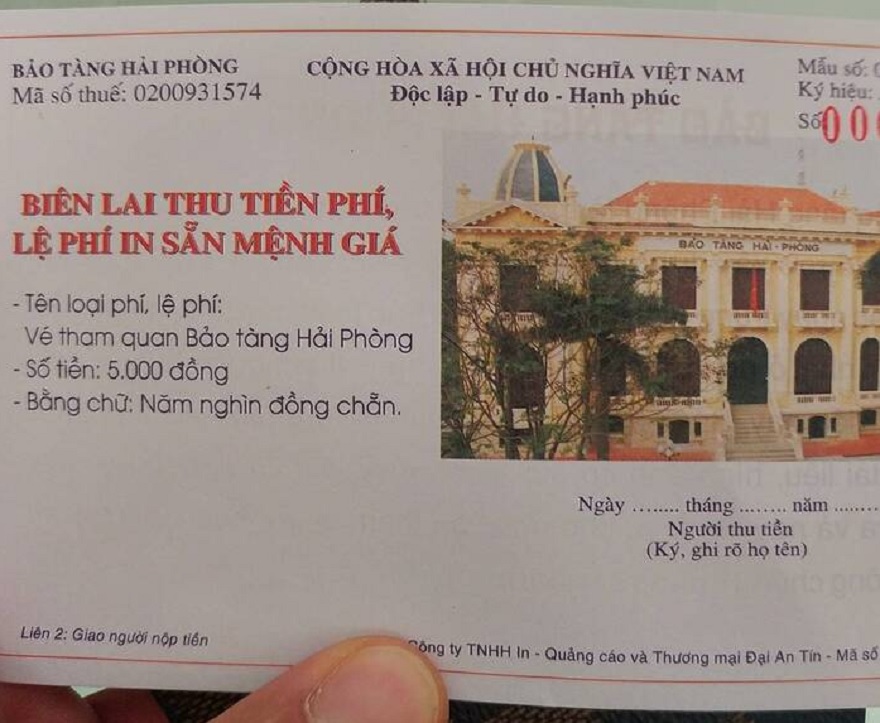
Entrance ticket to Hai Phong Museum
The Hai Phong Museum is situated at No. 65 Dien Bien Phu Street, Hong Bang District, right in the heart of the city. Guests can easily access the museum via public or private transportation.
- Opening days: Tuesday through Sunday (closed on Saturday and Sunday afternoons)
- Operating hours: 8:00 – 10:30 and 14:00 – 16:30.
- Entrance fee is an accessible 5,000 VND per person.
The Architecture of Hai Phong Museum
Covering an area of approximately 1,200 m2, the museum spans two main floors featuring 16 exhibition rooms and a basement. The basement serves as an artifact storage facility, the first floor houses thematic zones dedicated to Hai Phong’s history, culture, and revolution, while the second floor showcases exhibits on the city’s science, technology, and arts. The museum features a spacious front courtyard ideal for hosting cultural, artistic, and educational public events.
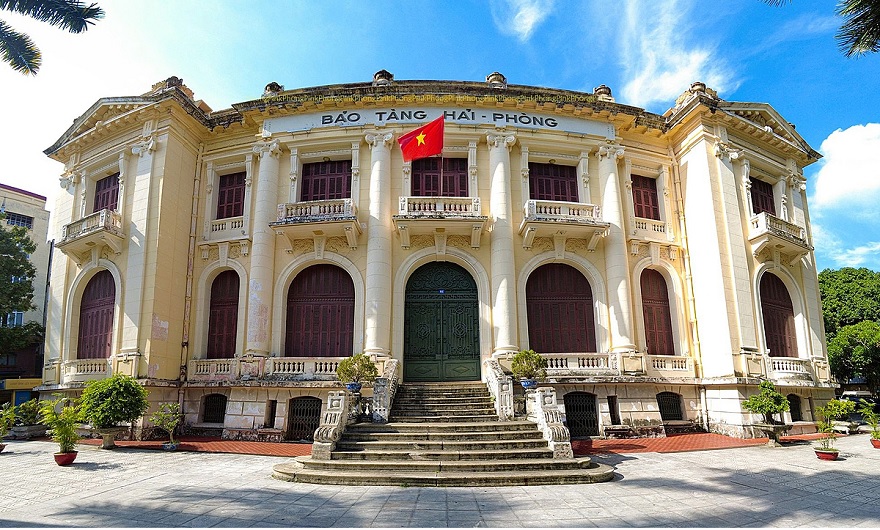
Hai Phong Museum
The museum’s facade stretches approximately 40 meters in length and 16 meters in height, divided into three sections: a grand central section flanked by two smaller projecting wings. The central section features five windows on the second floor, with three large central windows and two smaller ones on either side. The first floor mirrors this symmetrical design, with the sole distinction being that the first-floor windows are arched, and the central bay serves as the main entrance painted in an elegant green.
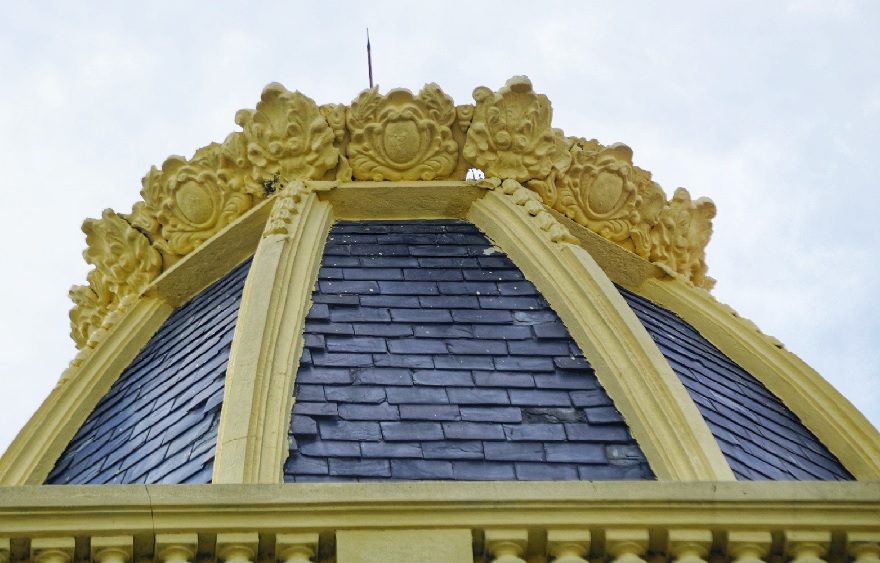
The European-style roof design of Hai Phong Museum
Inside, a grand hallway leads visitors gracefully into the exhibition galleries. The corridor is tastefully decorated with paintings, photographs, and signage relevant to the museum’s core themes. The exhibition halls are designed in a contemporary style, complete with ambient lighting and professional acoustics. Artifacts are meticulously arranged in chronological or thematic order, preserved with utmost care and accompanied by clear, informative labels.
Exhibition Spaces of Hai Phong Museum
The museum’s exhibition areas span the first and second floors, offering a total display area of 1,283m2 divided across 16 rooms covering 12 distinct topics. There is also a dedicated room for temporary thematic exhibitions commemorating national and municipal holidays as well as relevant cultural events. The museum houses a total of over 22,000 artifacts, with 1,736 artifacts and 840 photographs and documents currently on public display.
The first floor showcases numerous prehistoric archaeological relics discovered at excavation sites such as Bai Ben, Cat Do, and Trang Kenh… These artifacts are systematically classified and displayed in historical progression. Most notable among them is the Cai Beo archaeological site discovered in Cat Ba. These relics are categorized into two cultural layers:
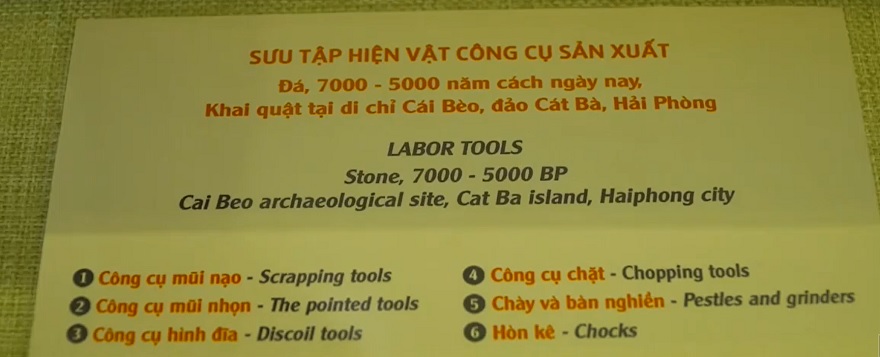
The lower layer, Cai Beo 1, belongs to the pre-Ha Long culture dating back 7,000 – 5,000 years
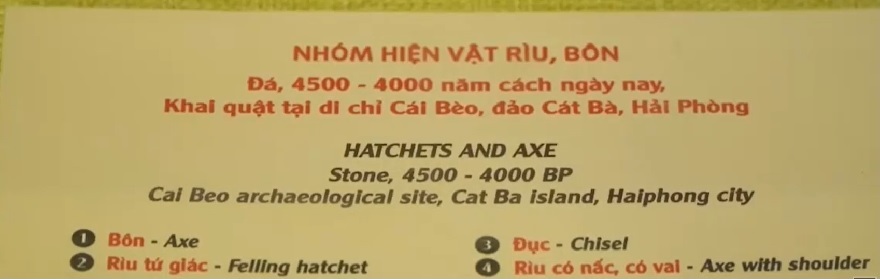
The upper layer, Cai Beo 2, belongs to the Ha Long culture dating back 4,000 years
The stone artifacts here are wonderfully diverse, including short axes, rough-hewn tools, scrapers with small points, and ground implements. The creators of Cai Beo 1 established an ancient fishing village, representing the earliest populace to explore and claim northeastern coastal Vietnam, laying the foundation for maritime Neolithic culture following the Hoa Binh and Bac Son periods. The inhabitants of Cai Beo 2 contributed to the formation of the Ha Long culture, which flourished during the Neolithic era and served as a precursor to the Metal Age in northeastern coastal Vietnam—holding profound significance for the land of Hai Phong.
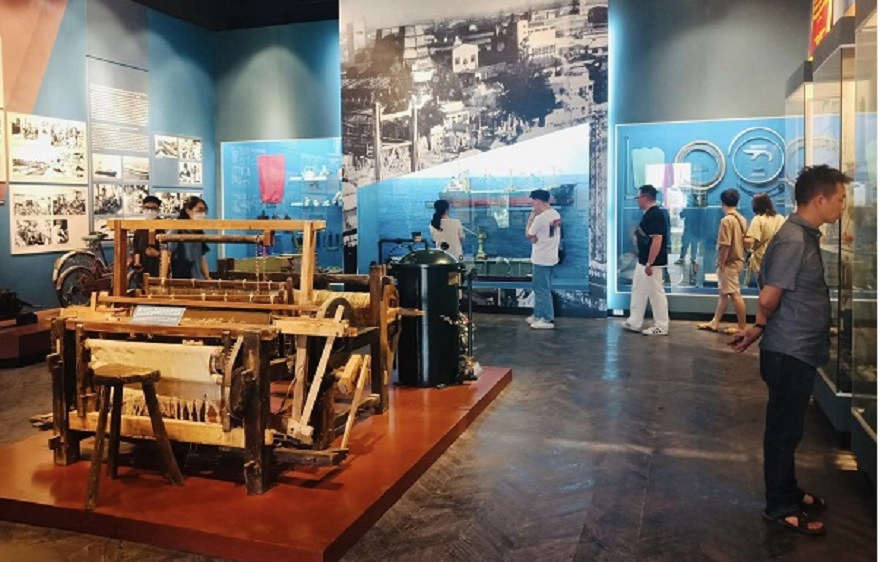
Ancient labor tools of early Hai Phong residents
The second floor illustrates the developmental journey of the port city. The galleries here display a rich variety of exhibits depicting the daily lives of ancient Hai Phong residents. Through production tools, animal specimens, dioramas, and symbols associated with the lives of farmers, factory workers, and local industries, visitors are offered a multifaceted perspective of Hai Phong—transcending the conventional perception of a bustling harbor filled with ships or crowded streets.
The Hai Phong Museum features expansive and diverse exhibition spaces encompassing numerous thematic zones. Guests can explore and learn about the history, revolution, and culture of Hai Phong through the artifacts, photographs, documents, and models on display. Below are some standout exhibition areas not to be missed:
- Metal Artifact Exhibition Zone: This is the museum’s largest and oldest display area, occupying over half of the first floor. Visitors can admire 279 metal artifacts dating from thousands of years ago up to the modern era, reflecting Hai Phong’s long-standing and affluent culture. These exhibits include worship items, decorative objects, daily utensils, wartime relics, and agricultural tools used by generations of Hai Phong people. Guests can trace the evolution and refinement of Hai Phong’s metalcraft artistry over time. Notable highlights include the largest ancient bronze bell in Vietnam, cast in the 13th century; a royal palanquin of the Nguyen Dynasty crafted from gold and jade; various swords, daggers, axes, and spears from anti-French uprisings; and machinery and tools from Hai Phong’s early industrial sectors.
- Ceramic Artifact Exhibition Zone: Located at the rear of the first floor, this is a captivating and distinctive showcase featuring 1,200 ceramic artifacts dating from the 10th to the 20th centuries. These pieces reflect cultural exchanges and trade between Hai Phong and regional and global nations. The collection includes vases, bowls, plates, teapots, and jars originating from China, Japan, Thailand, Cambodia, and the Netherlands, uncovered during construction and archaeological digs across Hai Phong. Visitors will appreciate the remarkable diversity of ceramic artistry in Hai Phong and beyond. Key highlights include a 10th-century blue-glazed bowl, ranked among Vietnam’s oldest ceramic treasures; a unique pomelo-shaped floral vase representing a signature creation of Hai Phong ceramics; and a Japanese celadon teapot sent as a royal gift from the Japanese court to Emperor Minh Mang in 1832.
- Textile Artifact Exhibition Zone: Situated at the front of the second floor, this elegant and romantic gallery showcases 300 textile artifacts dating from the 19th to the 20th centuries, illustrating the beauty and richness of traditional weaving and garment arts in Hai Phong. The collection features traditional attire such as ao dai (long tunics), four-panel dresses (ao tu than), traditional peasant shirts (ao ba ba), and checkered scarves (khan ran) worn by the Kinh, Tay, and Nung ethnic groups, tailored from luxurious fabrics like silk, brocade, and linen with exquisitely embroidered patterns. Visitors can sense the refinement and grace of Hai Phong women through these garments. Prominent highlights include a modernised ao dai worn by actress Ngoc Lan, tailored from green silk adorned with peacock motifs; a Tay ethnic four-panel dress made of white linen featuring triangular patterns; and a Nung ethnic scarf dyed red using Gac fruit and decorated with S-curve motifs.
- Paper Document Exhibition Zone: Located at the rear of the second floor, this engaging and educational gallery displays 200 paper artifacts from the 19th and 20th centuries, charting the evolution of education and print media in Hai Phong. The collection comprises books, newspapers, magazines, flyers, and official documents from various historical periods, produced using techniques such as woodblock printing, lead typesetting, and rotogravure, and written in Chinese characters, Nom script, Quoc ngu (Romanized Vietnamese), and French. Visitors can glean invaluable historical insights through these documents. Notable highlights include the book “Old and New Hai Phong,” printed in 1937 as one of the earliest publications on the city’s history and geography; the “Hai Phong” newspaper, launched in 1959 as the city’s inaugural local publication; and the flyer “Save Hai Phong,” published in 1946 as a vital historical testament.