Location and History of the Hai Phong Opera House
According to the Hai Phong Museum, the city of Hai Phong was established on July 19, 1888, by a decree of the French President and was classified on par with Hanoi and Saigon. During these years, the French actively promoted the development of the Hai Phong port. Following the establishment of the wharf from 1885 to 1887, the French installed a drainage system on the Cam River, set up warehouses, and erected navigational markers at Hon Dau to guide incoming and outgoing vessels. Consequently, by the end of the 19th century, Hai Phong had emerged as a premier seaport and industrial hub in northern Vietnam.
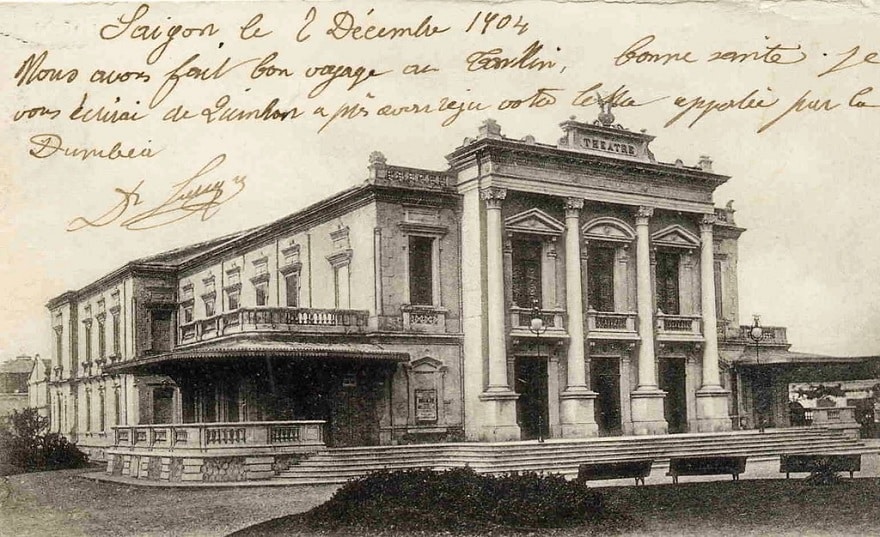
Hai Phong Opera House a century ago
Alongside urban development, the French constructed cultural landmarks to cater to the refined tastes of French capitalists, indigenous mandarins, and the Vietnamese bourgeoisie. As the demand for artistic and cultural enrichment grew among this elite circle, the need for a grand theater became imperative. Thus, the establishment of the Hai Phong Opera House was an inevitable progression.
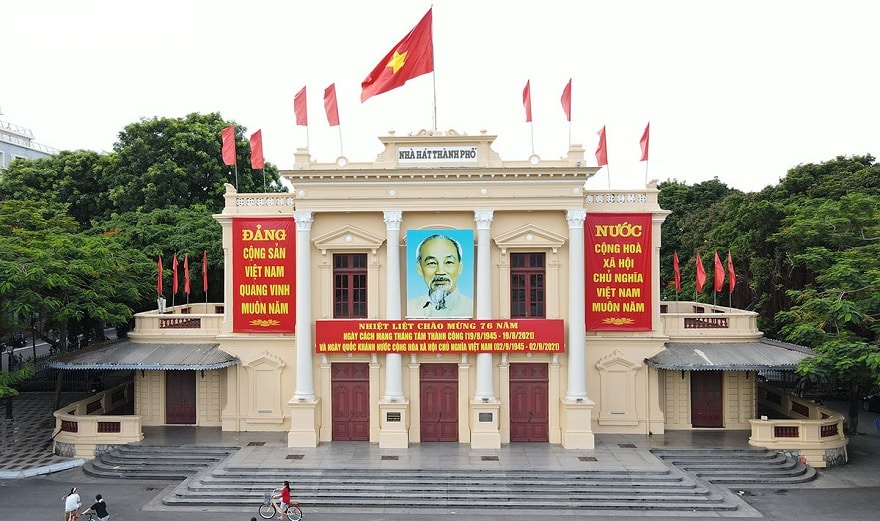
The Hai Phong Opera House was built in the heart of the inner city, at the intersection of the European, Chinese, and Vietnamese quarters as designated by the French urban planning mandate. The chosen site was the elevated and spacious grounds of the ancient An Bien market. Locally referred to as the “Western Theater,” it was designed in distinct French architectural style, contrasting sharply with traditional Vietnamese performance venues such as Tuong, Cheo, or Cai Luong theaters. The moniker “Western Theater” emerged around 1919, when Vietnamese patrons were first permitted to attend performances inside. Prior to that, the theater exclusively served the French community, hosting opera, classical concerts, and theatrical productions by touring artists from France. While traditional Vietnamese theaters were typically built on stilts with thatched or tiled roofs, featuring wide, elevated stages and surrounding audience seating, the Hai Phong Opera House broke ground in 1904 and reached completion in 1912.
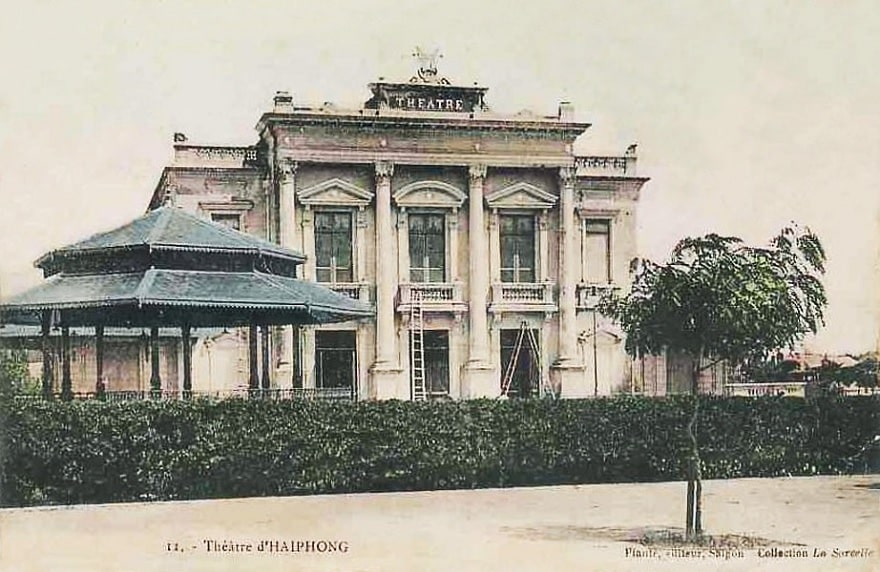
The structure is meticulously designed after the prototype of the Paris Opera, with building materials imported directly from France. Construction was executed by Vietnamese craftsmen and laborers under the direction of a French architect.
The construction of the theater was far from effortless. Architects and laborers faced formidable challenges, including shortages of materials, tools, funding, and skilled labor. Furthermore, the project met with resistance from local residents, as it occupied the grounds of the historic market and stood as a visible symbol of French colonial oppression. Modeled after the Paris Opera House, the structure features exquisite ornamentation and harmonious bas-reliefs of exceptional artistic value. Built using premium materials such as stone, brick, iron, cement, and glass imported entirely from France, the theater was also equipped with cutting-edge electricity, plumbing, and acoustic systems of its era.
Beyond its striking architectural splendor, the Hai Phong Opera House is a revered historical landmark intertwined with pivotal moments in Vietnam’s national journey. It witnessed the first public meeting of the Viet Minh in 1945, where President Ho Chi Minh addressed the political climate and rallied the populace to reclaim their independence. This monumental gathering drew thousands of citizens, exerting immense pressure on the French administration. In 1946, the theater became a battleground during the hostilities between the Viet Minh and French forces, with resistance fighters shelling the building to halt the French advance. This conflict inflicted heavy structural damage and caused numerous casualties. Later severely damaged during the American-Vietnamese War, the theater was meticulously restored in 1973. Today, it preserves its original architectural grandeur and continues to host major cultural and political events for the city of Hai Phong.
Architecture and Interior Design of the Hai Phong Opera House
The Hai Phong Opera House is designed in the Baroque architectural style—an artistic movement that originated in Italy before spreading to Austria, Spain, and parts of France. The building was elaborately crafted after the prototype of the Paris Opera, utilizing materials transported directly from France. Adorned with unique, harmoniously composed floral motifs and bas-reliefs of high artistic merit, the structure features a distinctive U-shape with two projecting wings on either side.
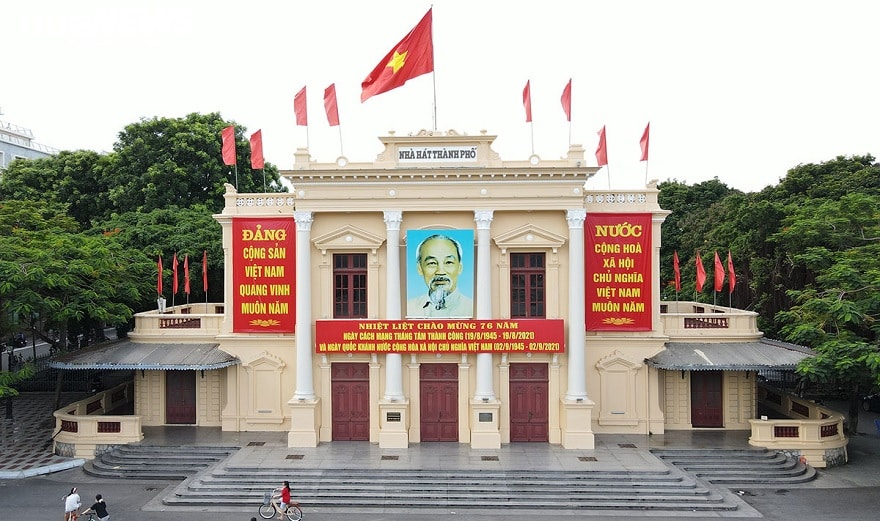
Facade of the Opera House
The grand facade is classically proportioned, featuring three main entrances complemented by two side doors. These entryways are embellished with stately stone columns and ornate sculpted reliefs. Above each doorway hangs a carved panel depicting legendary French literary and theatrical figures such as Molière, Racine, and Corneille. Crowned by a magnificent central dome flanked by allegorical statues of goddesses and crystal chandeliers, the facade reaches a height of 18 meters and spans 87 meters in width.
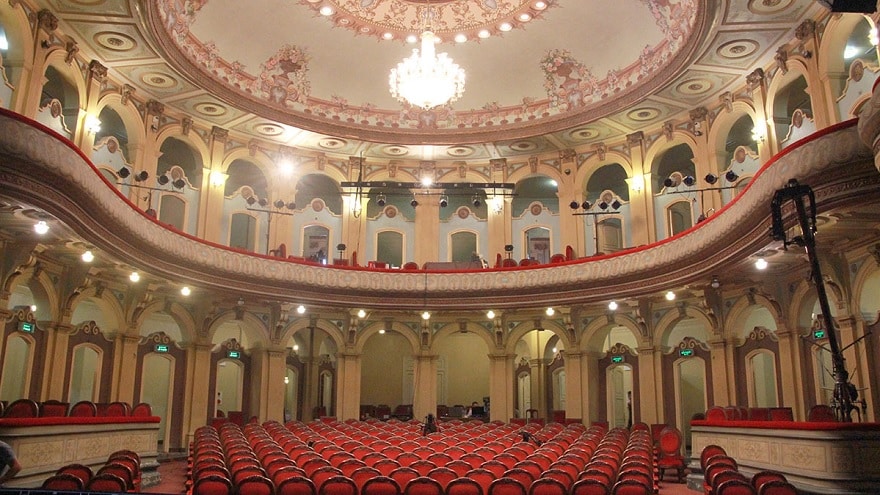
The auditorium with a seating capacity of 400 guests
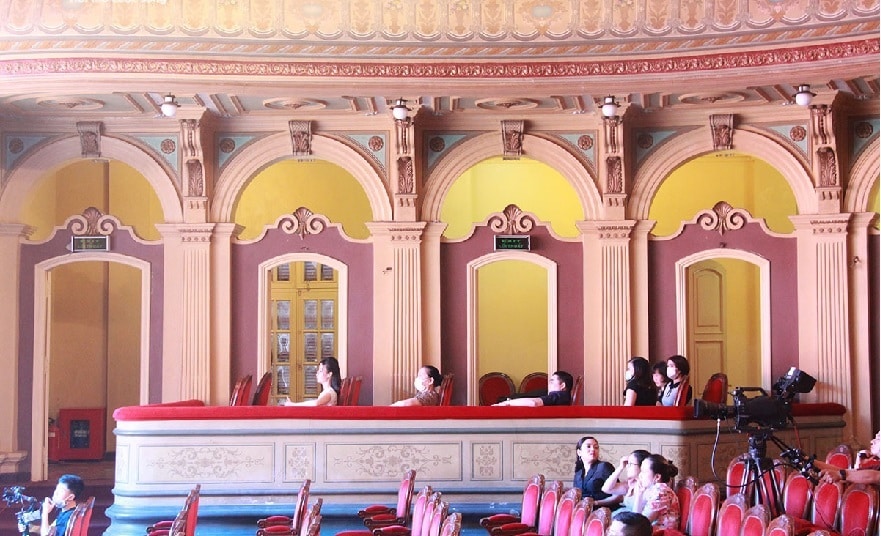
Along both sides of the first-floor auditorium and the second-floor balcony, private boxes are designed for families or groups wishing to enjoy performances together in an exclusive setting.
Step inside the theater, and you will be instantly captivated by the breathtaking splendor and luxury of its interior. The grand foyer spans 900 square meters and can accommodate approximately 400 patrons. Styled in opulent Baroque design, the foyer boasts intricate, exquisite details: soft golden walls adorned with murals depicting serene landscapes and artistic pursuits, ceilings embellished with delicate patterns and magnificent chandeliers, and twin spiral staircases ascending to the upper levels.
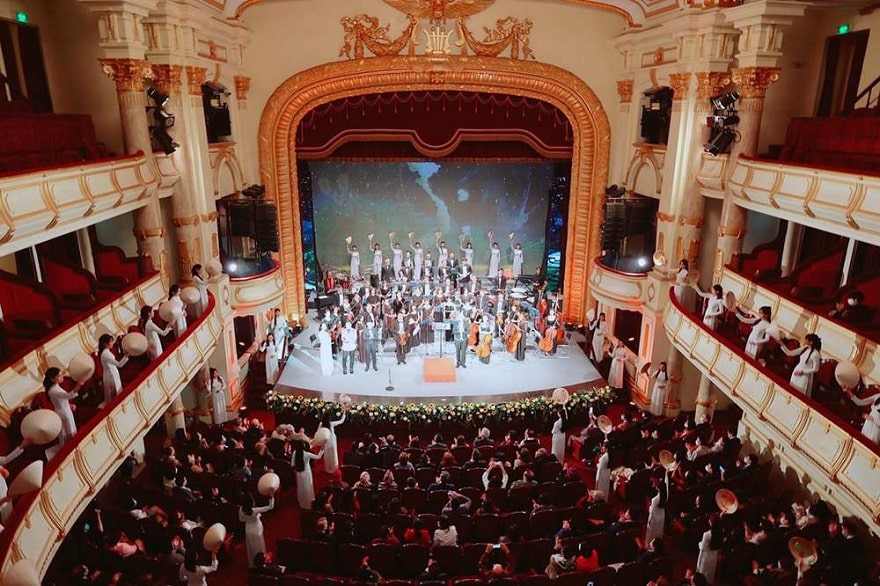
The stage area
The stage area is unpartitioned vertically, extending seamlessly from the podium to the structural roof and ceiling. Measuring 12 meters in width and 9 meters in depth, the upper stage space houses the theater’s comprehensive electrical and climate control systems. Roman-style doorways connect the stage directly to the backstage, dressing rooms, performers’ lounges, and technical control booths. The rectangular stage layout features an orchestra pit situated at the front for musicians.
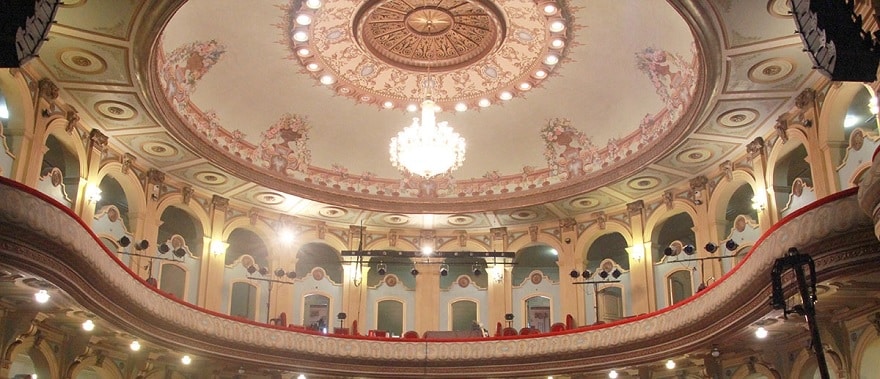
The auditorium dome at the theater
To fulfill its theatrical purpose, the auditorium lacks a dividing ceiling between floors, allowing an uninterrupted vertical space from the ground level to the magnificent dome. This hallmark of Western European architecture enhances spatial grandeur while serving as a canvas for master painters to showcase their talents through breathtaking ceiling art. The soaring, vaulted dome also ensures exceptional acoustic resonance, allowing music to diffuse flawlessly to every seat in the house.
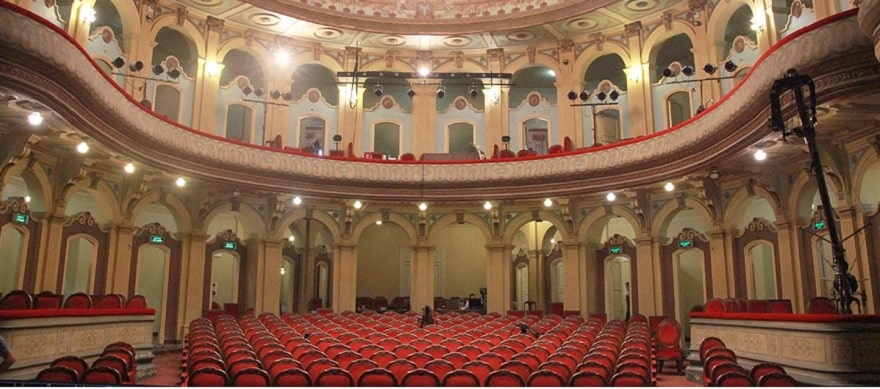
The auditorium features an open circular-arc layout, with the open section seamlessly connecting to the stage via the proscenium arch. The seating area consists of approximately 350 wooden chairs upholstered in rich red wool.
The architecture of the Hai Phong Opera House is not merely a stunning work of art, but a living symbol of the city’s rich history and culture. Having witnessed numerous milestone events in the nation and city—from the August Revolution uprisings to the Indochina War—the theater remains the premier venue for grand cultural and political celebrations in Hai Phong, continually contributing to the flourishing of local arts and tourism.
Activities at the Hai Phong Opera House
During the French colonial era, the Hai Phong Opera House served as a cultural and political sanctum exclusively for the elite and affluent classes of the port city. In those days, only prominent theater troupes from France and elite domestic companies were permitted to perform on its stage. Today, however, the theater has embraced a broader public role, serving as a magnificent venue for commemorating major national holidays, cultural gatherings, and vibrant festivals. For instance, visiting the theater during New Year’s Eve offers a profound glimpse into the vibrant cultural and spiritual life of the Vietnamese people.
A visit to the Hai Phong Opera House invites you not only to admire its French colonial architecture and stunning interior artwork, but also to experience captivating performances such as Tuong (classical Sino-Vietnamese opera), Cheo (traditional Vietnamese folk theater), Cai Luong (reformed regional theater), and other musical showcases. Furthermore, the venue serves as an exquisite setting for celebrated Vietnamese musical concerts, including Ca Tru (ceremonial chamber singing), modernized traditional ensemble music blending Western and Vietnamese elements, Quan Ho folk songs, Chau Van spiritual singing, and other timeless melodies.
Conveniently located at 65 Hoang Van Thu Street, Hai Phong City, the Hai Phong Opera House is open from Monday to Sunday, 7:30 AM to 5:00 PM. Should you require any assistance or wish to learn more during your visit, complimentary information and guided tour services are readily available at the Customer Information Office.