
Location and Origins of Hon Ga Choi
Situated in the southwestern sector of Ha Long Bay, approximately 5 kilometers from the Ha Long International Cruise Port, Hon Ga Choi (Trong Mai Islet) stands out gracefully among thousands of limestone karsts with its one-of-a-kind form. Its precise coordinates on Google Maps are 20.8669° N, 107.0447° E. Hon Ga Choi is the breathtaking result of millions of years of geological tectonic evolution. Composed of limestone, the islet has been shaped by the relentless, erosive dance of wind and sea water. It is through this magical touch of nature that the silhouettes of two chickens—one male and one female—facing each other in a lifelike stance were meticulously “sculpted.”

The name Hon Ga Choi (Fighting Cock) or Trong Mai (Rooster and Hen) was coined by local fishermen who named the island based on its distinctive appearance, passing the name down through generations until it became traditional. The name has also been translated into various languages, such as Chicken Rock, Kissing Bay, or Tau Chi Su. Each of these names conveys the enduring bond and affection between the two birds, as well as the romantic allure of the islet.
Legend has it that since the very founding days of the nation, the Vietnamese people faced invasions from the sea. Witnessing this, the Jade Emperor dispatched the Mother Dragon accompanied by a brood of Baby Dragons to assist the Vietnamese in repelling the invaders. However, after the enemies were decisively defeated, the Jade Emperor waited in vain for the dragons to return. He then sent a pair of roosters down to awaken the dragons and lead them back, but mistakenly dispatched a rooster and a hen instead. Upon descending to the mortal realm, the pair became enchanted by the picturesque landscape, lingering and cuddling together, completely forgetting their mission until they gradually turned to stone. Thus, Trong Mai Islet has since become a timeless symbol of marital devotion, eternal bonding, and the profound yearning for happiness that our ancestors so cleverly wove into this majestic land of Ha Long.
Nevertheless, according to an official dispatch sent to relevant departments and sectors on October 14, 2014, the Department of Culture, Sports and Tourism of Quang Ninh (before it was divided into the Department of Culture and Sports and the Department of Tourism) was assigned to coordinate with related agencies to conduct public opinion polls and unify the use of the name “Trong Mai Islet” instead of “Hon Ga Choi.” By virtue of Decision No. 1418/QĐ-UBND issued on July 4, 2014, by Quang Ninh Province, the name “Hon Ga Choi” was restricted from official documents and publications in favor of “Trong Mai Islet.” Explaining this decision, the Quang Ninh tourism authorities noted that the name “Hon Ga Choi” could easily be misunderstood by international visitors and failed to evoke positive sentiment, as it implied aggression, bellicosity, and a tense atmosphere unsuited to modern global integration trends. Conversely, the name “Trong Mai Islet” embodies love, tender romance, mutual protection, and support, weaving a timeless love song amidst the vast, awe-inspiring seascape of Ha Long Bay—a UNESCO World Heritage and Natural Wonder of the World.
Distinctive Form and Symbol of Ha Long Bay


How to Visit Hon Ga Choi
To admire Hon Ga Choi, visitors typically take Cruise Route No. 1, one of the most popular itineraries for exploring Ha Long Bay on a day trip. This 4-hour journey departs from the international cruise port, guiding you past iconic landmarks such as Thien Cung Cave, Dau Go Cave, Dinh Huong (Incense Burner) Islet, and finally culminating at Hon Ga Choi.

Map showing the location of Fighting Cock Islet along the Cruise Route 1 itinerary
Tickets for this route are readily available at the Ha Long International Cruise Port or Tuan Chau Marina. The inclusive package fee, covering both the boat ticket and sightseeing admissions, is 460,000 VND per person. Group shared boats generally depart at 8:00 AM, with the final daily departure at 3:00 PM. For guests desiring greater schedule flexibility and enhanced privacy, private charters are available with early departures starting from 6:30 AM.
However, to preserve Hon Ga Choi, the Ha Long Bay Management Board has implemented specific protective measures: establishing dedicated navigation channels for observation and photography, enforcing a mandatory minimum distance of 50 meters from Trong Mai Islet, and restricting vessel speeds to under 10 km/h within a 200-meter radius.
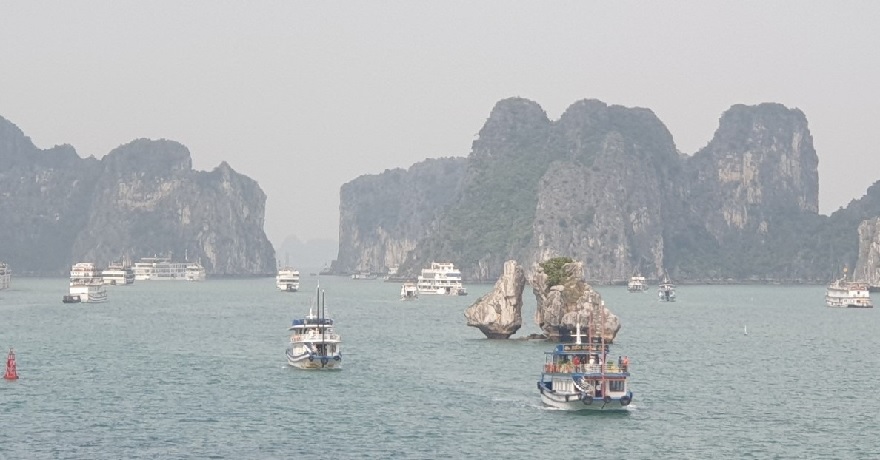
Viewing Hon Ga Choi (Trong Mai) from a sightseeing cruise
Read more: Ha Long Bay Cruise Boat Rates
We hope this article has provided you with valuable insights into Hon Ga Choi and inspired you to craft your itinerary for an upcoming getaway. What are you waiting for? Experience Ha Long Bay in person and witness this extraordinary natural wonder with your own eyes! After reading, what aspect of Hon Ga Choi left the deepest impression on you? Feel free to share your thoughts in the comments below!