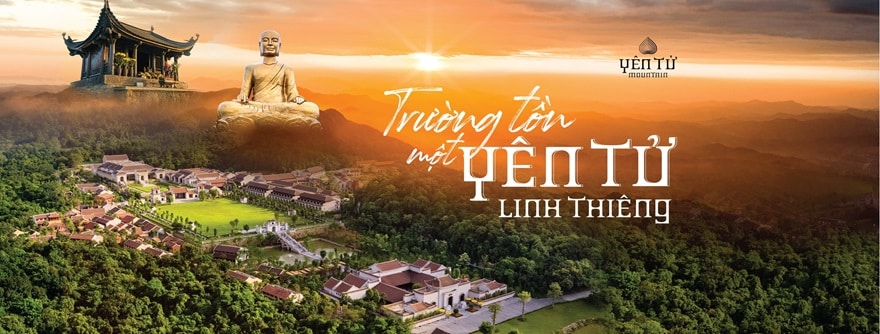
Though its exact origins remain unrecorded, a timeless Vietnamese proverb says, “Accumulate virtue and practice asceticism for a hundred years; without ascending Yen Tu, one cannot attain spiritual enlightenment.” Where is Yen Tu Pagoda located, and why does this saying endure? In the article below, we invite our esteemed guests to discover essential insights and the exclusive services offered at Yen Tu Pagoda.
Read more: Top 9 Most Sacred Pagodas in Quang Ninh
Where is Yen Tu Pagoda Located?
Yen Tu Pagoda, often referred to by locals simply as the East Yen Tu scenic relic complex, is situated in Nam Mau village, Thuong Yen Cong commune, Uong Bi city, Quang Ninh province. This magnificent complex comprises numerous hermitages, shrines, and stupas stretching from the foot of the mountain all the way to the sacred peak of Yen Tu. Notable architectural landmarks include Trinh Pagoda, Giai Oan Pagoda, Mot Mai Pagoda, Hoa Yên Pagoda, Lan Pagoda, Bao Sai Pagoda, Van Tieu Pagoda, and at the very summit, Dong Pagoda (Bronze Pagoda). Unlike Bai Dinh Pagoda (Ninh Binh) or Tam Chuc Pagoda (Ha Nam)—which are grand complexes celebrated for their monumental statues and record-breaking scales—Yen Tu exudes an atmosphere of timeless antiquity, spiritual heritage, and the pristine, restorative air of sacred mountain forests.
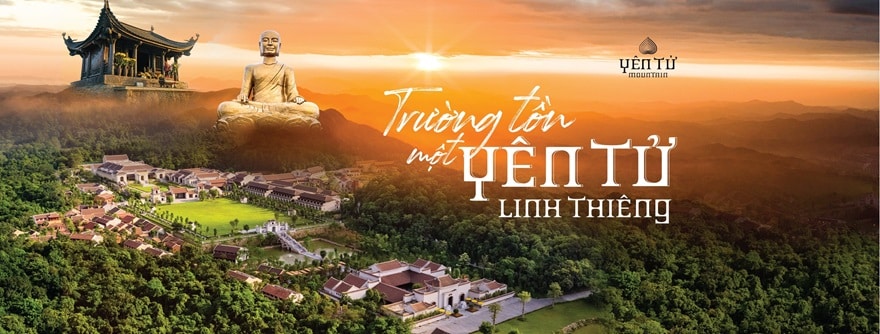
Yen Tu Pagoda
Yen Tu Pagoda is revered as a profoundly sacred sanctuary in the hearts of generations of Vietnamese people, widely regarded as the cradle of Vietnamese Buddhism. It was here that the Buddhist Emperor Tran Nhan Tong pursued his spiritual practice, attained enlightenment, and founded the Truc Lam Yen Tu Zen lineage—a uniquely Vietnamese school of Buddhism that laid the foundation for the flourishing of national religion and cultural identity that persists to this day.
The Historical Origins of Yen Tu Pagoda
With a history spanning over 700 years, Yen Tu Pagoda is inextricably linked to the legacy of Buddhist Emperor Tran Nhan Tong (1258 – 1308), the sovereign who twice led the army and people of the Tran Dynasty to glorious victory against the Mongol invaders. After abdicating the throne in favor of his son, Tran Anh Tong, he left the imperial palace to seek the path of enlightenment. He chose Yen Tu Mountain as his sanctuary for spiritual cultivation and teaching monks, nuns, and commoners alike. Here, he established the Truc Lam Yen Tu Zen school, a distinct Vietnamese Buddhist tradition harmonizing Zen and Pure Land teachings under the philosophy of “finding Zen amidst the mortal world, and the mortal world within Zen.”
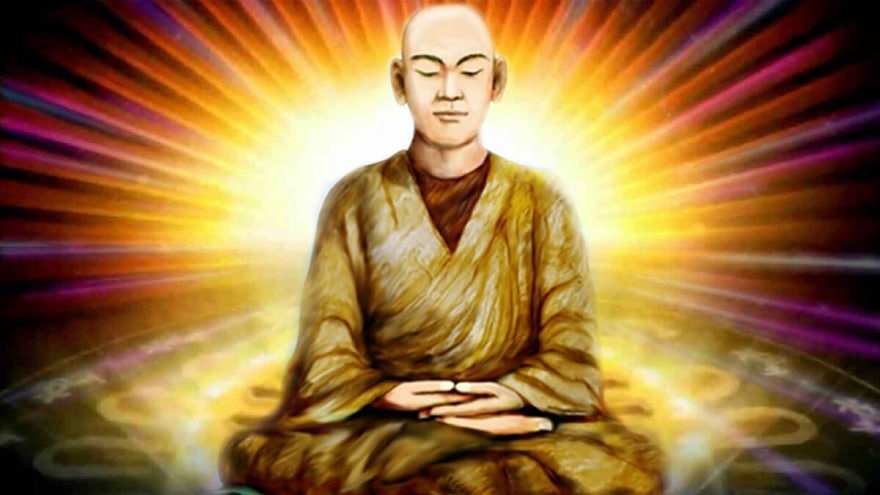
Tran Nhan Tong
Following the passing of Buddhist Emperor Tran Nhan Tong, under the stewardship of Phap Loa, numerous new pagodas were constructed, including Van Yen (Hoa Yen), Van Tieu, Giai Oan, Long Dong, and the Quy Duc Mausoleum housing the Hue Quang Stupa. This era marked a period of large-scale architectural development. In the late Tran period, as the imperial court weakened and Confucianism gained dominance at the expense of Buddhism—compounded by the Ming invasion and their policies of forced assimilation—many of Yen Tu’s magnificent architectural masterpieces were entirely destroyed.
In the 18th century, during the Le Dynasty and Trinh Lord era, the Truc Lam Zen school was revived, and Yen Tu Pagoda underwent extensive restoration. Notably, during the reign of Emperor Le Thanh Tong, the pagodas, hermitages, and stupas were magnificently restored to their former splendor. During this period, Yen Tu was somewhat influenced by the Chinese Linji (Lam Te) Zen tradition, as evidenced by archaeological discoveries of ancient stone stupas inscribed with the words: “Lam Te Chan Truyen Phu Lang Phai.” By the Nguyen Dynasty, the Truc Lam lineage and Yen Tu Pagoda fell into decline once more, leaving the structures in ruins.
Key Landmarks and the Journey to Conquer Yen Tu Pagoda
In ancient times, the only way to ascend Yen Tu Mountain to the legendary peak of Phu Van was entirely on foot, weaving along meandering earthen trails beneath lush bamboo and pine canopies. Today, travelers have the added convenience of a cable car system. Visitors can purchase a round-trip combo ticket for 300,000 VND per person at the Tam Quan gate area. This cable car route spans over one kilometer, offering breathtaking panoramic views of the verdant Yen Tu mountain forests during the ascent. Afterward, travelers can continue on foot to explore other key sites within the scenic area. Even so, many visitors still choose the traditional hiking route to experience the entire journey at a leisurely pace, immersing themselves fully in the breathtaking natural landscape crafted by heaven and earth. This ancient route stretches over 6 kilometers, reinforced by thousands of sturdy stone steps that ensure a comfortable journey despite the considerable slope.
1. Nuong Village
Nestled right at the foot of Yen Tu Mountain is Nuong Village. Legend has it that when King Tran Nhan Tong relinquished his throne to practice asceticism at Yen Tu, many of his imperial concubines followed him. Upon reaching Giai Oan Stream, the King issued an imperial decree advising the concubines to return to their hometowns, yet many chose to remain at the foot of the mountain to settle, thereby establishing Nuong Village. Inspired by this legend, Nuong Village has been meticulously recreated with houses and streets reflecting the architectural charm and rustic elegance of a Tran Dynasty settlement. The dwellings face pristine natural surroundings where crystal streams meet lush forests, filling the air with the soothing music of flowing waters and birdsong—a true natural symphony of Zen.
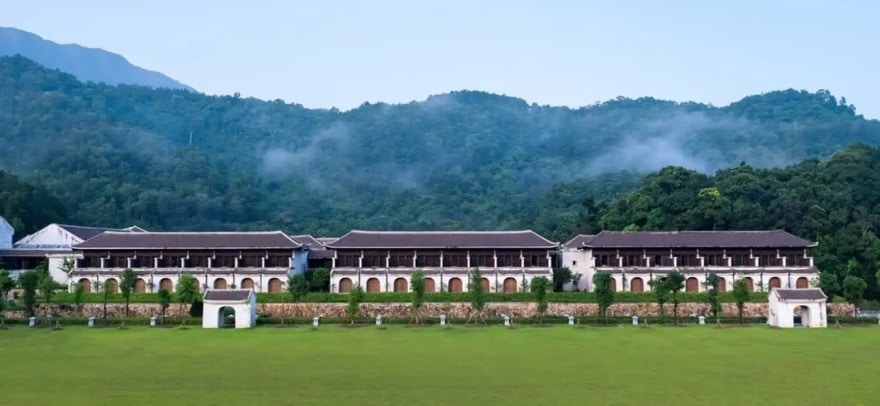
Nuong Village Area, Yen Tu
The houses are constructed with terracotta brick and earthen walls, complemented by exquisite ironwood gates and doors. The focal point of Nuong Village is its central, two-tiered communal hall, where traditional folk performances such as Cheo, Xam, and Quan Ho singing are hosted to delight visitors.
2. Giai Oan Stream and Giai Oan Pagoda
Continuing onward from Nuong Village, travelers will arrive at Giai Oan Stream and Giai Oan Pagoda (Those taking the cable car will bypass this area). Giai Oan Stream originates from a poignant tale of a hundred palace maids who tragically ended their lives here after being denied permission to follow the King. According to legend, after twice defeating the Mongol invaders, King Tran Nhan Tong abdicated his throne to practice asceticism at Yen Tu, founding the Truc Lam Zen school and transforming the region into the Buddhist capital of Dai Viet. Unwilling to see their sovereign remain on the mountain, King Tran Anh Tong sent imperial concubines and palace maids to persuade him to return. However, Tran Nhan Tong remained steadfast in his spiritual devotion and urged everyone to go back. To demonstrate their unwavering loyalty to the King, several palace maids plunged into the stream and perished. Deeply moved by their tragic fate, the King ordered a shrine to be built to perform liberation rituals for their souls. Since then, the stream has been named Giai Oan (Stream of Exoneration), and the site where the King performed the memorial rites became Giai Oan Pagoda. Though ravaged by centuries of time, Giai Oan Pagoda has been rebuilt and expanded on its original foundation. Furthermore, a unique distinction of this temple is that among all the pagodas on Yen Tu, Giai Oan is the only one featuring a shrine dedicated to the Mother Goddess (Den Mau).
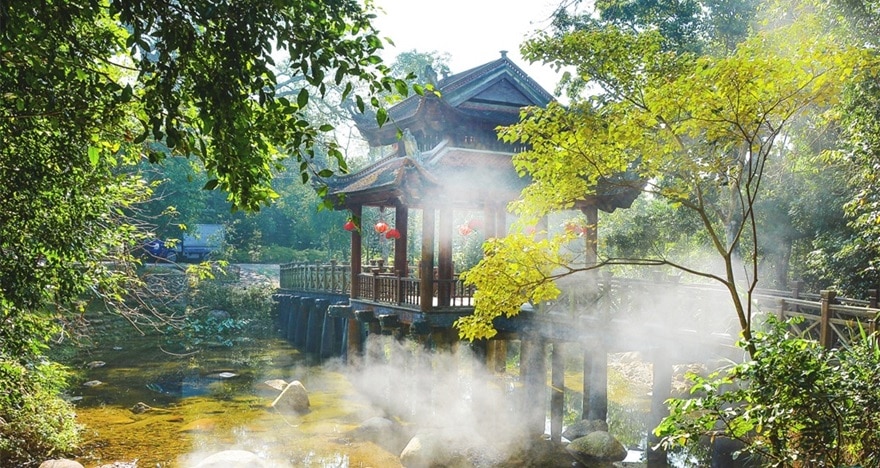
Giai Oan Stream Area, Yen Tu
3. The Ancestral Stupa Garden (Vuon Thap To)
Just behind Giai Oan Pagoda, ascending roughly 400 meters and turning left for about 50 meters, visitors will reach Lo Ren Hermitage. Legend has it that when Buddhist Emperor Tran Nhan Tong first arrived at Yen Tu, he erected this hermitage to forge tools for the surrounding pagodas and local villagers. Past Lo Ren Hermitage lies the magnificent Ancestral Stupa Garden. Currently, this complex houses 64 stupas, including 40 newly restored structures renovated in 2002. The most prominent masterpiece here is the Hue Quang Gold Stupa, the sacred resting place of the relics of the First Patriarch of Truc Lam, Buddhist Emperor Tran Nhan Tong. Built on a square foundation of approximately 180 square meters, the 10-meter-tall stupa consists of six tiers crafted from interlocking greenstone blocks, standing proudly at the very center of the garden. Flanking the base of the stupa are two ancient banyan trees that seemingly embrace the entire Hue Quang structure.
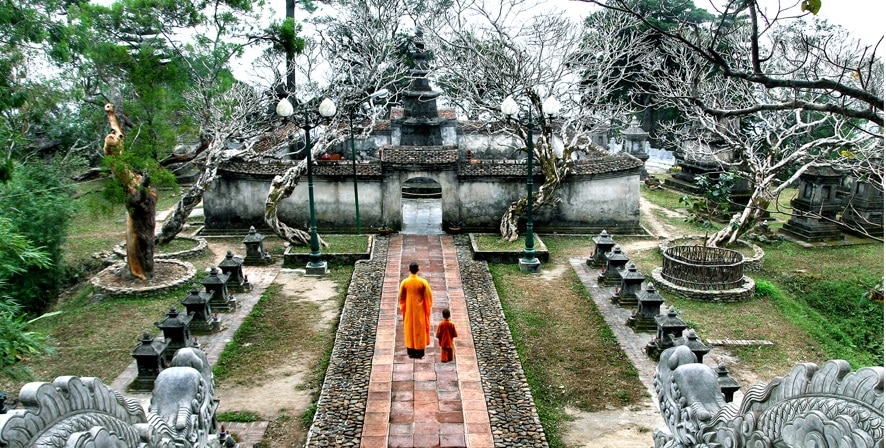
The Ancestral Stupa Garden
4. Hoa Yen Pagoda
Continuing up a 200-meter sloping path (comprising 136 stone steps) from the stupa garden, travelers will arrive at Hoa Yen Pagoda. This pathway is paved with large square bricks embossed with chrysanthemum motifs typical of the Tran Dynasty (84 of which remain today). Notably, Tran Dynasty chrysanthemum bricks are exclusively found in imperial relics and royal residences of the Tran Dynasty, underscoring the supreme status of the Yen Tu historical and scenic complex.
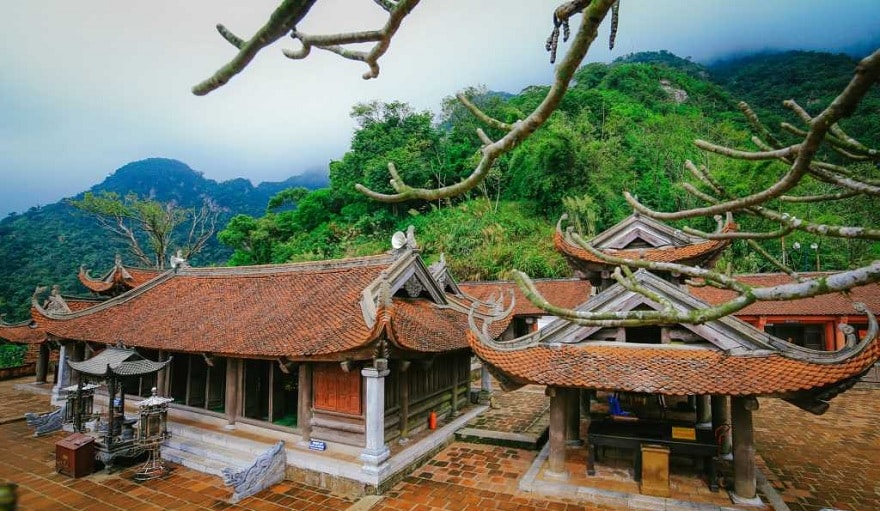
Hoa Yen Pagoda
Hoa Yen Pagoda, also known as Van Yen Pagoda—and affectionately called Chua Ca (The Great Pagoda), Chua Chinh (The Main Pagoda), or Yen Tu Pagoda by locals—is the largest and most magnificent temple in the Yen Tu complex. This sacred site witnessed the exact moment the Tran Emperor left behind the secular world to embrace Buddhist teachings. Situated at an altitude of 535 meters above sea level and originally founded by Zen Master Hien Quang over 700 years ago, it began as a humble hermitage named Van Yen. During the Le Dynasty, when Emperor Le Thanh Tong visited the temple, he was captivated by its breathtaking scenery where myriad flowers bloomed and mists wove themselves into floral patterns before the temple gates, prompting him to rename it Hoa Yen (Flower and Mist) Pagoda. Notably, the courtyard is graced by three ancient frangipani trees aged over 700 years; visitors arriving during the blooming season are treated to an utterly transcendent spectacle.
5. Mot Mai Pagoda (Single-Roof Pagoda)
Proceeding 200 meters further from Hoa Yen Pagoda, travelers will reach Mot Mai Pagoda. Featuring a remarkably unique architecture with just a single projecting roof, the entire temple is built directly against a sheer cliff face. During the Tran Dynasty, the King frequently retreated here to read scriptures and compose religious texts. The pagoda is known by several names, including Bo Da, Ly Tran Hermitage, Ban Mai Pagoda, and Thanh Long Dong (Blue Dragon Cave)… After the Emperor attained enlightenment, posterity erected a temple at this sacred site. Built in the shape of the Chinese character for “One” (一) and consisting of four narrow bays, the statues and ritual objects are all carved from white stone.
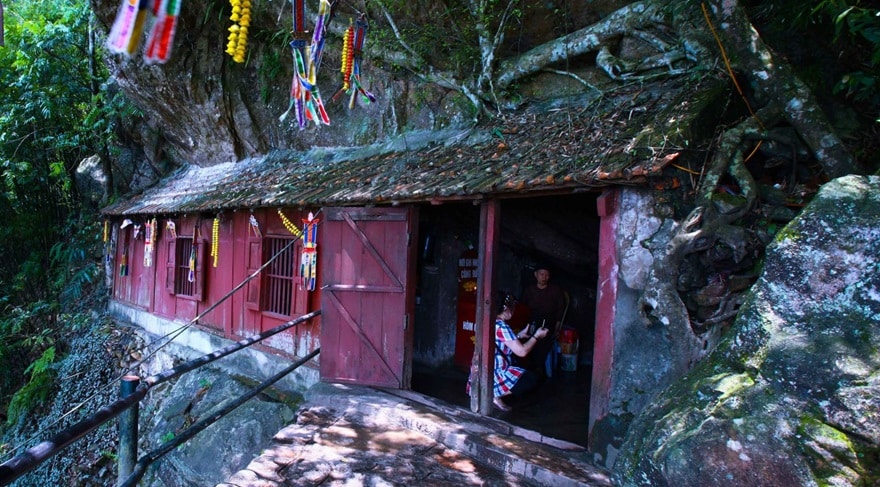
Mot Mai Pagoda clinging precariously to the cliffside
6. Ngoa Van Hermitage
Leaving Mot Mai Pagoda and following the trail hugging the mountainside leads to Ngoa Van Hermitage (Hermitage in the Clouds). Just ahead lies the Tu Waterfall cascading from a 10-meter-high rocky cliff, roaring through crevices before rushing across the pathway and plunging into the abyss. Ngoa Van Hermitage leans against the mountainside beneath the canopy of two giant pine trees. Mist blown in by the sea breezes from the East Sea meets the cool mountain air of Yen Tu, transforming into gossamer wisps of vapor like curling incense smoke that drift among the pine branches and float gently through the bamboo forest. The mountain scenery dissolves into a delicate veil of mist before gradually reappearing in varying shades of emerald and white, resembling a mesmerizing traditional ink wash painting. At the entrance of Ngoa Van Hermitage, along the lower slopes, stand Thung Hermitage (Pestle Hermitage) and Duoc Hermitage (Medicine Hermitage).
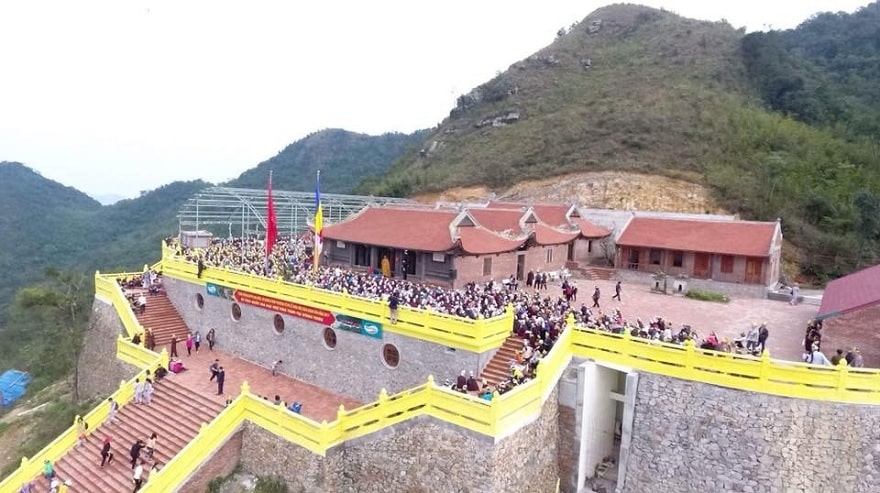
Architectural style of Ngoa Van Hermitage
According to legend, Duoc Hermitage was originally where An Ky Sinh refined medicinal herbs. When King Tran Nhan Tong arrived to practice asceticism at Yen Tu, he transformed Duoc Hermitage into an apothecary workshop. Precious medicinal herbs gathered from Yen Son and surrounding areas were carefully cultivated and processed into “Hong Ngoc Suong” (Ruby Dew) medicine. These precious remedies were distributed to heal monks and ordinary folk—especially the impoverished who could not afford medicine. Standing here, pilgrims can gaze out towards the distant sea, catching glimpses of Ha Long Bay while gentle wisps of white cloud wrap around them in a cool embrace, evoking an extraordinary sense of inner peace. Ascending a steep stretch of slope, travelers are rewarded with breathtaking natural vistas: endless expanses of vibrant emerald bamboo forests softly veiled by drifting white clouds, creating a poetic masterpiece brimming with vivid hues across the Yen Tu landscape.
7. Bao Sai Pagoda
Ascending from Ngoa Van Hermitage along a nearly vertical pathway, visitors will encounter Bao Sai Pagoda (those taking the cable car will bypass this temple). Perched precariously at an altitude of 724 meters above sea level and leaning against a soaring cliff face, Bao Sai Pagoda occupies a dramatic vantage point. During the era when Supreme Emperor Tran Nhan Tong practiced asceticism here, there was only a hermitage inside a grotto named Ngo Ngu Vien. Bao Sai, the First Patriarch’s most trusted senior disciple, practiced here. Tran Nhan Tong entrusted Bao Sai with editing and printing all the scriptures of the Truc Lam Zen school, which were then distributed to pagodas nationwide to propagate Zen teachings among devotees and Buddhists. Following the passing of Zen Master Bao Sai, Ngo Ngu Vien was expanded, and later generations named the temple in his honor. The pagoda houses three magnificent bronze statues of the Truc Lam Three Patriarchs, seated side by side upon crimson-lacquered and gold-gilded bronze lotus thrones. “Bao Sai” refers both to the temple and to the revered senior disciple of the Truc Lam Patriarch; the name translates poetically to “droplets flowing into fringes,” symbolizing the profound absorption of the wondrous Buddha Dharma by all sentient beings. Bao Sai Pagoda stands as an enduring emblem of spiritual immersion for Buddhist practitioners.

Bao Sai Pagoda viewed from above
8. Van Tieu Pagoda
Just a few hundred meters from Bao Sai Pagoda lies Van Tieu Pagoda (Pagoda in the Clouds). Because it is perched on a mountain range 724 meters above sea level—acting as a natural fortress wall blocking sea winds—moisture condenses into dense, multi-layered clouds that shroud the area year-round. Seen from a distance, the pagoda appears and disappears mysteriously amidst the drifting mists. In ancient times, it was merely a humble hermitage known as Tu Tieu Hermitage before being rebuilt into the grand pagoda it is today by the Second Patriarch, Phap Loa.
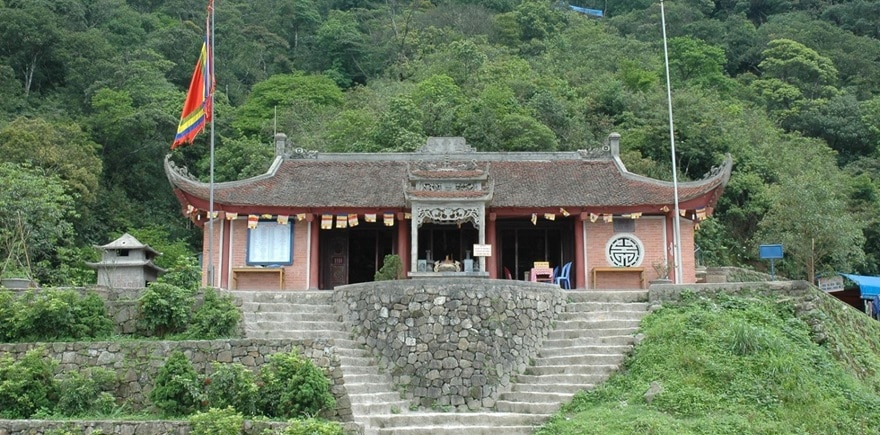
Van Tieu Pagoda
9. Statue of An Ky Sinh
Situated at an altitude of 900 meters, 569 meters away from Van Tieu Pagoda on a wide, flat expanse of land, stands a statue of a monk in dark robes with his hands clasped before his chest, gazing silently toward the pathway as if in deep prayer. This 3.5-meter-tall monolithic rock formation is said to embody An Ky Sinh, an ascetic who attained spiritual enlightenment and whose spirit merged into the stone. The unique Statue of An Ky Sinh appears both as a natural rock formation and a masterful sculpture, standing majestically upon the heights to imbue the surroundings with an ethereal, celestial aura. Legend recounts that during the reign of Qin Shi Huang, in Phu Huong village, Lang Giang region, a man named An Ky Sinh wandered the coastal areas healing the poor. When Emperor Qin Shi Huang embarked on his eastern tour, he summoned An Ky Sinh to discuss medicine and bestowed gifts upon him. An Ky Sinh left the treasures in the village communal house and set out to find the elixir of immortality for the Emperor. Reaching Bach Van Sơn (White Cloud Mountain) and enchanted by its pristine beauty, he chose to remain, gathering leaves and compounding medicines to save mankind. Upon arriving at Yen Tu, he first established an apothecary hermitage at Duoc Hermitage before moving to the present site of the stone statue, where he eventually passed away.
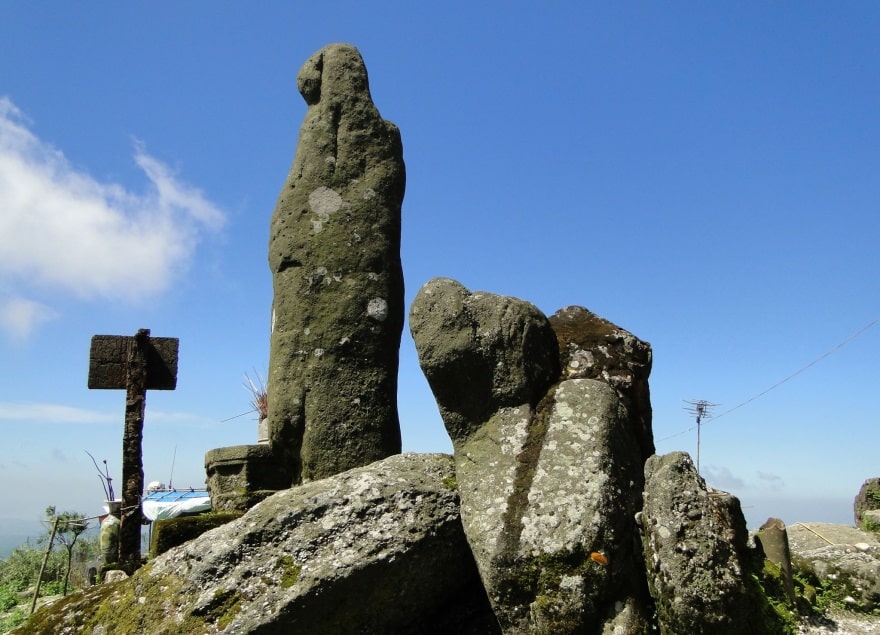
Statue of An Ky Sinh
10. Dong Pagoda (Bronze Pagoda)
After conquering 8,900 stairs, travelers reach the sacred peak of Yen Tu, home to Dong Pagoda—the ultimate pilgrimage destination for every devotee and traveler. Officially named Thien Truc Tu (Heavenly Indian Pagoda), Dong Pagoda clings precariously to the highest summit of the Yen Tu range at an altitude of 1,068 meters above sea level. The ascending trail is rugged and challenging, designed to test the resolve of pilgrims. Thus, only after a long, arduous trek demanding immense physical endurance and unwavering willpower can visitors finally set foot in this sacred sanctuary. Your reward is an incomparable panorama.
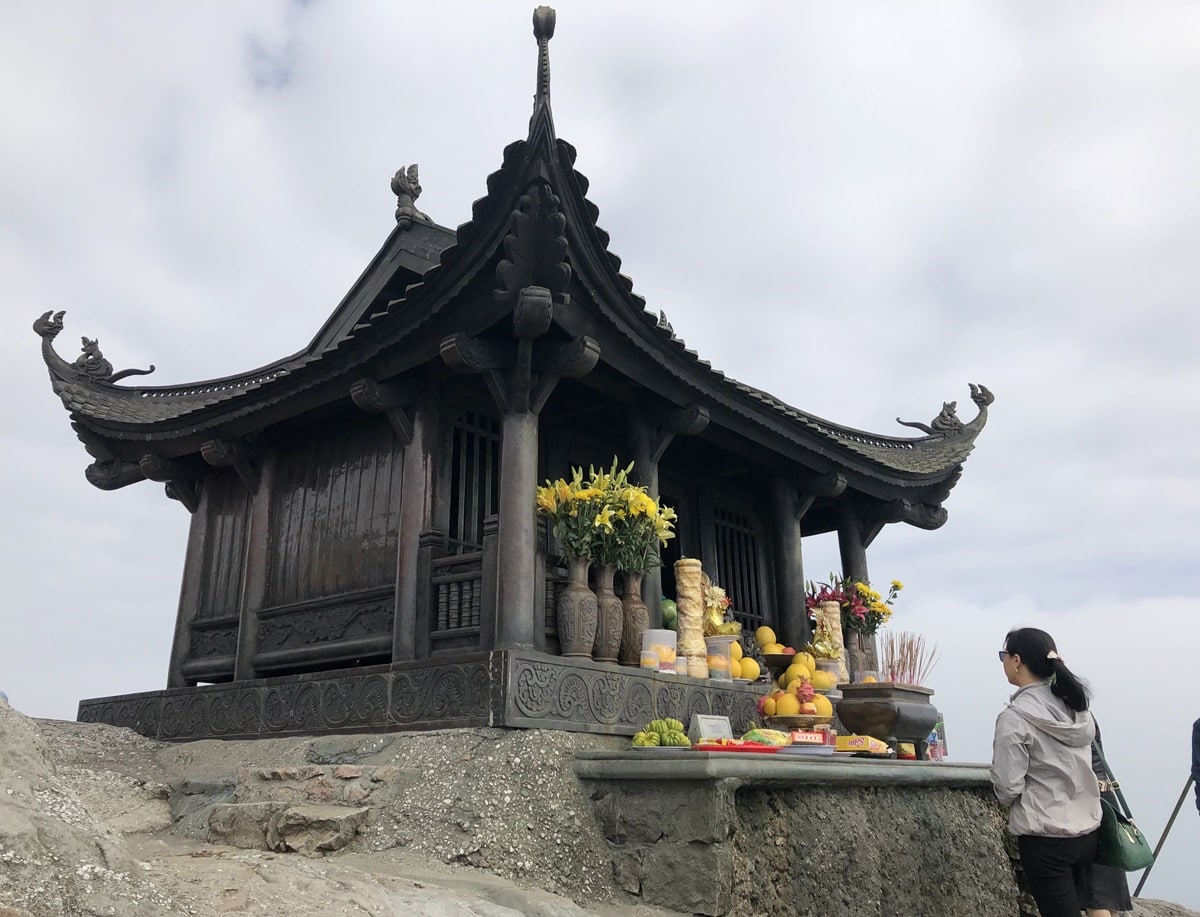
Dong Pagoda, Yen Tu
Dong Pagoda is the highest altitude temple in Vietnam, originally built during the Later Le Dynasty. Having undergone numerous restorations and embellishments, the temple today wears a completely renewed visage. Cast after the architectural prototype of Dau Keo Pagoda in Thuan Thanh, Bac Ninh, Dong Pagoda covers a floor area of nearly 20 square meters, weighs 70 tons, and measures 4.6 meters in length, 3.6 meters in width, and 3.35 meters in height. Each bronze brick and tile weighs approximately 4 kilograms, while each of the four supporting pillars weighs 1 ton. The bronze bell and ritual gong flanking the sides each weigh over 250 kilograms. Inside the temple rest a statue of Shakyamuni Buddha alongside three statues of the Truc Lam Three Patriarchs: the First Patriarch Tran Nhan Tong, the Second Patriarch Phap Loa, and the Third Patriarch Huyen Quang.
Accommodation Services at Yen Tu Pagoda
Currently, the Yen Tu Pagoda area offers two distinct resort enclaves for travelers wishing to stay overnight: Nuong Village Yen Tu and Legacy Yen Tu, with Nuong Village offering much more accessible pricing compared to Legacy. Below is detailed information and room rates for both properties.
Read more: Yen Tu Day Tour
1. Room Rates at Nuong Village Yen Tu
The cultural ambiance of the Tran Dynasty is vividly recreated at “Nuong Village” at the foot of Yen Tu Mountain—the very site where King Tran Nhan Tong came to practice asceticism over 700 years ago. Beyond stepping into a living historical architecture, visitors to Nuong Village can savor signature local delicacies of Quang Ninh province, such as black sticky rice banh chung, banh gio (rice pyramid dumplings), and nem chua (fermented pork rolls).
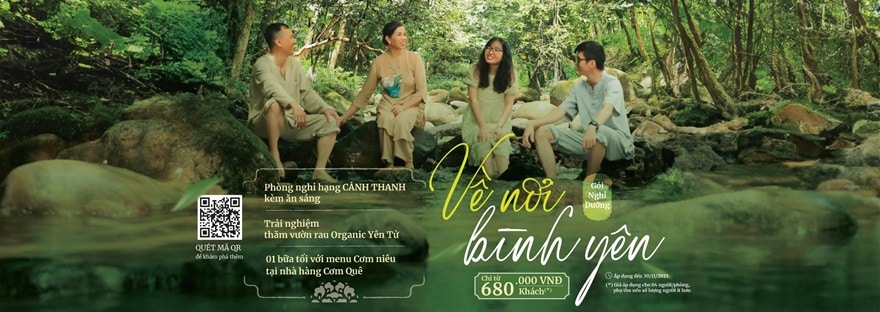
Accommodation Services at Nuong Village Yen Tu
- Rates applicable from now until December 31, 2023
- Featuring 95 rooms. Each room includes 4 cocoon-style bunk beds. The 8-person room consists of 2 connecting 4-bed rooms.
| Nuong Village Yen Tu Rate Card | ||
| Room Type | Sun – Thu | Fri & Sat |
| Classic | 1,200,000 | 1,800,000 |
| Superior | 1,500,000 | 2,100,000 |
| Deluxe | 1,800,000 | 2,400,000 |
Room Amenities
- All rooms are equipped with two-way air conditioning.
- Ensuite bathrooms and tea-making setups.
2. Room Rates at Legacy Yen Tu
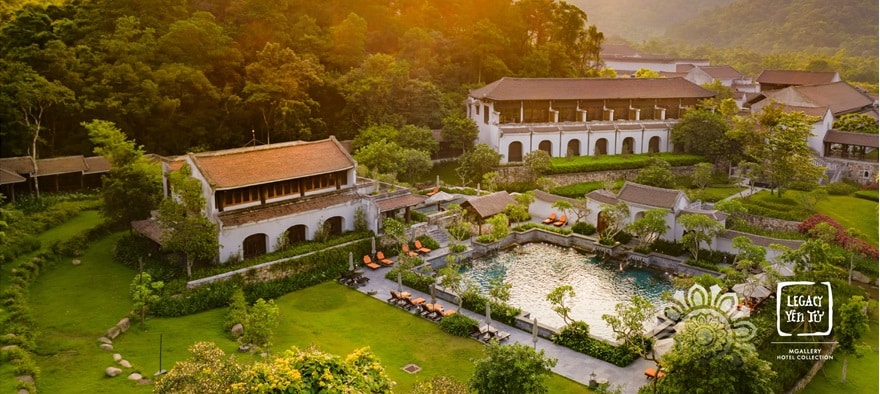
Legacy Yen Tu features a total of 133 meticulously appointed guestrooms. Each accommodation is adorned with handcrafted furnishings produced using traditional artisanal methods, creating a seamless harmony with the overarching architectural vision. A distinctive touch in every room is the inclusion of a wooden calligraphy inkstone and a living space bathed in natural sunlight. These exquisite details establish a unique distinction found nowhere else but Legacy Yen Tu. The entire hotel is designed with a quiet, unpretentious luxury that impeccably channels the heritage, culture, traditional crafts, and mystical atmosphere of Yen Tu Mountain.