
Ha Long, an enchanting and magnificent city in Vietnam, is renowned not only for Ha Long Bay – one of the world’s natural heritage sites – but also as a treasure trove of historical monuments and breathtaking landscapes that embody the pride of the Vietnamese people and the distinct heritage of Ha Long’s residents. Among these cherished historical and scenic gems, Poem Mountain (Bai Tho Mountain) stands as the ultimate “telescope” overlooking the emerald waters of this heritage city.
see more: Famous tourist attractions and experiences in Hon Gai
Introduction to Poem Mountain
Poem Mountain, a majestic limestone mountain formed during the Devonian period through the Indonesian Orogeny, was historically known as Roi Den Mountain or Truyen Dang Son (Beacon Mountain). The iconic name “Bai Tho” (Poem Mountain) was officially established in 1468 after King Le Thanh Tong carved a poem into the cliffside during a royal inspection tour.
Rising 168 meters above sea level, the mountain is situated in Bach Dang Ward (Hon Gai), the vibrant heart of Ha Long City. From its summit, travelers are rewarded with sweeping panoramic views of the cityscape and the breathtaking splendor of Ha Long Bay. Historically, the mountain served as a strategic watchtower to spot offshore enemies, where guards would light signal fires to alert the imperial capital of imminent invasions. Today, Poem Mountain has evolved into an alluring trekking destination for adventurous visitors exploring Ha Long.
In 2017, a forest fire—triggered by careless campers who lit a fire, resulting in severe environmental damage and a subsequent landslide—prompted local authorities to officially close the mountain to the public. Despite numerous endeavors to restore tourism access to Poem Mountain, it remains officially closed to this day. Nevertheless, intrepid travelers continue to visit despite the warnings; notably, Caroline, the granddaughter of a British billionaire, conquered the peak in May 2019, creating a social media sensation with her breathtaking photographs.
Legends and the Origin of Poem Mountain’s Name
According to local folklore, Poem Mountain and Man Mountain form an inseparable pair. The ancient myth of the giant who carried stones to mend the sky tells that when the universe was first created and the heavens had numerous breaches, the scorching sun tormented the mortal realm. Hearing the fervent prayers of the people, the deities dispatched a giant to patch the torn sky. As he carried heavy loads of stones, fragments spilled and scattered across the bay, creating hundreds of thousands of large and small islands. The final load was carried across Cửa Lục Bay; feeling the immense weight, the giant shifted his burden to ease his shoulder, causing his carrying pole to snap in half. One basket tumbled into Xich Tho commune, forming Man Mountain, while the other fell into Hiep Khau commune—historically known as Yen My canton, which today encompasses the four wards of Hong Gai, Bach Dang, Yet Kieu, and Tran Hung Dao, forming the central district of Ha Long City where Poem Mountain stands tall through the millennia. Because both halves of the fractured pole shaped the terrain, Poem Mountain and Man Mountain share strikingly similar silhouettes. Furthermore, researchers note that the geology, geomorphology, and flora and fauna ecosystems of these two peaks are remarkably alike. Viewed from afar, both mountains tower majestically above their surroundings, leaning against the expanse of Cua Luc. Seen from the northeast, Poem Mountain resembles a tender, nurturing Mother Nature cradling her beloved child upon the gentle waves of Ha Long. Thus, nature has bestowed upon Ha Long City not only stunning landscapes but also a profound spiritual and cultural heritage passed down through generations, serving as the ultimate symbol of a dynamic, intelligent, and modern city.

The former name of Poem Mountain was Truyen Dang, popularly referred to as Roi Den (Lantern Light). Folklore recounts that in bygone days, local fishermen casting their nets throughout the region would fish by day and anchor together here at night. They tied their boats to the cliffs, and the warm glow of oil lamps from the vessels painted the waters red like stars, while a beacon atop the mountain guided ships safely along the navigation channels. Hence, locals called it Roi Den Mountain. Another historical account suggests that during the Mongol invasions along the Bach Dang River, Poem Mountain served as a vital garrison station along the frontier. The soldiers stationed here were tasked with hanging a lantern atop the peak each night to signal peace and security. In times of emergency, they would ignite massive bonfires—made from dried firewood mixed with wolf dung—sending towering plumes of smoke into the sky to alert subsequent guard stations and neighboring regions.
The mountain earned its current name, Poem Mountain, from a royal inspection tour by King Le Thanh Tong, who carved poetry into the rock face in 1468. According to scholars, during his visit to An Bang, King Le Thanh Tong composed three poems: two in classical Chinese (Han script) and one in Nom script. Of the two Chinese poems, one was inscribed on Truyen Dang Mountain, and the other on Chich Tro Hon Dua Mountain over Ha Long Bay. This masterpiece stands as a resounding declaration of independence, asserting national sovereignty over the seas and islands, and reaffirming the territorial boundaries established by the feudal court in the northeastern sky. Alongside King Le Thanh Tong’s poem, the southeastern cliffside also bears a responsive poem penned by Lord Trinh Cuong in 1729, as well as a collection of verses by notable scholars of the Nguyen Dynasty.
According to poet Tran Nhuan Minh, former chairman of the Quang Ninh Union of Literature and Arts Associations, Poem Mountain holds the rare and distinguished honor of bearing the names of poetic masterpieces, making the mountain itself a living poem. Such a landmark exists in perhaps only one or two places throughout all of Vietnam. Poem Mountain features a total of 12 poems, but only three possess exceptional literary value worthy of masterpieces. The first is by King Le Thanh Tong; the second, in my opinion, is the finest poem in 18th-century Vietnam, authored by Lord An Do Vuong Trinh Cuong; and the third was written by Nguyen Can in 1910. In essence, Poem Mountain truly belongs to these three poems.
Poem Mountain is not only a repository of literary masterpieces but also a witness to pivotal historical moments for the military and people of the mining region. On May 1, 1930, the residents of Hon Gai erupted with joy upon seeing the red flag with the golden hammer and sickle fluttering atop Poem Mountain—a powerful symbol of the working class’s triumph over French colonial rule in the mining district. Since then, this flag has remained atop Poem Mountain as a profound symbol of national pride. Throughout the resistance war against the US, Poem Mountain played a crucial role in anti-aircraft defense, communications, and medical operations. An anti-aircraft watchtower, the Main Power Center (belonging to the Quang Ninh Post Office), and a public loudspeaker system that broadcast direct combat orders from the Quang Ninh Provincial Air Defense Council were all stationed on Poem Mountain. Additionally, several caves within the mountain were utilized for manufacturing, residences, emergency aid stations, supply shops, classrooms, and offices for various agencies and enterprises during the US bombing campaigns. Through those arduous periods of concurrent labor and combat, Poem Mountain witnessed countless feats and selflessness driven by the miners’ unwavering pursuit of independence and freedom.
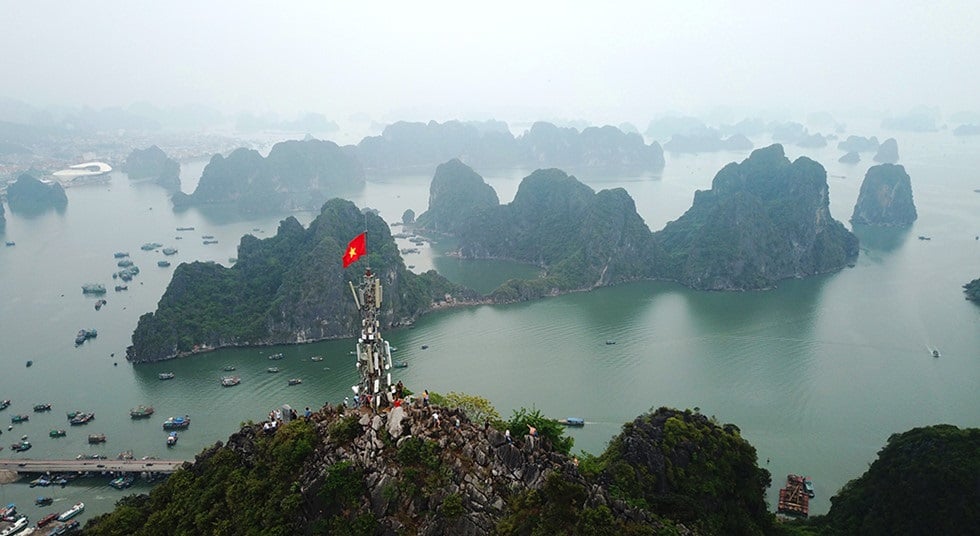
The red flag with a yellow star flutters proudly atop Poem Mountain
Today, Poem Mountain quietly witnesses the peaceful daily life and evolving transformation of this heritage city. Nestled at the foot of the mountain are revered historical and cultural relics such as Long Tien Pagoda, Duc Ong Tran Quoc Nghien Temple, and the Poem Mountain Cultural Center—destinations frequently visited by Ha Long residents during special occasions like the Lunar New Year and local festivals. Visiting Poem Mountain allows every traveler to not only admire a landscape of majestic natural beauty but also feel the beating “soul” of a land rich in history, emotions, and enduring spirit.
However, since late 2017, following incidents involving a forest fire and rockslides, Poem Mountain has been officially closed with warning signs posted to ensure the safety of visitors and preserve the heritage site. According to the Quang Ninh Department of Culture and Sports, on May 18, 2017, a forest fire broke out in the protection forest area of the Poem Mountain historical and cultural site due to human negligence. The fire decimated approximately 2 hectares of protection forest and triggered rockfalls on the mountain. To guarantee the safety of tourists and protect the monument, the People’s Committee of Ha Long City decided to temporarily suspend tourism activities at the Poem Mountain site starting May 19, 2017. By February 2023, following public feedback, the Quang Ninh provincial government began reviewing proposals for the restoration and sustainable development of Poem Mountain tours to cater to public demand.
Literary Works Inscribed on Poem Mountain
1. The Poem by King Le Thanh Tong
The prominent verse inscribed on Poem Mountain is a classical Chinese poem composed by King Le Thanh Tong, carved into the stone in 1468 during his naval inspection tour of the northeastern waters, when he anchored his royal fleet at the base of Truyen Dang Mountain overlooking Ha Long Bay to enjoy wine and compose poetry. This poem is commonly known as “Ngu che Thien Nam dong chu de” (“Thien Nam Dong Chu” being the royal pen name of King Le Thanh Tong). The poem is engraved on a relatively flat rock face, approximately 2.5 meters above the ground, consisting of 56 classical Chinese characters written in a continuous flow without modern punctuation marks. Out of these 56 characters, 21 have weathered away entirely and are illegible, while the remaining characters are severely faded. Preceding the poem is a 49-character preamble (colophon), which has also degraded almost completely. Fortunately, the poem was recorded in ancient historical texts, providing a reliable reference for scholars.
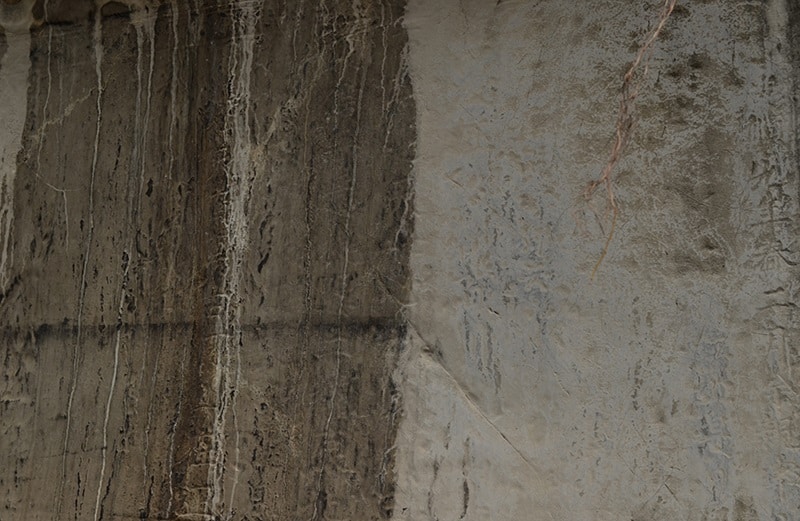
King Le Thanh Tong’s inscribed poem on Poem Mountain has weathered over time
This poem praises the picturesque and poetic natural landscape while reflecting King Le Thanh Tong’s profound patriotism and national pride. He led his naval forces to inspect the northeastern waters to safeguard national borders and security against potential threats from the Mongol invaders. He also built a powerful and prosperous dynasty, widely regarded as the “golden age” of Vietnamese history. The poem exemplifies the king’s artistic brilliance and majestic stature, standing as a masterpiece of Vietnamese literature. Utilizing classical Chinese poetic forms reminiscent of traditional Chinese verse, he infused it with the distinct cultural essence of Vietnam. He vividly and emotionally described natural scenery with imagery such as “gentle breeze” (phong hòa), “splendid scenery” (cảnh lệ), “calm seas without waves” (hải bất dương ba), “sailing the Yellow Sea” (phiếm Hoàng Hải), and “inspecting An Bang” (tuần An Bang). This poem ultimately gave the mountain its new name, Poem Mountain, as it is the only surviving poetic inscription on the mountain after Lord Trinh Cuong’s poem was destroyed.
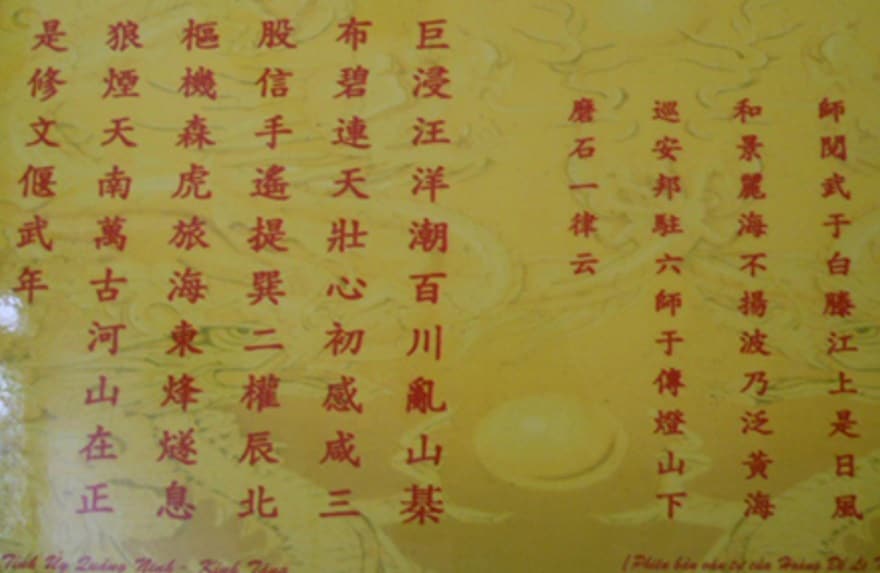
The restored poem by King Le Thanh Tong
A rough translation of the poem’s meaning is as follows: “Vast and boundless waters, a hundred rivers converging / Countless mountains scattered like chess pieces, sheer cliffs touching the skies / With grand ambitions, yet in our foundational days we followed the precedent, as decreed by the hexagram of the Nine Third line / Now, freely wielding absolute authority, our majesty is swift as the divine wind / To the north, rebel factions like tigers and leopards have been pacified / In the eastern seas, the smoke of war has extinguished / For all eternity, the southern realm’s mountains and rivers remain steadfast / Now is the precise time to reduce military affairs and cultivate civil governance.”
2. The Poem by Lord An Do Vuong Trinh Cuong
261 years later, in 1729, Lord An Do Vuong Trinh Cuong—a renowned poet of the Le-Trinh era—also led his military inspection tour through this region. He encamped his troops at the foot of Truyen Dang Mountain. Upon reading King Le Thanh Tong’s poem, Lord Trinh composed a responsive regulated verse in eight lines of seven characters (that ngon bat cu), adopting the rhyme scheme “yen” from the original poem and reusing four key characters: “thien” (heaven), “quyen” (authority), “yeu” (love), and “nien” (years) from Le Thanh Tong’s work. The poem includes the following preamble:
“Finding ourselves in an era of peace, with abundant leisure amidst myriad duties, we embarked on a pleasure journey and exercised our poetic muse. Riding our naval vessels out to the eastern sea, we beheld mountains as picturesque as paintings and waters serene and clear. Both our naval and land forces displayed the strength of tigers and the roar of thunder. Filled with sudden inspiration, we followed the rhyme scheme of the ancient inscription on the cliff face, composing this seven-character regulated verse to leave upon the rock.”
3. The Poem by Le Can (Nguyen Can)
Nguyen Can’s poem was originally located lower on the cliff face than the works of King Le Thanh Tong and Lord Trinh Cuong. Following the construction of the ancient Poem Mountain Shrine, this particular inscription was buried deep underground when the surrounding courtyard foundation was elevated with added soil.
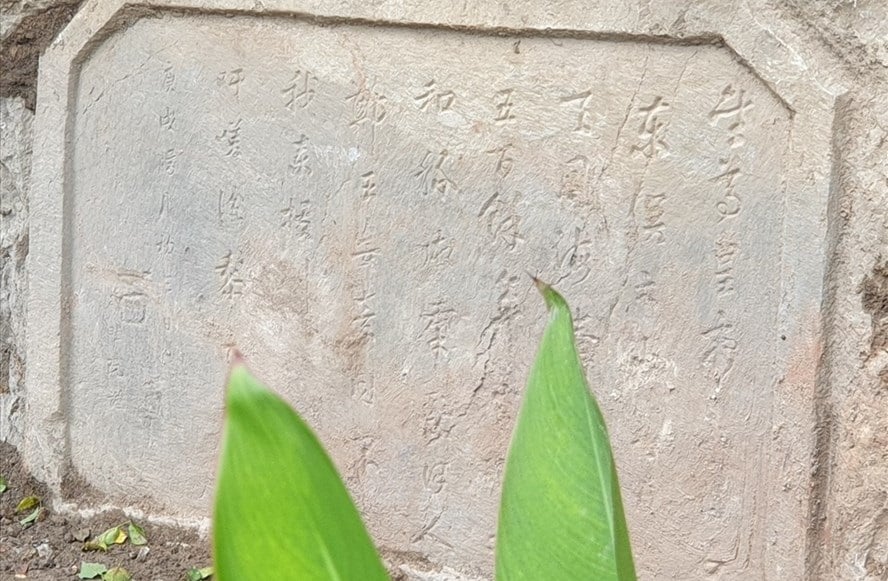
Nguyen Can’s poem on Poem Mountain
Nguyen Can’s poem was carved onto the cliffs of Poem Mountain in 1910. The transliterated classical Chinese reads: “Thánh Tông hoàng đế đề thi thạch/ Đông minh chi sơn cao bách xích/ Thiên phong, hải đảo nhật dạ kích/ Ngũ bách niên dư, tự do xích/ Họa xưng ngự bút ế hà nhân?/ Trịnh Vương vọng ý đồng bất dân/ Ngã lai bạt kiếm, nộ thả sân/ Hu ta hậu Lê chi quân thần”. (Meaning: Emperor Thanh Tong inscribed poetry upon the stone / The mountain in the Eastern Sea towers hundreds of feet high / Heavenly winds and sea waves strike day and night / Yet after more than 500 years, the characters remain undestroyed / Daring to claim the responsive verse as royal calligraphy; who could this be? / Lord Trinh’s arrogant intent was to endure eternally / I arrive, drawing my sword in righteous indignation and wrath / Alas for the monarchs and ministers of the later Le Dynasty).
Guide to Hiking Poem Mountain
You can easily locate the trailhead on Google Maps by searching for ‘Poem Mountain Trailhead’ (Lối vào Núi Bài Thơ). If traveling by taxi, simply tell the driver to take you to Poem Mountain—they will recognize the destination and drop you off right at the entrance of the alley. If riding a motorbike, follow the precise GPS coordinates. The entrance is situated on “Hang Noi” Street, right off “Le Thanh Tong” Street. Ample street parking for motorbikes is available nearby. In the past, the entrance to Poem Mountain was inconspicuous and easily missed—a narrow doorway tucked between storefronts. Today, however, a large sign marks the entrance prohibiting mountain climbing; if you spot this sign, you have arrived at the exact location.

However, if she deems you capable of navigating the trail obstacles, she will grant you passage through her backyard where the path begins, requesting a small nominal fee. Offer a couple of dollars (50,000 VND per person) for international travelers, while local visitors pay according to customary discretion. It is a very small price to pay, so please do not argue with her. You will pass through several dog kennels in the backyard to reach the stairway leading up the mountainside. Frequently, one of the friendly dogs will accompany you for part of the trek.
This section marks the most challenging part of the hike. After passing the owner’s residence, you will climb a flight of stairs leading to a locked metal gate. Previously, hikers could simply climb over the gate and fence. Today, however, it is entirely draped in 2-to-3-meter-high barbed wire, making a direct climb impossible. Consequently, you will need to scramble up the rocks to the right of the gate for about 3 meters to bypass the fence. Afterward, you must maneuver through a gap previously cut into the wire mesh. The opening is spacious enough for an adult to crawl through; as long as you can manage the rock scramble, passing through is entirely feasible.
The remainder of the hike is relatively manageable since it primarily consists of staircases that are easy to follow. Nevertheless, it is a strenuous uphill workout, so you may need to pause occasionally for a sip of water. Throughout the trek, you can enjoy captivating glimpses of Ha Long Bay, providing a wonderful excuse to stop and catch your breath. The final stretch of the hike is quite demanding as the stairs disappear, requiring you to scramble across large boulders.
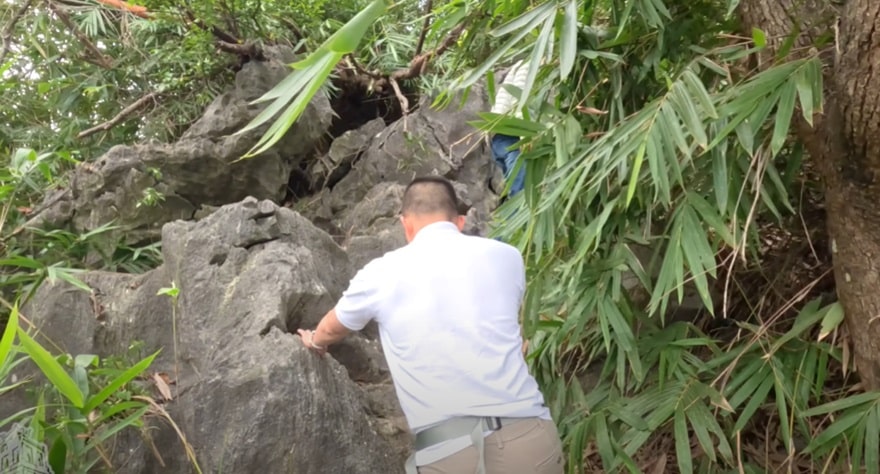
Visitors must scramble across large boulders to continue their ascent
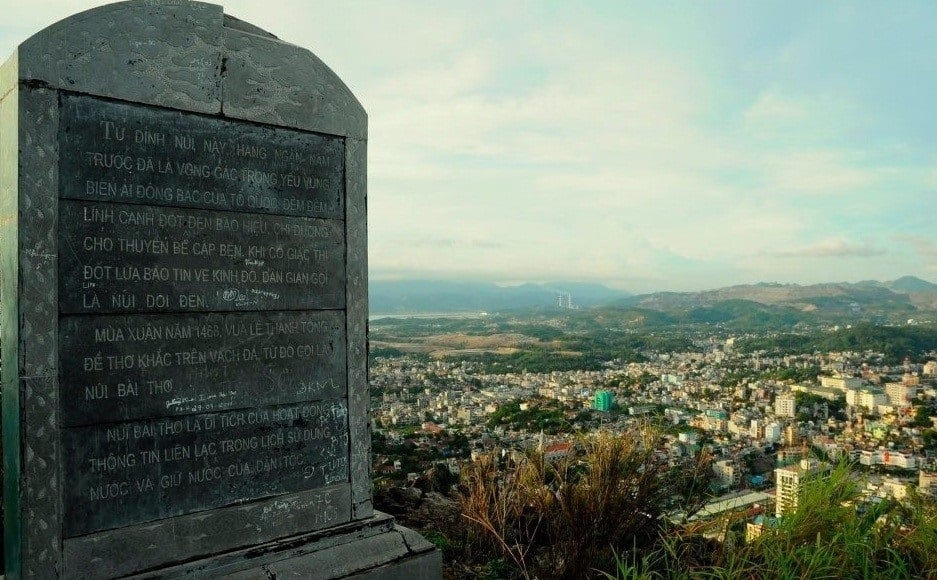
The stone stele at the summit of Poem Mountain
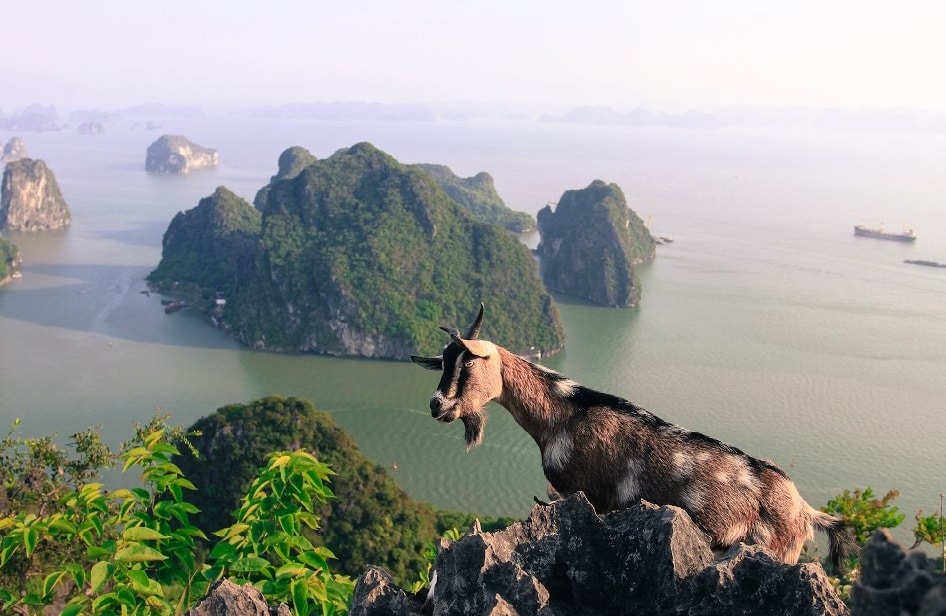
Wild mountain goats delight visitors along the trail to the peak

Panoramic view of Ha Long from the summit of Poem Mountain