Located in the Northeast of Vietnam, within the Van Don district of Quang Ninh province, Ngoc Vung is one of the few island communes that has preserved its pristine beauty alongside a rich array of historical landmarks. Notable sites include the Cong Yen wharf, the ancient Ngoc Vung Citadel, and the 12.7mm artillery emplacement used by islanders during the resistance against the United States. Also significant is the Ho Chi Minh Memorial site; however, one cannot overlook the ancient Ngoc Vung Citadel—also known as the Mac Dynasty Citadel—a provincial-level heritage site that serves as a cornerstone of the island’s historical identity.
Read more: Ngoc Vung Island
The ancient Ngoc Vung Citadel was historically known as Bao Tinh Hai (meaning “Tĩnh Hải Garrison”), situated in Binh Hai village, Truong Chinh commune, Ngoc Vung, Van Don district. It remains one of the few ancient remnants on the island, holding profound historical significance.
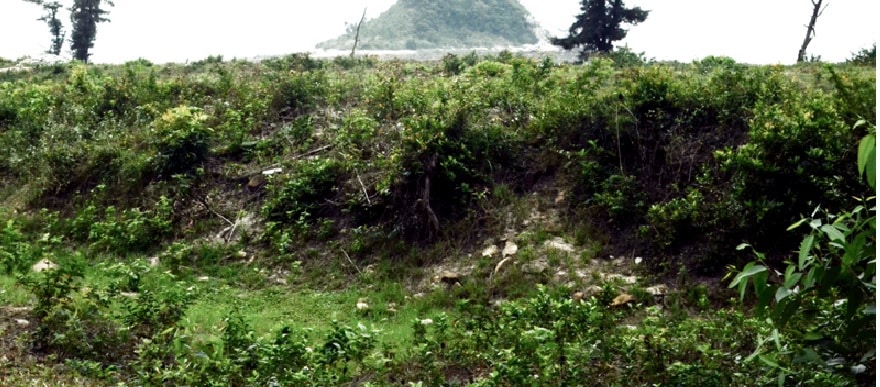
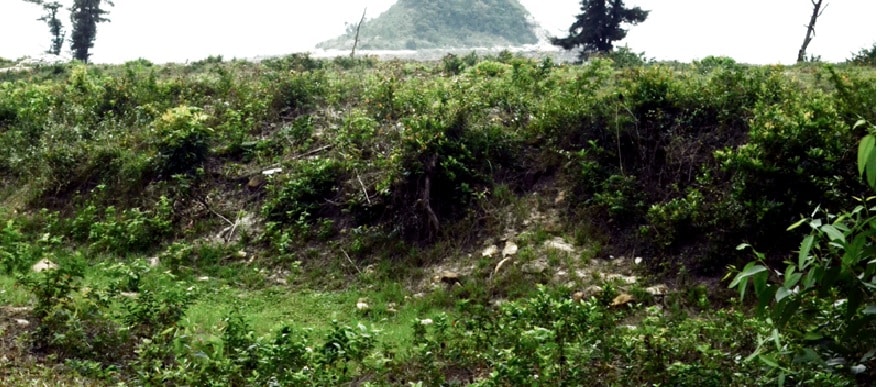
Remnants of the ancient Ngoc Vung Citadel
According to documentation compiled by the Quang Ninh Museum in October 2011, the citadel was originally constructed in the 16th century during the Mac Dynasty, leading locals to refer to it as the “Mac Dynasty Citadel.” During the Nguyen Dynasty, in the 20th year of the Minh Menh reign (1839), the fortress was rebuilt and renamed Bao Tinh Hai Citadel.
Mr. Vu Van Bao, Chairman of the Veterans Association of Ngoc Vung commune, Van Don district, shares: “The ancient citadel once spanned the entire area from the east to the south, covering a total area of approximately 2 hectares. The original Mac Dynasty Citadel was built primarily of stone, reinforced with earth-filled embankments. The stone walls were approximately 0.8 to 1 meter thick. The staircases within the citadel were constructed using stone slabs measuring 40 x 40 cm and about 15 cm thick. The outer enclosure walls were the highest sections, reaching a height of 2 to 2.5 meters, while the inner sections were about 1.5 meters high and 2 meters wide. In 1996, the government allocated the land to local residents, who subsequently renovated the site, altering its original appearance to what you see today.”
Ngoc Vung Citadel is a classic example of outdoor military architecture, featuring a square-shaped layout commonly found in the styles of the Ho, Le, Mac, and Nguyen Dynasties. In 1973, an archaeological team from the Vietnam Institute of Archaeology discovered that the structure was built with earth inside, stone embankments outside, and bonded with lime mortar. While standard wall sections were built with a single layer, the corners were reinforced with double layers, each about half a meter thick. The citadel featured two gates, each 3 meters wide, located in the middle of the walls. The northern gate served as a point for launching troops or intercepting enemies, while the southern gate faced the sea, acting as the primary defensive position against attacks arriving by water.
Ngoc Vung Citadel held a vital position within the maritime border defense system of Northeast Vietnam. It protected the Van Don trading port and controlled the sea routes passing through Ngoc Vung Island or entering the western side of Quan Lan. Despite the passage of time and historical turbulence, only the ruins remain today. Nevertheless, given its recognized value, it stands as a clear testament to the patriotic tradition and the sophisticated maritime defense systems developed by our ancestors throughout the history of nation-building and protection.
Read more: 2-Day 1-Night Ngoc Vung Island Tour