Tra Co Church is a beautiful and historic religious landmark located in Tra Co Ward, Mong Cai City, Quang Ninh Province. With a history spanning over 80 years, the church was built in the Gothic architectural style, featuring numerous pointed arches, towering bell towers, and intricate wood carvings. Together with Tra Co Beach and Sa Vi Cape, Tra Co Church has become an essential destination for travelers visiting the northernmost frontier of the Fatherland.
See more: Travel to Mong Cai – A journey to explore the frontier of the Fatherland
https://www.youtube.com/watch?v=n_zQMhLuVvE
Among the residents who moved to settle on Tra Co Island, there was a small group of Catholic believers. During that time, Catholic activities in Tra Co were quite modest; the faithful primarily gathered in small groups on boats, consisting mainly of family and friends. In the early years, these believers mostly practiced their faith privately, making communal gatherings rare. Back then, a priest would visit only once every three or four years to administer the sacraments. Due to the significant travel difficulties of the era, the expansion of the faith was very limited.
It was not until 1857 that the Tra Co parish was officially established. At that time, Father Cap (the first priest of Tra Co parish) performed a highly significant act for the people of Tra Co: he decided to move the parish seat from Truc Son to Tra Co village and establish the parish there. Subsequently, he encouraged migration to the Dong Nhan (Dong Thinh) area and built a church for the faithful to gather and worship God. At that time, the church was constructed from timber sourced from the village forest and was equipped with two smaller bells and two large drums.
However, in 1860, King Tu Duc issued an edict banning Christianity nationwide, forcing the believers to dismantle the church. In 1862, when the situation had temporarily stabilized, Father Cap moved the site to the Trang Lo (also known as Got) hamlet and built a seven-compartment wooden church to replace the one that had been dismantled.
By 1861, in the northern coastal region, a man named Ta Van Phung, who claimed to be Le Duy Minh and a descendant of the Le dynasty, declared himself a leader, rose up in Quang Ninh, and occupied the Hai Ninh prefecture. In March 1862, Nguyen Van Thinh (also known as Cai Tong Vang) joined forces with Ta Van Phung to oppose the Imperial Court, besieging the Bac Ninh citadel. Many Catholic families, seeking refuge from the conflict, fled to Tra Co Island. Consequently, the number of believers grew steadily, and the need for organized religious life expanded. This necessitated that the priests establish new congregations to ensure that worshiping God could be conducted with more solemnity and order. It was within this historical context that the Tra Co parish gradually took shape.
Initially, Father Cap divided the Tra Co parish into five congregations: Tra Co, Luong, Truc Son, La Phu, and Xuan Ninh. Later, the parish expanded as two more congregations, Tien Yen and Ha Lai, requested to join, bringing the total to seven. Despite the challenging and remote terrain, all seven congregations gathered at the parish to celebrate major holidays such as Easter and Christmas, praising God together.
By 1880, the church had fallen into a state of severe disrepair. Furthermore, as the number of parishioners continued to rise, the expansion of the faith and the construction of a larger church became an urgent need for the parish. Consequently, the Father organized an appeal for the congregation to contribute labor and resources to build a new church. Materials were purchased from La Phu; the exterior was built with earthen bricks, and the pillars were made from village forest timber, with interior wood carvings added to make the place of worship more solemn and reverent. After its completion, this main church was placed under the care of the Xuan Ninh congregation until the migration period in 1954.
In 1910, Father Trang Nghiem (known in the West as Paro CP), a member of the Dominican Order, arrived in Tra Co. Upon his arrival, he envisioned building a new, spacious church in the Western architectural style. To realize this goal, he spent three years in preparation. On one hand, he had to manage diplomacy with local authorities to purchase ironwood from the Mieu forest (Cuong Tien Yen mountain) and transport it via rafts. This work was not simple, but thanks to the determination of the faithful, the transport was successful. On the other hand, he appealed to the entire parish to contribute labor and resources for this monumental project.
In 1913, Father Trang Nghiem began construction on the new church (the main building that remains to this day). In August of that year, the new church was erected to the cheers and witness of the entire Tra Co community. The new church was grand, featuring 9 compartments, a length of 130 feet (52 meters), a width of 30 feet (12 meters), and a height of 30 feet (12 meters). It was roofed with Chinese-style tiles, and the walls were built from limestone.
In 1914, following the completion of the new church, Father Trang Nghiem added one more compartment, bringing the total to ten. According to stories from the elders, the people of Tra Co had to collect shells and clams; they were then crushed and mixed with lime to build the church walls. Afterward, the Father commissioned a worship altar with four gold-plated vermilion columns, donated to the Church by Mr. Trum Ba Sinh (Nguyen Khac Kieu).
In 1916, Father Trang Nghiem was transferred. During his six years of service, he had devoted immense effort to fulfilling the mission of a shepherd entrusted to him by God. That same year, Father Gracia Trang Thien was assigned to lead the Tra Co parish, continuing to manage and guide the congregation.
In 1918, Father Gracia began the construction of a bell tower in the Western (German) style. The tower stood 90 feet (36 meters) tall from the foundation to the top of the Cross; this massive undertaking took two years to complete.
Between 1924 and 1926, under the leadership of three priests—Gracia Thien CP, Fernandez Xuyen, and Daminh Le Dinh Kiem—the church underwent renovations, including the construction of two side porches, a new altar, a gold-plated vermilion main altar, and a small palanquin purchased from Kim Bich parish (Hai Duong).
In 1928, Father Gioan Tuyen arrived to lead Tra Co parish. He established many organizations, including a brass band and a religious vow society (which persists to this day and was taken to the South). Afterward, he hired workers to transport bricks from the “Bird’s Nest” mountain to renovate the church in the upper area.
In 1930, Father Franco Du OP arrived to take charge. By this time, the church had begun to deteriorate. He decided to renovate the main sanctuary. First, he had the exterior walls of the side porches replastered and had the entire floor tiled with ceramic tiles. In the sanctuary, he replaced the multicolored glass in the windows and expanded the sanctuary area. He also repaired the altar, paved the stone processional path around the church, and covered the sandy courtyard with white gravel, which was transported by the parishioners’ merchant boats. During this renovation, many benefactors and generous individuals contributed resources to ensure the project’s success.
From 1931 to 1954, subsequent priests did not undertake major construction projects, but they dedicated their efforts and zeal to maintaining the sanctuary, keeping it grand and beautiful.
1965 marked the migration milestone from Dong Hiep to Suoi Dia and Ho Nai, which subsequently led to the formation of two parishes: Tra Co I and Tra Co II. 108 years after the parish’s establishment in 1857, Tra Co had been served by 20 generations of parish priests.
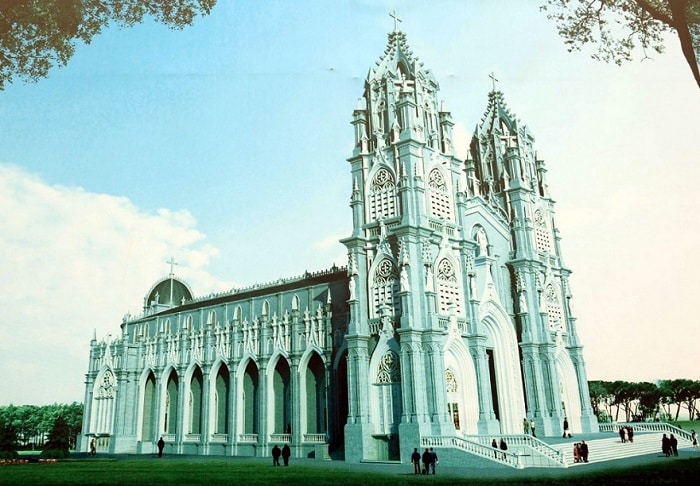
The church was severely damaged during the 1979 Sino-Vietnamese border war when Chinese troops invaded Vietnam. However, it was restored by the parish community in 1995, recovering its original beauty. The church covers an area of over 12,000 square meters, faces South, and is built in the Gothic architectural style with numerous pointed arches reaching toward the sky. The façade features a towering bell tower, a pointed roof, and arched windows. The bell tower houses a bronze bell that is over 80 years old. Inside, the church contains exquisite wood carvings that reflect local cultural nuances. On the two side walls are 14 Stations of the Cross, depicting the life of Jesus Christ. The church also retains an 80-year-old bronze bell.
Over time, the church deteriorated due to age and the harsh climate of the Eastern region. Consequently, the current parish priest, Father Giuse Ngo Van Vang, and the local community agreed to build a new sanctuary. In 2017, the Provincial People’s Committee approved the reconstruction of the church according to the parishioners’ wishes. It was completed on April 12, 2023, after nearly six years of effort. The new church was built on the foundation of the old sanctuary in the shape of a cross, with a length of 68m, a sanctuary width of 16m, side corridors of 2m each, cross-wing widths of 24m, and a bell tower height of 46.5m. The total interior area is 800 square meters, capable of accommodating 1,000 people for Mass.