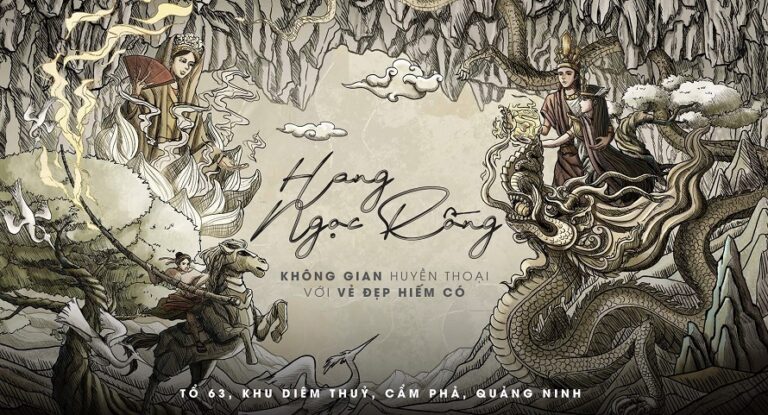
Ancient tales of the Dragon Cave pagoda,
The mountain resembles a crouching unicorn,
Where the King ascended to the blooming lotus throne,
Radiating the sacred aura of Bach Yen Van.
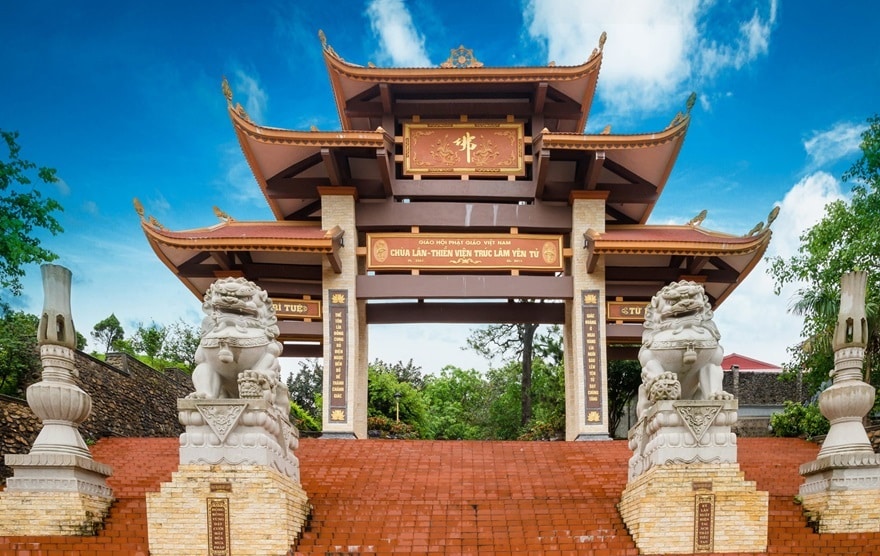
Perched upon a hill shaped like a resting unicorn, Lan Pagoda—formerly known as Truc Lam Zen Monastery—was once one of the most significant sites within the system of pagodas and towers of the Truc Lam Yen Tu Zen sect. The prestige and grandeur of Lan Pagoda have been immortalized in local folklore through the saying: “The gate of Lan Pagoda, the courtyard of Muong Pagoda, the fields of Quynh Pagoda,” referring to its grand entrance, expansive courtyard, and vast surrounding farmlands.
Read more: Top 9 Most Sacred Pagodas in Quang Ninh
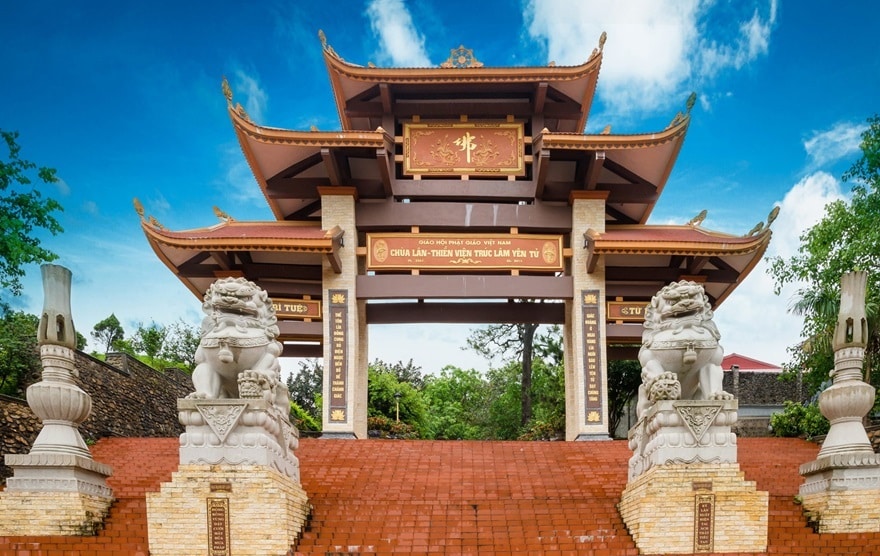
Truc Lam Yen Tu Zen Monastery
An Introduction to the History of Truc Lam Zen Monastery
Lan Pagoda is the traditional name for what is now known as Truc Lam Yen Tu Zen Monastery, historically referred to as Long Dong Tu (Dragon Cave Pagoda). It is located in Nam Mau Village, Thuong Yen Cong Commune, Uong Bi City. These three names share the following origins:
First, “Long Dong Tu,” or “Dragon Cave Pagoda,” originated when King Tran Nhan Tong, on his journey to Yen Tu Mountain, paused to rest and dreamt that he was riding a dragon into a cave. Inside, he discovered a crystal-clear lake filled with golden lotus flowers emitting a mesmerizing fragrance. The dragon guided him around the lotus ponds, where the flowers emanated an aura accompanied by melodic music echoing from every petal. As he was placed upon a lotus throne, the King awoke. He was greeted by a lingering scent, echoes of music still in his ears, and a sudden appearance of numerous earth dragons. Thus, the site was deemed a dwelling place for dragons, leading to the establishment of Long Dong Tu.
Sunlight illuminates the Dragon Cave,
The Tiger Slope remains abundant.
Second, it was called “Ky Lan Zen Monastery” (Unicorn Zen Monastery) because locals grew accustomed to calling the site Ky Lan Pagoda—or Lan Pagoda for short—due to its location on the Yen Tu mountain range, which, from a distance, resembles a crouching unicorn. Finally, it is known as “Truc Lam Yen Tu Zen Monastery,” representing the Vietnamese Zen sect founded by King Tran Nhan Tong.
Lan Pagoda was commissioned by Truc Lam Dieu Ngu (King Tran Nhan Tong) shortly after he took monastic vows in 1293. It evolved into the Ky Lan Institute, serving as a hub for Buddhist teachings and the cultivation of monks within the Yen Tu pagoda system. Lan Pagoda held a position of prestige, second only to Hoa Yen Pagoda, and hosted many high-ranking monks, with King Tran Nhan Tong himself residing and lecturing there.
The “Tam To Thuc Luc”—a historical record documenting the journeys of the three Truc Lam patriarchs—contains detailed accounts of King Tran Nhan Tong’s lectures at the Ky Lan Institute on the 9th day of the first lunar month in 1306. He preached and directly addressed inquiries from his disciples. In Buddhist literature, only two of his lectures have been recorded: the first at Liem Pagoda in Hai Duong, and the second here at Ky Lan Pagoda, a site frequently visited by the Second Patriarch Phap Loa and the Third Patriarch Huyen Quang for sermons and scriptural studies.
The Architecture of Truc Lam Yen Tu Zen Monastery
Following the Tran Dynasty, Lan Pagoda remained a renowned center of worship, continuously guided by successive Zen masters. During the Le Dynasty, Zen Master Chan Nguyen, a pivotal figure in the revival of Buddhism, compiled sacred texts such as “Thien Tong Ban Hanh,” “Kien Tanh Thanh Phat,” and “Tue Nguyen In Truc Lam Tam To Tue Trung Thuong Si Ngu Luc” within the main sanctum of Ky Lan. During the resistance war against the French, the pagoda was almost entirely destroyed by fire. All that remained were the tomb tower complexes—roughly 23 structures—including three ancient towers. Among the most notable are the Viên Minh and Viên Quang main hall towers, and the revered Tịnh Quang Golden Tower, constructed in 1726 by royal decree from the Le Dynasty. Located behind the Patriarch’s house lies the reliquary of Zen Master Tue Dang, the teacher Chan Nguyen—a master of enlightenment bestowed with the title “Tang Thong Chinh Giac Hoa Thuong” by the Le imperial court. Additionally, to the left of the Tinh Quang Tower stands a 700-year-old banyan tree. With its sprawling canopy and massive roots, it would take dozens of people to encompass its base. A cluster of its roots has enveloped a persimmon tree, leading visitors to marvel at the sight of persimmon branches seemingly growing directly from the banyan’s trunk. Alongside the ancient towers and preserved artifacts, this venerable banyan tree stands as a living witness to history and a rare natural treasure.
In an effort to honor the ancestral lineage and preserve the legacy of the Truc Lam Zen sect, the foundation stone for the reconstruction of Lan Pagoda—now the Truc Lam Yen Tu Zen Monastery—was laid with solemn ceremony on January 19, 2002. The project was initiated by the Most Venerable Thich Thanh Tu, Abbot of the Truc Lam Zen Monastery in Da Lat, and realized through the contributions of monks, nuns, and Buddhists from across the country and abroad.
On the birthday of King-Monk Tran Nhan Tong, November 11, 2002, the Lan Pagoda – Truc Lam Yen Tu Zen Monastery was officially inaugurated, spanning an area of nearly five hectares. Built with modern materials while meticulously preserving the traditional essence of Vietnamese temple architecture, the monastery features key structures such as the Main Sanctuary, the Patriarch’s House, the Drum Tower, the Bell Tower, monks’ quarters, a meditation hall, the Trang Phap Hall, and the Arhat Hall. The layout is expansive and minimalist, featuring Vietnamese script on the horizontal lacquered boards and parallel scrolls.
“Buddhism illuminates the path to liberation from the cycle of rebirth
Zen offers a direct route, transcending ranks to reach true Suchness”
Today, Lan Pagoda houses several unique and precious artifacts. The main sanctuary contains a bronze Shakyamuni Buddha statue weighing nearly 4 tons, currently the largest bronze statue in Yen Tu. Another remarkable piece is the Bodhidharma statue crafted from fragrant rosewood imported from South America. Standing 3.2 meters tall (with a 0.65-meter-high pedestal and a width of 0.95 meters), this 3.2-ton masterpiece features exquisite carvings. It is placed behind the main sanctuary, in front of the Hall of the Three Truc Lam Patriarchs, donated by devout Buddhists. In the courtyard of the monastery sits a red granite “Nhu Y” (Wish-Fulfilling) sphere, measuring 1.595 meters in diameter and weighing 6.5 tons, sourced from the An Nhon quarry in Quy Nhon. The sphere rests on a 4-ton square stone pedestal, surrounded by an octagonal water basin featuring eight petal-shaped tanks, symbolizing the Eightfold Path. The sphere is officially recognized by the Vietnam Guinness Book of Records as the largest of its kind in Vietnam.
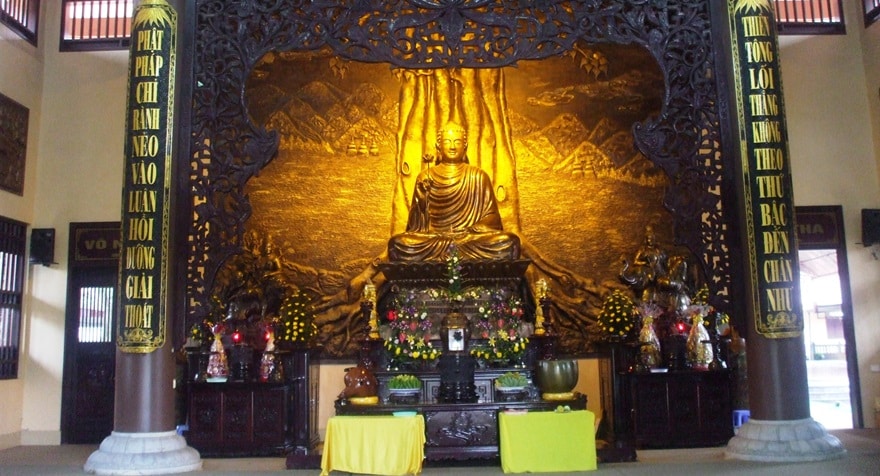
4-ton bronze Shakyamuni Buddha statue at Lan Pagoda
The Arhat Hall houses a set of 18 wooden Arhat statues, intricately carved with diverse expressions and postures. This wooden collection evokes the spirit of Tay Phuong Pagoda and the famous poem by Huy Can: “The Arhats of Tay Phuong Pagoda, today the world has moved forward, I gaze at the statues and they seem to brighten again, chasing away the twilight shadows, dissipating the mist.”
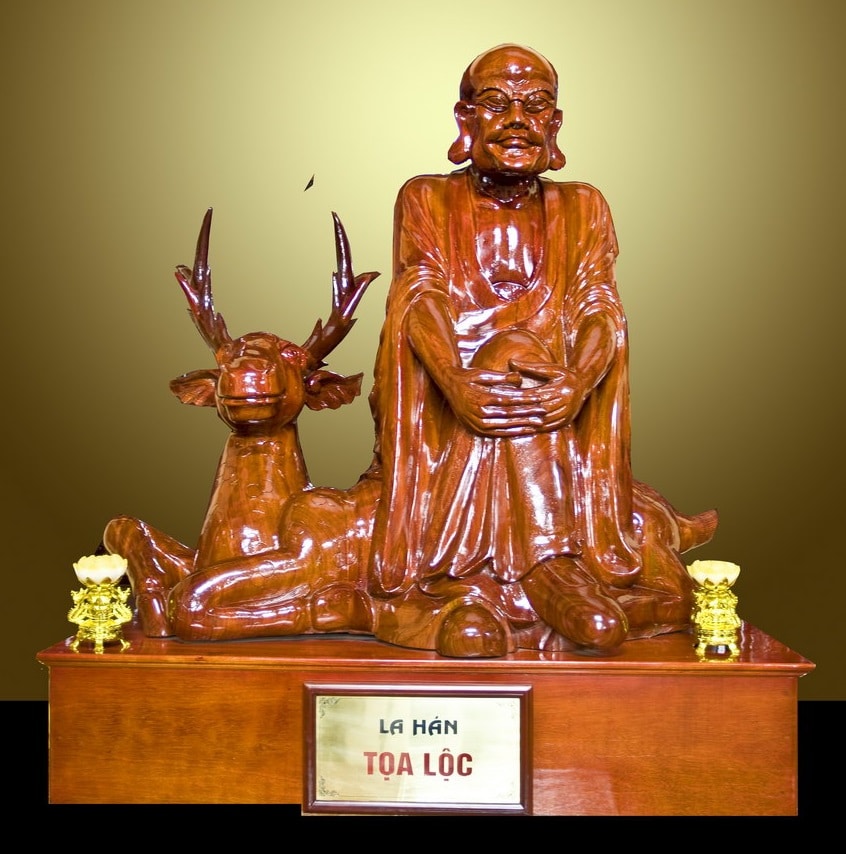
Arhat Statues
Notably, the monastery includes the vast and airy Trang Phap Hall. Spanning 4,000 m2 across two floors, it was inaugurated in 2012. In front of the Trang Phap Hall stands a 14-meter-tall granite statue of Guan Yin (Quan The Am), the largest granite Bodhisattva statue in Vietnam. Before the statue lies the “Lake of Serenity” (Ho Tinh Tam), set within a spacious, verdant landscape. Upon visiting the monastery, gazing out over this serene landscape—especially the lake—offers a profound sense of tranquility and inner peace.
See more: 1-Day Yen Tu Tour