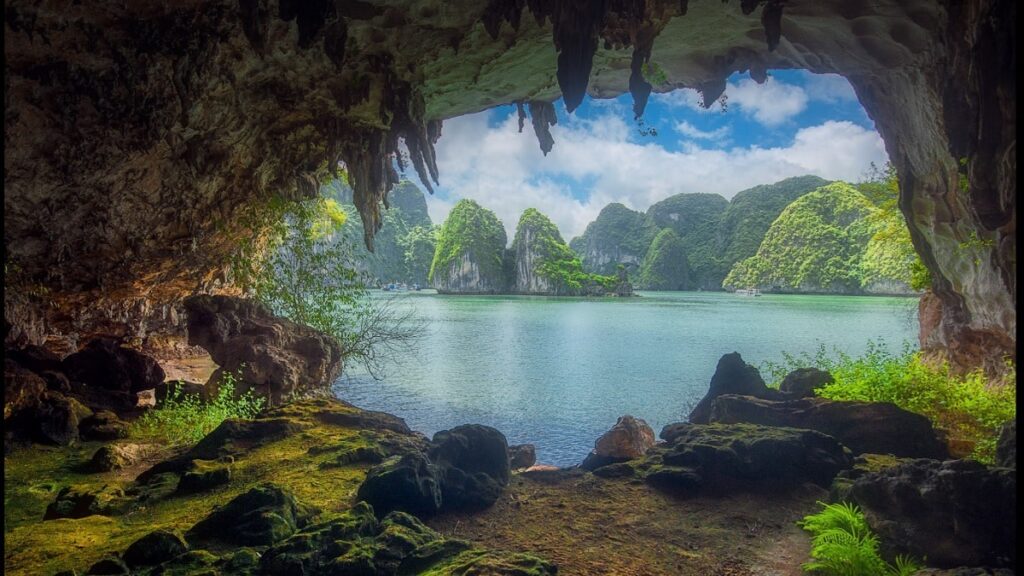
Halong Bay is one of the world’s most magnificent natural wonders, renowned for its thousands of majestic limestone islands and breathtaking caves. Among them, Bo Nau Cave (Pelican Cave) stands as an iconic, highly celebrated landmark dating back to the early 20th century. Preserving its pristine and untouched allure, this extraordinary cavern allows modern travelers to deeply resonate with the profound sense of wonder captured by a legendary photographer in 1958, who immortalized its timeless elegance and the mesmerizing majesty of Halong Bay.
Read More: Discover Halong Bay’s Most Splendid Caves and Their Geological Heritage
Geographical Location of Bo Nau Cave
Bo Nau Cave is situated in the southeast of Hon Trong Mai (Fighting Cocks Islet)—a world-famous symbol of Halong Bay featuring two towering limestone roosters facing one another. Located within the itinerary of Route 2 for Halong Bay sightseeing cruises, it lies approximately 13 kilometers from Tuan Chau International Passenger Port, translating to a serene 90-minute voyage by boat. While Route 2 is exceptionally popular for day-boat excursions, most standard vessels bypass this hidden sanctuary, much like Dong Tien Lake. Consequently, visiting Bo Nau Cave typically requires chartering a private vessel or booking an exclusive overnight luxury cruise that offers customized itineraries.
Read More: Halong Bay Cruise Ticket Prices and Private Boat Charter Guide
Bo Nau Cave is celebrated as one of the most distinguished caverns in Halong Bay, boasting a rich history and exceptional scientific significance. According to veteran local fishermen, the cave historically served as a winter sanctuary for migratory pelicans flying in from the cold northern regions—hence its original local moniker, “Hang Bo Nong” (Pelican Cave), which later evolved phonetically into “Bo Nau.” This poetic name also mirrors the rich, reddish-brown hues of the ancient stalactites lining the interior, reminiscent of a pelican’s plumage. Spanning an expansive area of roughly 1,000 square meters divided into two grand chambers (vastly eclipsing the 300-square-meter expanse of Trong Cave), Bo Nau remains refreshingly untamed and untouched by heavy commercialization. It promises discerning travelers an unforgettable immersion into unspoiled nature, historical lore, and geological splendor.
History and Significance of Bo Nau Cave
Bo Nau Cave holds a revered place in Halong Bay’s heritage, recognized for its venerable history and high scientific value. Historical archives reveal that Bo Nau was among the earliest discovered and most deeply admired grottoes on the bay. In 1958, an iconic photograph captured by Nguyen Duy Kien framed the magnificent entrance of Bo Nau Cave, draped with cascading stalactites, with undulating mountain ranges fading into the misty sea horizon and the striking silhouette of a crimson sail. This masterpiece became an enduring, quintessential symbol of Halong Bay for generations to come.
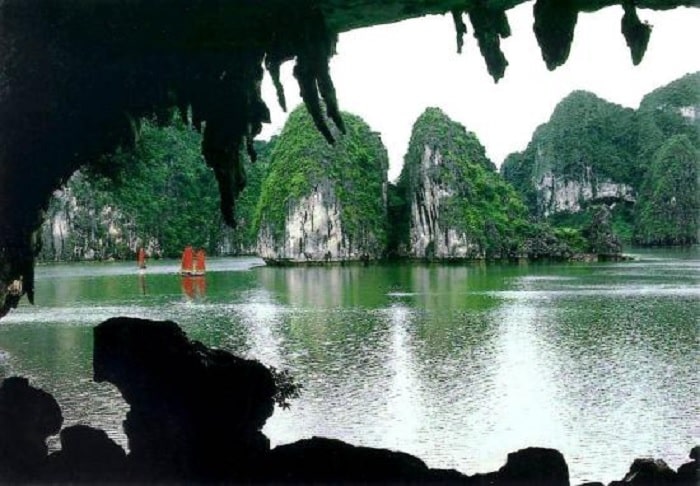
Photographer Nguyen Duy Kien capturing the view from inside Bo Nau Cave in 1958
Furthermore, Bo Nau is a quintessential karst cave of immense scientific importance. Its interior formations evoke legendary tales of ancient mythological battles, notably those of Saint Giong—a mythical national hero. Right near the entrance, striking stalactites resemble a divine warhorse and a long celestial sword. Ancient folklore recounts that after vanquishing the northern invaders, Saint Giong assisted the local populace in driving away lingering demons before ascending to the heavens, leaving behind his sacred sword and noble steed to watch over and protect the villagers.

Stalactites shaped like a warhorse and a long sword inside the cave
Beyond its historical gravitas, Bo Nau Cave is a profound source of artistic and cultural inspiration, captivating generations of landscape photographers. Echoing the grandeur of magnificent subterranean architectures like Sung Sot (Surprise) Cave—whose 30-meter-high vaulted ceiling features delicate, velvet-like depressions resembling a grand opera house—Bo Nau exudes a similarly majestic ambiance. Towering rock formations rise majestically from the cave floor toward the upper arches near the entrance. Three mystical stone pillars grace the mouth of the cave, arrestingly shaped like three celestial immortals gathered in a timeless chess match—two intensely focused on the game while the third acts as a poised referee. This enchanting tableau envelops visitors in an ethereal realm of mythological wonder.
Beauty and Scenery of Bo Nau Cave
As one of the most aesthetically stunning and venerable caverns on the bay, Bo Nau encapsulates deep historical and geological treasures. Nestled southeast of Hon Trong Mai, where twin limestone monoliths resemble a pair of embracing roosters, Bo Nau features a distinctive frog-mouth-shaped entrance spanning approximately 200 square meters. Inside, the cavern opens into a broad, level floor bordered by walls adorned with delicate drapes of glistening stalactites.
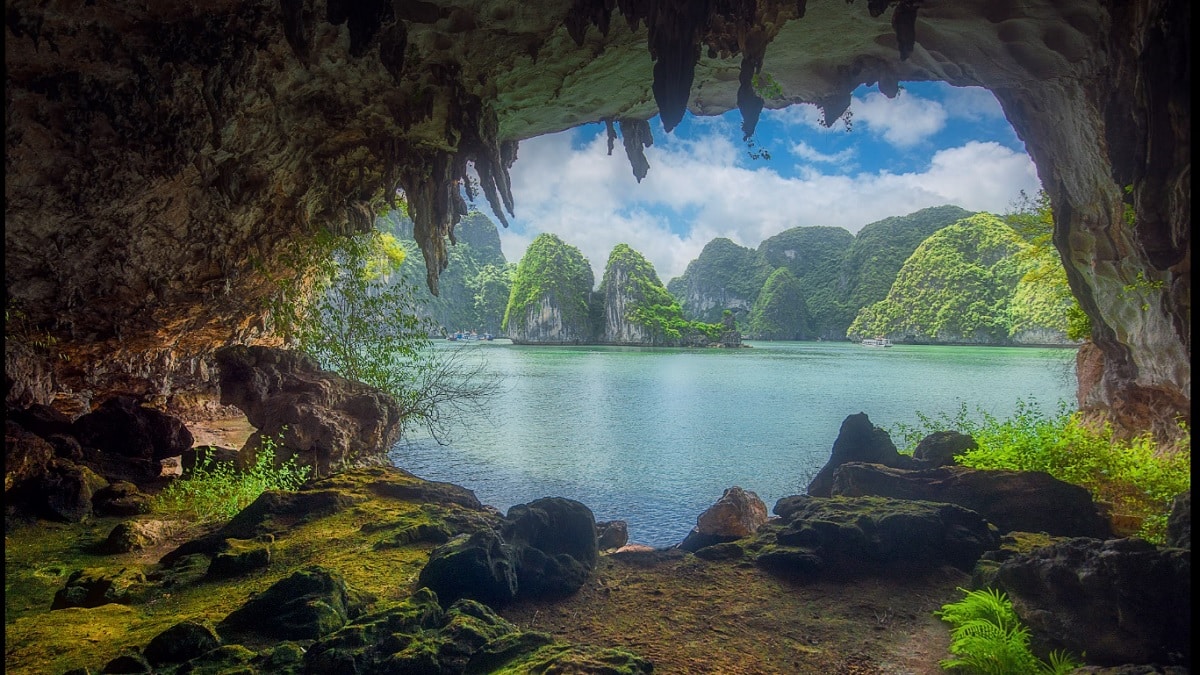
The Entrance of Bo Nau Cave
The threshold of the cave is framed by a secluded sandy cove accessible exclusively via luxury kayaks or traditional bamboo rowboats, as large motor vessels cannot navigate the shallow entrance. The arched opening resembles an upturned giant seashell, framing an intimate interior reminiscent of a grand acoustic theater. Natural cracks perforate the domed ceiling, allowing gentle beams of sunlight to filter softly into the grotto. As the cave floor narrows inward and a protective limestone islet shields the front, the interior lighting remains delightfully diffused and gentle. Crowning the upper entrance are the three iconic stone figures of the celestial sages deep in their eternal chess match.
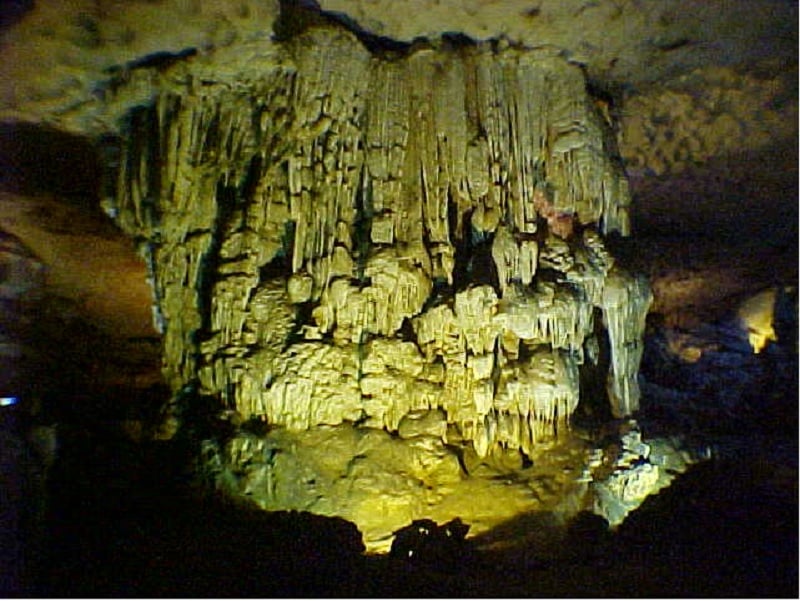
A colossal stone pillar seemingly holding up the entire cavern
Stepping deeper into the interior, guests are immediately greeted by a breathtaking, monumental stone column stretching seamlessly from the vaulted ceiling down to the bedrock—giving the sublime impression that this singular pillar has single-handedly supported and preserved the entire cavern through the millennia. Situated right beside the passageway are the aforementioned stalactite formations depicting the mythical warhorse and sacred sword of Saint Giong, anchoring the landscape in epic folklore.
Fascinating Insights You May Not Know About Bo Nau Cave
- Bo Nau Cave was originally named “Hang Bo Nong” (Pelican Cave) because it once served as a warm winter haven for migratory pelicans journeying from the north. Over time, local pronunciation softened the name to “Bo Nau.”
- Bo Nau is officially documented as one of the earliest discovered caves in Halong Bay, gaining widespread acclaim during the French colonial era in the early 20th century for its peerless scenery.
- Spanning an expansive 1,000 square meters across two distinct chambers, the cave remains remarkably pristine, preserved in its wild, unadulterated state without heavy commercial interventions.
- Although located along Halong Bay’s Route 2—which accounts for 50% of overall bay visitors—Bo Nau remains wonderfully exclusive, visited by only a select handful of discerning travelers seeking off-the-beaten-path tranquility.
We hope this comprehensive guide provides inspiring insights into Bo Nau Cave. Should you wish to charter a private luxury vessel to explore this magnificent landmark, please do not hesitate to contact us for bespoke travel arrangements.