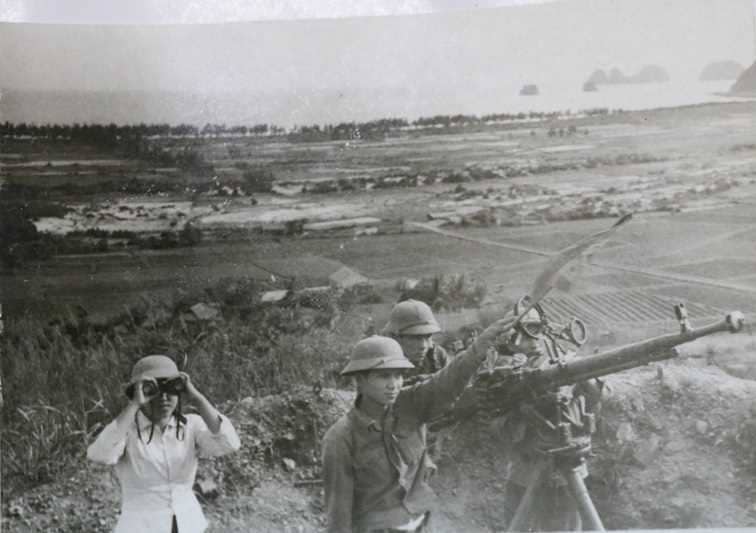
Ngoc Vung Island is not only a stunning travel destination but also a vital historical landmark from Vietnam’s resistance war against the United States. This island served as a strategic frontier protecting the northern maritime borders of the nation. It was here that local forces successfully downed numerous American aircraft, dismantling the enemy’s aerial escalation strategy, safeguarding the North, and supporting the liberation and reunification of the South. On Ngoc Vung Island, there remains a 12.7mm artillery position commanded by platoon leader Nguyen Danh Suu. This very site shot down the 200th American aircraft over Quang Ninh province on December 24, 1972, marking a significant victory for the Vietnamese military and people.
Historical records indicate that the Ngoc Vung Militia Company was established in 1964. This was a specialized military unit formed during the height of the resistance against the United States. The company consisted of 45 members, comprising one combat-ready platoon, one infantry platoon, and a medical and communications team. The combat platoon was tasked with defending key high-altitude hills, disrupting enemy navigation, and downing American aircraft attacking targets in Quang Ninh and Hai Phong. The infantry platoon participated in raids and sabotage missions to neutralize enemy forces, while the medical and communications squad maintained vital links with other units, provided intelligence, and offered medical care to injured soldiers.
To counter U.S. aerial attacks, the combat-ready platoon was stationed on Diem Canh, Ong Cu, Tung Mieu, and Can Dao hills. These hills were named by the Military Command based on their elevation; for instance, Diem Canh Hill stands at 103.2 meters, Ong Cu Hill at 206.5 meters, Tung Mieu Hill at 104.2 meters, and Can Dao Hill at 48.5 meters. Notably, the Diem Canh Hill position was equipped with three 12.7mm anti-aircraft guns provided by the main army forces—powerful weapons capable of downing advanced U.S. aircraft such as the F-4, F-105, and B-52—while Can Dao Hill was fortified with heavy machine guns.
These hills offered commanding views, allowing soldiers to spot enemy aircraft from afar and engage them at low altitudes. To evade detection, the positions were expertly camouflaged with bamboo, branches, and netting. Soldiers worked under grueling conditions, facing severe shortages of supplies and manpower while enduring constant bombardment. Reports from that era confirm that the Ngoc Vung area was one of the most intensely bombed regions; the tonnage of ordnance dropped here accounted for two-thirds of all bombs dropped on the entire Van Don district. Nevertheless, through ingenuity, determination, and resilience, the soldiers successfully built and protected these positions, contributing to the ultimate victory of our people.
Throughout the resistance, the unit shot down 23 American aircraft, including the aforementioned 200th plane over Quang Ninh on December 24, 1972. This heroic achievement was recognized and honored nationwide. It shook the enemy, bolstered the morale of the Vietnamese people, and played a pivotal role in the victory of the resistance war. December 24, 1972, also marked the end of the U.S. air wars of destruction over Quang Ninh.
Today, the Diem Canh hill (Hill 103.2) remains a site of immense historical significance, forever etched in the annals of history and serving as a point of pride for the people of Ngoc Vung and the entire Quang Ninh province. During the resistance against U.S. imperialist aggression, under the leadership of the Party, Ngoc Vung acted not only as a northern maritime fortress but also as a “steel shield” that downed many enemy planes, crushing U.S. aerial escalation to protect the socialist North and providing a solid rear base for the South to defeat the invaders and achieve national reunification.
In recognition of these heroic feats, the people and military of Ngoc Vung were honored by the Party and State with numerous prestigious medals and orders. Most notably, on December 31, 1973, the Ngoc Vung forces were awarded the title of “Hero of the People’s Armed Forces” and the “First-Class Military Exploit Order.” Furthermore, they were repeatedly honored on the “Determined to Win” flag bestowed by President Ho Chi Minh to the Northeast armed forces, among many other awards. On November 14, 2002, the 12.7mm artillery site on Ngoc Vung Island was officially recognized by the Quang Ninh Provincial People’s Committee as a provincial-level historical site. These are enduring symbols of the indomitable fighting spirit and supreme sacrifice of the Vietnamese people.
If you wish to visit the 12.7mm artillery site on Ngoc Vung Island, you can choose one of the following three routes:
- Option 1: Take a high-speed boat from Ha Long Pier (Ha Long City) across Ha Long Bay, which takes about 45 minutes to reach Cong Yen Port. From there, travel by motorcycle or car past the Ngoc Vung Border Guard Station, then continue along a paved road for about 5km to the junction leading to the military unit. Turn left and climb over Hill 94.5 (the Tung Ly range), where the Ngoc Vung Island Command’s combat position is located, then continue for another 3km to reach the 12.7mm artillery site.
- Option 2: Take a boat from Vung Duc Pier (Cam Pha) for about 30km to reach Cong Yen Port. Then, follow the same directions as in Option 1 to reach the artillery site.
- Option 3: Take a boat from Cai Rong Port, the center of Van Don district, for about 47km to reach Cong Yen Port. Then, follow the same directions as in Option 1 to reach the artillery site.
See more: 2-Day 1-Night Ngoc Vung Island Sightseeing Tour