Perched at an altitude of 535 meters above sea level, Hoa Yen Pagoda is the largest temple within the Yen Tu Pagoda complex, which is why it is often referred to as the “Main Pagoda”. Originally established during the Ly dynasty under the name Phu Van, over 700 years ago it was merely a humble hermitage where the Buddhist Emperor Tran Nhan Tong chanted scriptures and expounded the Dharma. It was named “Van Yen” (Cloud and Smoke), signifying that the pagoda rests high upon the mountain peak, perpetually veiled in drifting mists and delicate clouds resembling wisps of smoke. When King Le Thanh Tong later visited the site and admired its vibrant floral beauty, he renamed the temple Hoa Yen (“Blooming Serenity”). Capturing the ethereal elegance of this sanctuary, a verse by Huyen Quang reads:
Night chill breathes softly through the bamboo blinds,
Rustling in the courtyard, autumn has arrived.
Forgetting the path, the pomegranate fragrance fades by the door,
Pine branches glisten across a net of woven moonlight.
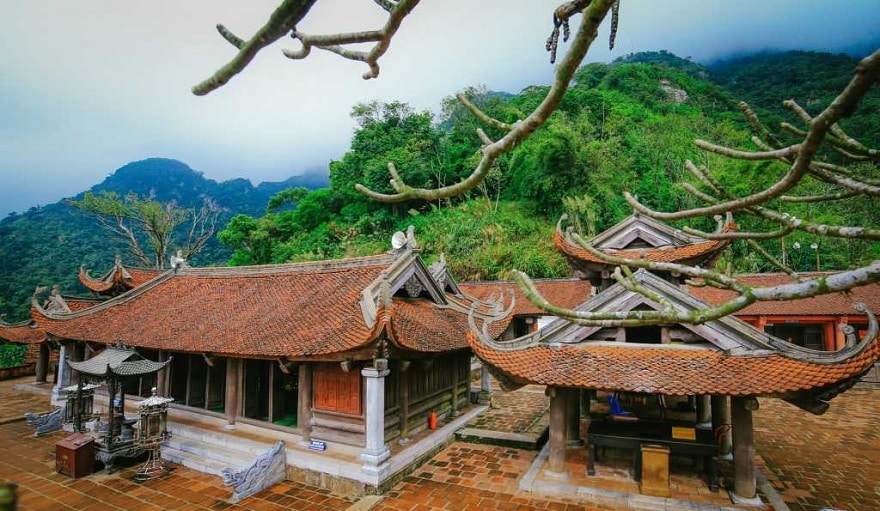
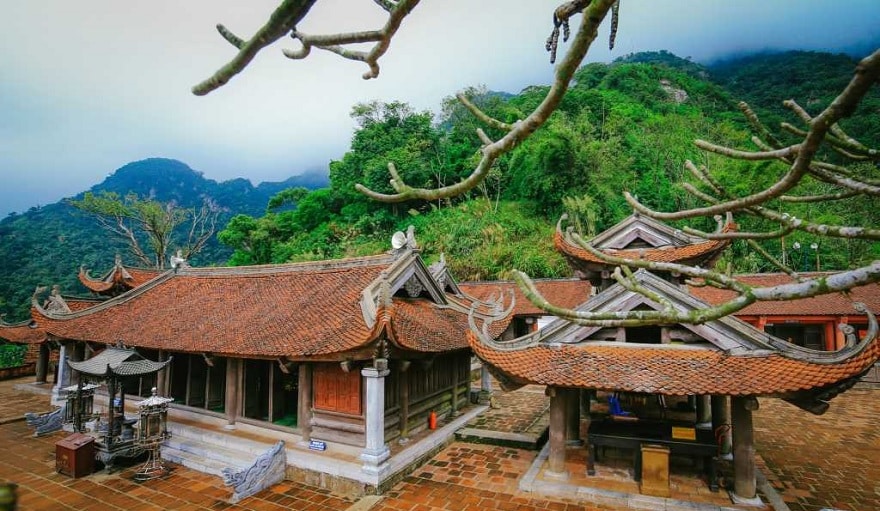
Hoa Yen Pagoda
See more: Top 9 Most Sacred Pagodas in Quang Ninh
Yen Tu emerges veiled in mist against a cloudy sky, resembling a breathtaking traditional ink-wash painting rendered with delicate, graceful, and deeply mystical strokes. It is precisely for this reason that Yen Tu is often likened to a celestial paradise on earth. Visitors arriving at Hoa Yen Pagoda at dawn will immerse themselves in the pristine purity of the mountain forests and flora, truly appreciating the exquisite perception captured in Nguyen Trai’s ode to Yen Tu:
Upon Yen Tu’s highest towering peak,
The sky brightens sharply at the fifth watch.
The universe unfolds before the eyes over the vast sea,
Voices and laughter—amidst the azure clouds. Paws of jade spears frame the doorway,
Beaded pearl curtains drape from the stones.
Nhan Tong’s relics still linger here,
Witnessed within the radiant brilliance.”
Perhaps the very first sights that captivate travelers on their journey to Hoa Yen Pagoda are three majestic, ancient frangipani trees standing with regal grandeur at over 700 years of age. Their gnarled trunks bear testimony to countless mountain storms, standing resilient and steadfast like legendary heroes amidst a battlefield. Before the Buddhist Emperor Tran Nhan Tong ascended Yen Tu to practice asceticism, the pagoda was originally constructed by Ly-dynasty monks with roofs thatched from forest leaves. After his arrival, the Emperor frequently held classes imparting the essential teachings of Zen Buddhism to his disciples Phap Loa, Huyen Quang, Bao Sai, Phap Khong, and others.
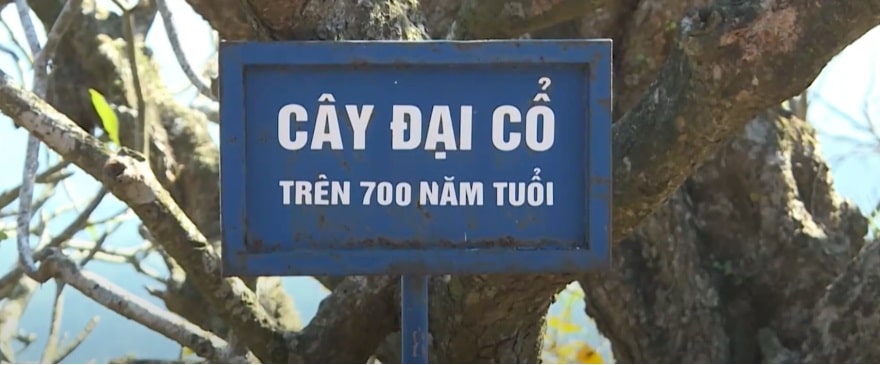
The 700-year-old ancient frangipani tree in front of Hoa Yen Pagoda
By 1317, when Phap Loa received the monastic robe and bowl to become the Second Patriarch, Hoa Yen Pagoda was grandly expanded into a sprawling architectural complex. Beyond the front hall and upper sanctuary dedicated to the Buddha, the complex included a bell tower, a drum tower, guesthouses, lecture halls, and monastic quarters. The present structure was built during the Nguyen dynasty featuring a five-bay layout shaped like the Chinese character for “Dinh” (T-shape). According to ancient geomancy, aligned with the mountain topography, Hoa Yen Pagoda is situated at the dragon’s head; the dragon’s eyes mark the location of the ancestral stupa, while the twin mountain ranges on either side resemble a dragon’s arms embracing the pilgrims’ path.
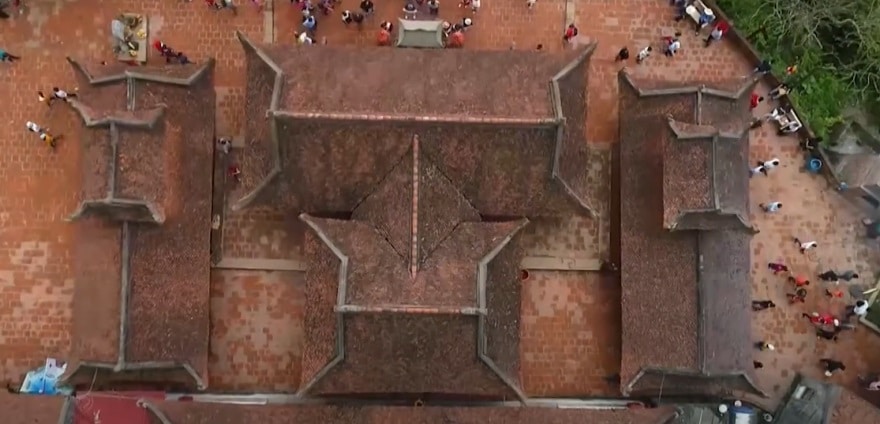
Today’s Hoa Yen Pagoda features an architecture styled after the Chinese character “Nation”
Today, the original bell tower, drum tower, meditation hermitage, monastic quarters, and guesthouse no longer remain. In late 2002, Hoa Yen Pagoda was restored with a layout closely resembling the Chinese character for “Quốc” (Nation), following the architectural principle known as “inner labor, outer nation” (“nội công, ngoại quốc”), meaning the inner structure forms a “Cong” shape enclosed by an outer perimeter akin to the “Quốc” character. Built upon a lotus-petal-shaped terrain embracing the mountain slope, the pagoda comprises two main sections: a front hall and a rear sanctuary spanning approximately 150 m², housing dozens of large bronze statues. The largest is a seated statue of Tran Nhan Tong positioned in the center of the rear sanctuary, meditating upon a lotus throne with an expression entirely untouched by worldly cares. In the left chamber, before the front hall, hangs a massive bronze bell cast in the 14th year of the Minh Mang reign, bearing an inscription composed by Dien Chinh Nguyen Sieu Pham praising Tran Nhan Tong and Yen Tu. An excerpt reads:
“We have heard that the sound of the bell and chimes has the power to awaken slumbering souls, resounding far and wide as the profound voice of the Dharma at the temple gates. Since the day the Buddha Emperor Dieu Ngu Giac Hoang Tran Nhan Tong abdicated the throne to pursue the spiritual path, the flame of Zen has burned brilliantly, remaining the most renowned mountain pagoda in all of Viet Nam…” (Translated from classical Chinese).
In front of the main sanctuary stands a remarkably ancient bronze incense burner. Behind Hoa Yen Pagoda lies the Pho Da Quan Am Bo Tat Pagoda, though it is now reduced to ruins. Just below Hoa Yen Pagoda is the Hue Quang Stupa Garden, where 97 interdependent stupas form a unified complex. At the center of the Quy Duc Mausoleum stands the Hue Quang Stupa, the final resting place of the First Truc Lam Patriarch, Dieu Ngu Giac Hoang Tran Nhan Tong. Inside the An Chi Mausoleum, a statue depicts Tran Nhan Tong in deep meditation draped in a crossed kasaya robe, radiating the serene and transcendent poise of an enlightened Zen master.
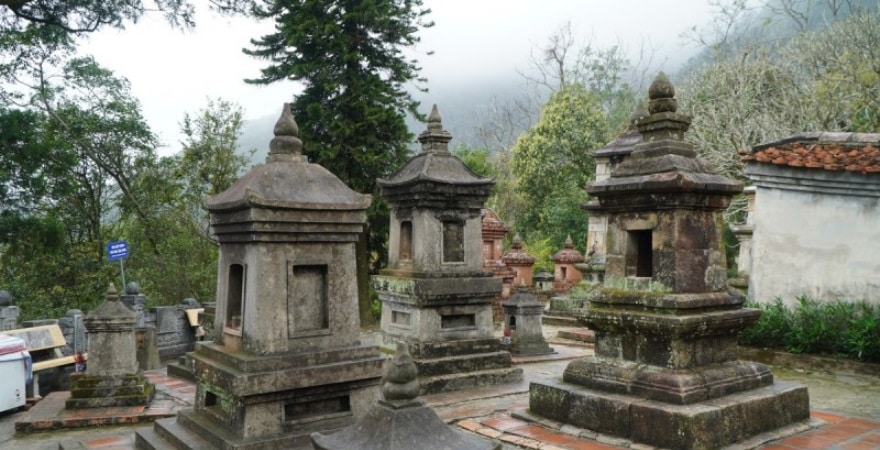
Ancient Stupas alongside Hoa Yen Pagoda
Hoa Yen Pagoda exemplifies the exquisite harmony between architecture and nature, as well as the seamless blend of the spiritual and secular worlds. The pagoda serves as the spiritual heart of the Yen Tu cultural and religious landscape—a sacred destination that every traveler aspires to visit during a pilgrimage to the revered Yen Tu scenic heritage area.