The Geological Formation History of Ha Long Bay
Ha Long Bay boasts a long-standing geological formation history shaped by various paleogeographic environments dating back nearly 570 million years. Between the Ordovician and Silurian periods (500 to 410 million years ago), the region was a deep sea. Later, during the Carboniferous and Permian periods (340 to 250 million years ago), it transitioned into a shallow marine environment. By the late Paleogene and early Neogene periods, spanning 26 to 20 million years ago, the sea transformed into part of an expansive coastal plain. The region was submerged by seawater multiple times during the Quaternary period over the past 2 million years. The present-day Ha Long Bay was shaped approximately 7,000 to 8,000 years ago due to marine transgression during the Holocene sedimentary evolution, which began around 17,000 to 18,000 years ago.

The geological history of Ha Long Bay encompasses three major tectonic periods. The first was the formation of the Caledonide geosyncline at the end of the Silurian period, approximately 410 million years ago. The second was the creation of the Indosinide foundation at the end of the Triassic period, about 200 million years ago. The final Alpine orogeny in the late Paleogene period, roughly 30 million years ago, produced the distinction between horsts and graben depressions, laying the structural foundation for the future Ha Long Bay. Two prominent paleogeographic environments existed in the Ha Long Bay area. The Carboniferous period, from 340 to 285 million years ago, was a globally warm era when giant swamps generated massive coal basins in Europe and America. In Ha Long Bay, carbonate sediments were deposited in shallow seas under hot, arid conditions, gradually forming thick layers of limestone. Over hundreds of millions of years, the sea floor steadily subsided, allowing limestone in the shallow marine zone to accumulate into thick strata reaching a depth of 1,200 meters, which ultimately created the signature karst landscape. Conversely, during the Triassic period 240 to 195 million years ago, while much of the world experienced hot, arid climates, the Ha Long region enjoyed a warm, humid climate. The decaying remains of giant fern forests formed the basis for the area’s coal deposits.
The Origin of the Name “Ha Long Bay”
Ha Long translates to “Descending Dragon”. Prior to the 19th century, the name Ha Long Bay was absent from traditional Vietnamese historical records, and the area was primarily known by names such as Giao Chau, Luc Thuy, An Bang, An Quang, Hai Dong, Hoa Phong, and Nhieu Phong. It was not until the late 19th century that the name Ha Long Bay appeared on French hydrographic maps of the Gulf of Tonkin and in various French and Vietnamese-language newspaper articles. The French-language publication “Hai Phong News” reported: “A dragon has appeared in Ha Long Bay.” The story is summarized as follows: In 1898, Sub-Lieutenant Lagoredin, captain of the vessel Avalanche, along with numerous sailors, encountered a pair of giant sea serpents in Ha Long Bay. Europeans associated these creatures with the mythical Dragons of Asian imagination. Due to the appearance of this extraordinary creature resembling a dragon, the body of water was named Ha Long Bay (according to Quang Ninh Culture and Arts, from a perspective, Quang Ninh, 2002).
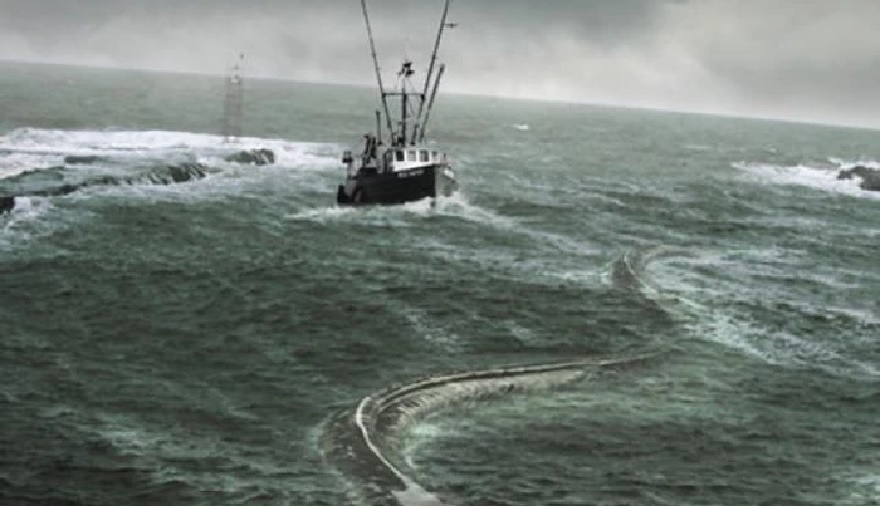
The giant sea serpent sighting recorded by elders and documented by the French colonial Navy.
The Legend of the Descending Dragon
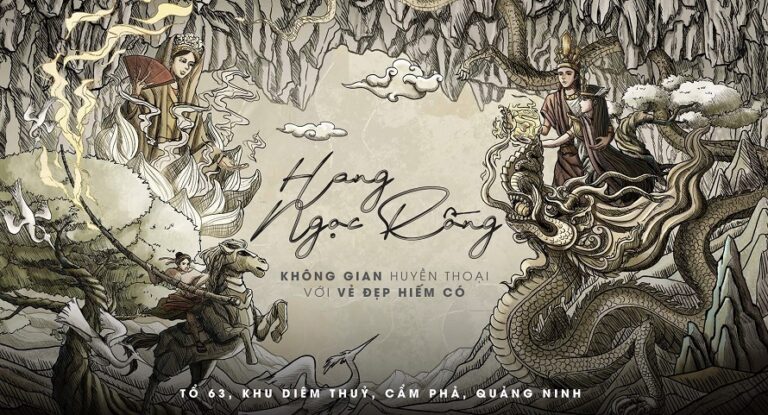
In Vietnamese, Ha Long means descending dragons. This name is tied to a legend handed down from generation to generation. The myth recounts that during the earliest days of national establishment, the Vietnamese people faced foreign invaders arriving by sea. Moved by their plight, the Jade Emperor dispatched Mother Dragon and her brood of Dragon Children to assist the Vietnamese in defeating the enemy. As enemy warships surged from the sea toward the mainland, the dragons descended from the heavens. Instantly, the dragons unleashed torrents of fire to incinerate the enemy vessels and hurled precious jade pearls that formed an immensely solid, towering stone wall between earth and sky, causing enemy ships to crash and shatter completely.

AI-generated simulation photo of a dragon landing in Ha Long
After routing the foreign invaders and helping the Vietnamese secure peace, the dragons paused to admire the local scenery. Finding the land peaceful, lush with greenery, and its people industrious and resilient, Mother Dragon decided to remain alongside her children in the very place where the battle had taken place to eternally protect the descendants of Dai Viet. Today, the spot where Mother Dragon landed is known as Ha Long Bay, while the place where the Dragon Children descended is Bai Tu Long Bay.
The legend of the descending dragon is believed to originate from the Hung Vuong period, when the Vietnamese people deeply believed in the existence of deities and mythical creatures. It also reflects the patriotism and steadfast anti-aggression spirit of the Vietnamese people, as well as divine assistance during times of adversity. Numerous writers, poets, and researchers draw upon it as an inspiration for artistic and scholarly works. Furthermore, it bestows upon Ha Long Bay a unique and meaningful name, cementing its status as an iconic symbol of the culture and history of the Vietnamese nation.
Legends of Ha Long Bay’s Caves
Exploring Ha Long Bay, travelers are treated to the majestic and magnificent beauty of numerous caves. Few realize that behind each of these caves lies a unique Ha Long Bay legend and its own captivating story. Let us delve into the stories behind the famous caves of Ha Long Bay below.
The Legend of Dau Go Cave
Dau Go Cave is one of the largest and most magnificent caverns in Ha Long Bay. According to legend, it received its name because long ago, a local villager was exceptionally skilled at boat-making. One day, an old man handed him a large log and instructed him to carve it into a boat. The old man claimed the log possessed magical properties: if he finished the boat within three days, he could keep it; otherwise, he must return it to the old man. The craftsman accepted the challenge and set to work. However, despite his utmost efforts, the log continuously warped and shrank, making it impossible for him to complete the boat. On the third day, the old man returned to retrieve the log, stating that it belonged to the Dragon God and only a deity could shape it. The old man took the log away and left it in Dau Go Cave, which has borne its name ever since.
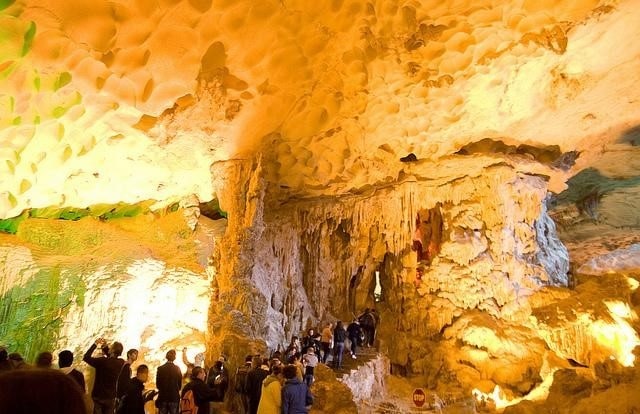
This legend is believed to stem from the awe-inspiring wonders of nature that surpass human comprehension. It also reflects the creativity and rich imagination of the Vietnamese people. This enchanting tale continues to attract widespread interest from visitors exploring Dau Go Cave.
Read more: Dau Go Cave – The Grotto of Wonders
Virgin Cave (Hang Trinh Nu) and Drum Cave (Hang Trong)
Virgin Cave and Drum Cave are situated on the Bo Hon island chain, alongside the Sung Sot Cave system, Dong Tien Lake, Luon Cave, and others. These two caves are associated with a beautiful yet deeply tragic love story that sparks the curiosity of countless travelers who come to explore them.
According to legend, in days gone by, there lived a remarkably beautiful fisherman’s daughter. She fell in love with a young man from a wealthy family in Van Don. However, the young man’s family opposed their marriage due to differences in social status, forcing him to marry another woman instead. On his wedding day, the groom fled to find the woman he truly loved. The couple boarded a small boat and escaped out to sea. Unfortunately, they were pursued by his family and pirates. Amidst the panic, the young woman prayed to the Dragon God for help. The Dragon God transformed her into a petrified human-shaped stone resting inside a cave. Upon discovering this, the heartbroken young man took his own life by leaping into the sea. The Dragon God likewise transformed him into a human-shaped stone standing within the opposite cave. Ever since, the two caves have been known as Virgin Cave and Drum Cave.
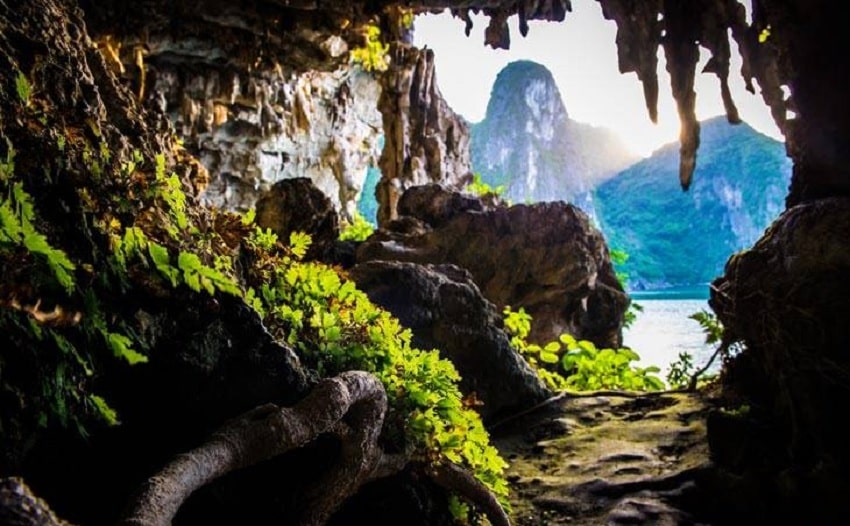
The legends of Ha Long Bay are not merely delightful folklore; they are enduring testaments to the creativity and boundless imagination of the Vietnamese people. These myths lend a distinct character to Ha Long Bay, establishing it as an unmissable destination when visiting Vietnam. When exploring Ha Long Bay, travelers not only admire breathtaking natural scenery but also listen to captivating and meaningful tales reflecting the history, culture, and spirituality of the Vietnamese nation.