Cua Van Floating Village is one of the most captivating destinations when exploring Halong Bay. It offers not only majestic natural landscapes but also the rich and distinct culture and history of the seafaring community. Visiting Cua Van Floating Village, travelers will enjoy fascinating and meaningful experiences that connect them deeply with nature and the local people.
Read more: Fishing Villages on Halong Bay
Introduction to Cua Van Floating Village
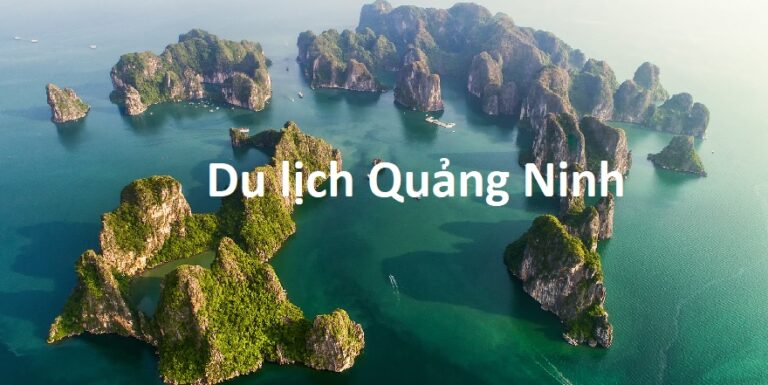
Tucked away amidst endless waves and the magnificent limestone mountain ranges of Halong Bay – twice recognized by UNESCO as a World Natural Heritage Site – Cua Van Floating Village has long stood as an inseparable symbol of poetic beauty and unique cultural life. More than just an appealing tourist destination, Cua Van is a space imbued with deep historical and cultural values, a “precious gem” that captivates travelers seeking peace and authentic experiences. Resembling a vivid traditional ink-wash painting, the image of colorful floating houses gently swaying on jade-green waters, surrounded by towering cliffs, creates an uniquely breathtaking and enchanting beauty. This pristine and rustic charm once earned Cua Van a spot on the list of the 16 most beautiful ancient villages in the world by the prestigious travel magazine Journeyetc.com. Even as time brings many changes, the enduring appeal and core values of Cua Van remain, inviting souls who love exploration. Geographically, Cua Van Floating Village is located in Hung Thang commune, Halong city, Quang Ninh province, nestled in a sheltered sea cove about 20 km from Tuan Chau International Passenger Port. Today, the Cua Van area lies within the core zone of the Halong Bay World Natural Heritage site and serves as a vital stop along Route 3 – a popular cruise route frequently operated by overnight cruises and private charter boats, offering visitors the chance to fully admire the beauty of one of Vietnam’s most famous floating fishing villages.
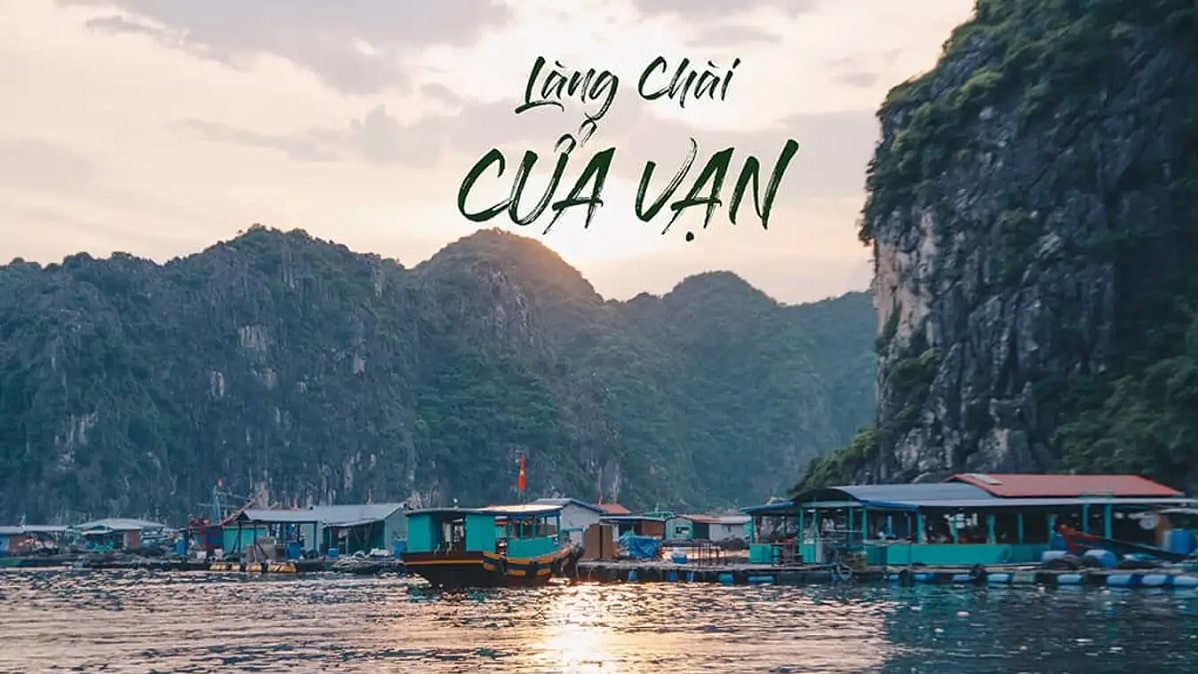 Cua Van Floating Village
Beyond its breathtaking natural beauty, Cua Van Floating Village prides itself on a rich history and distinctive traditional cultural values, serving as a testament to the continuous heritage of the resident communities on Halong Bay. A journey to explore Cua Van would be incomplete without understanding the origins and vibrant spiritual life of its people. The history of Cua Van can be traced back to the 19th century, when the first fishermen sought out this sheltered bay to anchor and make a living. According to research, Cua Van originated from two ancient fishing villages: Truc Vong and Giang Vong. Going even further back, human presence in this area is deeply connected to famous ancient cultures such as the Soi Nhu culture (Late Paleolithic period, approximately 18,000 – 7,000 BC) and the Cai Beo culture (Early Halong period, approximately 7,000 – 5,000 BC). Archaeological findings, including stone tools and pottery shards, suggest that Cua Van and its surrounding areas may have served as important storm shelters and trading outposts, and possibly even maintained connections with the once-bustling ancient trading port of Van Don. Over time, from a temporary stopover, Cua Van gradually evolved into a stable residential community and established itself as a cultural hub, embodying the unique identity of Halong Bay fishermen.
Before major changes took place in 2014, Cua Van Floating Village was a vibrant canvas of life on the water. Around 300 households with hundreds of floating houses closely clustered together, connected by small bridges, formed a distinct “floating street.” At that time, the lives of the Cua Van people were entirely entwined with the sea, where fishing, catching, and aquaculture formed their primary livelihoods. Children born and raised in these floating homes became familiar with oars and waves from an early age, making swimming an instinctive skill. The floating architecture of Cua Van also possessed its own unique charm, typically consisting of compact homes covering about 30 square meters, painted in vibrant, cheerful hues that not only enhanced the living space but also reflected the optimistic and joyful spirit of the coastal people.
The “soul” of old Cua Van lay in its exceptionally rich and unique intangible cultural heritage. Most prominent were the smooth, soulful folk melodies such as boat-rowing chants (*hát chèo đường*), courting duets (*hát ghẹo*, *hát giao duyên*), and sea shanties (*hò biển*) – melodies that faithfully reflected the labor, romance, love for the coastal homeland, and optimistic spirit of generations of fishermen. Alongside these were folk customs and spiritual beliefs tied to the sea, demonstrating reverence and harmony with nature.
A major turning point occurred in 2014 when the Quang Ninh provincial government implemented a policy to relocate hundreds of households living in floating villages within the core zone of the Halong Bay Heritage site, including Cua Van, to the mainland. This policy aimed to improve living conditions for the residents (providing access to solid housing, electricity, clean water, and better environmental sanitation), ensure safety against natural disasters, protect the bay’s ecological environment, and offer better access to education and healthcare for the fishermen’s children. The Cai Xa Cong resettlement area in Ha Phong ward, Halong city, became the new home for the Cua Van community and several other fishing villages. This transition initially brought inevitable challenges as residents had to adapt to a new lifestyle on land and seek alternative livelihoods. However, with support from local authorities and their inherent resilience, the lives of the villagers in the resettlement area have gradually stabilized. Many families have built or renovated more spacious homes, and most importantly, their bond with the sea and traditional crafts remains strong. Quite a few former Cua Van residents continue to fish at sea or quickly transitioned to participate in tourism service activities right on the bay where they spent their entire lives. This relocation story and new way of life serve as a vivid testament to human adaptability and relentless efforts to preserve cultural identity amidst social changes, while also presenting significant challenges for the preservation of the remaining physical heritage of Cua Van Floating Village today.
Costs and Important Notes When Visiting Cua Van Floating Village
Located in the core zone of the Halong Bay World Natural Heritage site and along Route 3 of the Halong Bay sightseeing tours, Cua Van Floating Village is an unmissable destination for travelers exploring Halong Bay. Typically, Route 3 is designed specifically for overnight cruises on Halong Bay; however, for a day trip, visitors can hire a private boat to reach this destination.
This is the most popular and widely chosen method to visit the Cua Van area. Most Halong cruises operating Route 3 itineraries (typically 2-day-1-night or 3-day-2-night tours) include sightseeing activities, kayaking, or sampan boat rides in the Cua Van floating village area. Choosing this option allows you to enjoy a resort-style experience on the bay while having ample time to explore Cua Van and nearby attractions.
| HALONG CRUISE PRICE LIST | ||
|---|---|---|
| CRUISE TIER | CHARTER PRICE (1 NIGHT) | INDIVIDUAL TICKET PRICE (1 NIGHT) |
| 3-star | 29,000,000 – 65,000,000 VND | 1,900,000 – 2,300,000 VND |
| 4-star | 45,000,000 – 85,000,000 VND | 2,950,000 – 3,500,000 VND |
| 5-star | 65,000,000 – 120,000,000 VND | 3,500,000 – 5,000,000 VND |
| 6-star | 120,000,000 – 200,000,000 VND | 5,000,000 – 8,000,000 VND |
Read more: Halong Cruises: 2-Day-1-Night, 3-Day-2-Night Tours
2. Private Day Boat to Cua Van Floating Village
If you lack time or prefer not to spend the night on the bay, renting a private Halong Bay sightseeing boat is a viable option. However, due to the long distance, a day trip to Cua Van by this method typically requires a minimum of 6 hours. You will need to cover the private boat charter fee (prices vary depending on the boat type and season) and purchase Route 3 sightseeing tickets for each member of your group. This is a flexible option for itineraries but more costly than joining a group tour or booking an overnight cruise.
- Private boat rental price: 4,000,000 – 5,000,000 VND/boat (48-seat boat, 6-hour journey duration)
- Route 3 sightseeing ticket price: 260,000 VND/guest
View details: Halong Bay Sightseeing Boat Price List
3. Speedboat
When planning a visit to Cua Van in 2025, it is essential for travelers to understand the current status of attractions and experiential activities here. The nostalgic charm remains, but certain facilities have changed or temporarily suspended operations.
1. Floating Village School Conservation Area: Relics of a Bygone Era
The floating school structure, which once hosted meaningful educational activities for the children of Cua Van and Vung Vieng, has met a similar fate of deterioration. Due to severe, irreparable damage and safety concerns, part of the school sank and was dismantled in late 2023. Currently, it is no longer an intact sightseeing spot.

The school at Cua Van fishing village is severely degraded and has not yet been repaired
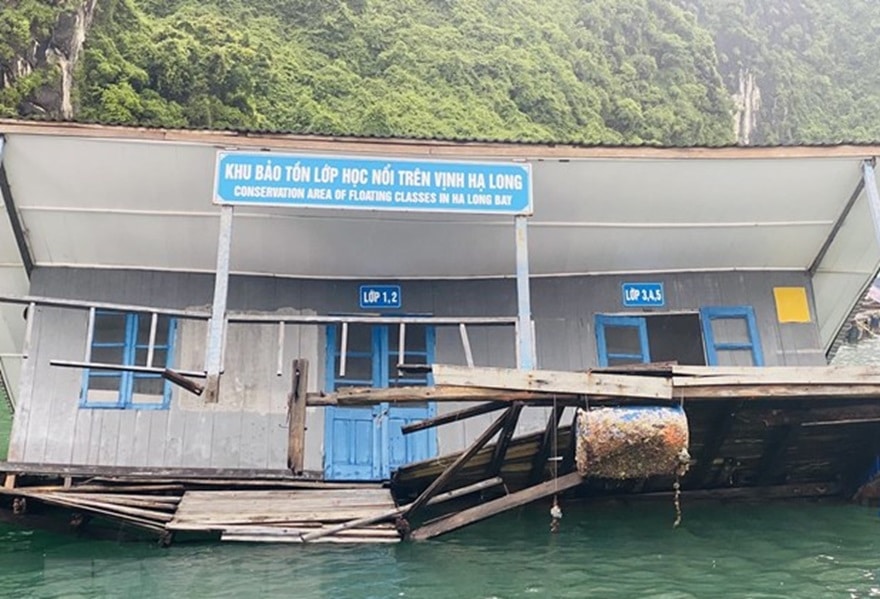
The Cua Van floating school conservation area has degraded
2. Cua Van Floating Cultural Center
One of the standout highlights and a former pride of Cua Van Floating Village is the Cua Van Floating Cultural Center. This is not only a unique architectural structure on the water but also considered the “heart” preserving the memories and heritage of the Halong Bay fishing community. Inaugurated in 2006 with support from the Norwegian Government under the Halong Ecomuseum project, it was the first floating cultural center for a fishing community in Vietnam, representing a unique ecomuseum model.
Inside the center, visitors once had the opportunity to immerse themselves in a rich exhibition space featuring over 1,200 documents, images, and vivid artifacts. These artifacts were arranged across various engaging themes, faithfully recreating all aspects of fishermen’s lives across generations: from unique livelihood methods, labor tools, daily utensils, and human life cycles on the waterways, to a vibrant spiritual life and meaningful messages about heritage preservation for the future. Furthermore, the center was a place where visitors could listen to sweet folk songs and courting duets performed by staff members (who are children of the fishing village), creating a true “living museum.” It successfully preserved, promoted, and introduced the distinctive traditional cultural values of Cua Van to numerous domestic and international tourists.
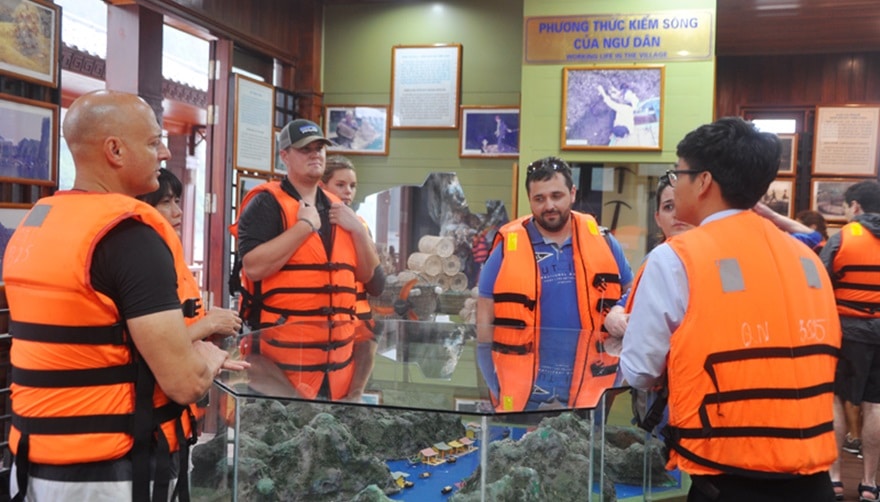
Historical displays at the Cua Van Floating Cultural Center
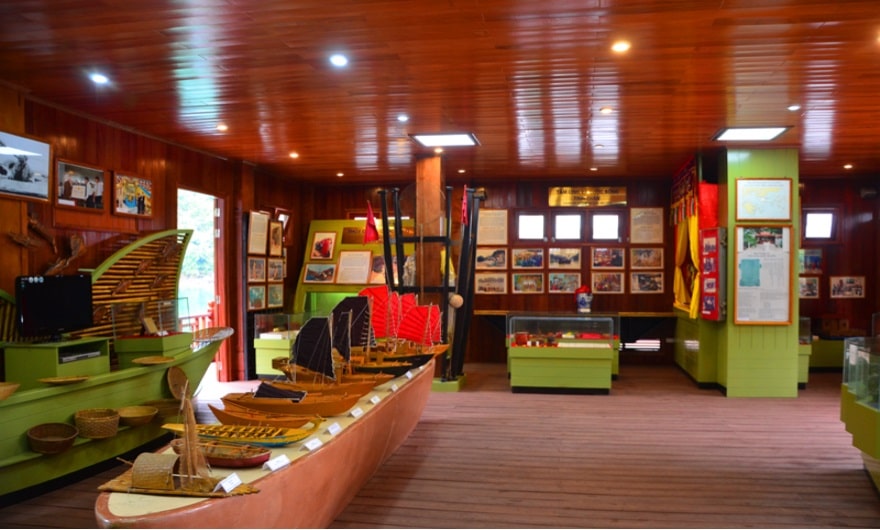
Exhibition area inside the Cua Van Floating Cultural Center
However, the most crucial and updated information that travelers need to know when planning a visit to Cua Van during the current period is: Due to severe infrastructure degradation after years of operating in a harsh marine environment (particularly the load-bearing steel beam structures, buoyancy systems, and walkways), the Cua Van Floating Cultural Center has TEMPORARILY SUSPENDED VISITOR RECEPTIONS since April 25, 2024, to undergo major maintenance and repairs.
As of now, the center REMAINS UNDER REPAIR and THERE IS NO OFFICIAL ANNOUNCEMENT regarding its reopening date. Visitors should check for updates from the Halong Bay Management Board or reputable travel agencies before their trip. Although temporarily closed to visitors, we hope that the restoration work will be completed soon so that the “heart” of Cua Van can be revived and continue its mission of preserving and spreading precious heritage values.
3. Fishing Village and Conservation Rafts Area
Visitors to Cua Van today can still admire the characteristic scenery of a floating fishing village amid the bay, featuring about 20 Cua Van raft houses retained for conservation purposes (including several model homes and former cultural houses). However, it should be noted that due to the harsh impacts of the marine environment over many years, most of these raft houses are in a state of severe deterioration. Wooden structures have rotted, and buoyancy systems and support frames are damaged, which may pose safety hazards.

The iron framing beneath the wooden houses is severely rusted and degraded, losing its structural support

Long-term seawater corrosion has caused the iron frame to flake off in chunks, tilting the wooden houses

Some wooden houses in Cua Van fishing village are gradually sinking into the water

The iron plates connecting pathways between houses are no longer safe
Therefore, the primary experience when visiting this area now involves taking a slow boat tour through the village, viewing the overall floating architecture from a distance, taking photos of Cua Van framed by surrounding mountains, and soaking in the peaceful, nostalgic atmosphere of a unique lifestyle that once existed. Approaching too closely or entering the raft houses may be restricted by management authorities or tour operators to ensure visitor safety.
Experiential Activities at Cua Van Floating Village
Although some main attractions are temporarily closed or no longer intact, visitors to Cua Van can still enjoy other engaging activities:
- Kayaking or Sampan Boat Rides: This is the most beloved activity and remains operational. Visitors can rent a kayak to paddle on their own or ride in a sampan (small wooden boat) rowed by locals (who participate in tourism services). This activity allows you to weave safely past the raft houses, explore the beauty of limestone cliffs and small caves up close, and enjoy the tranquility of this sheltered bay. It is the best way to fully absorb the natural landscape surrounding Cua Van.
- Swimming: Certain calm, clean water areas near the fishing village may be suitable for swimming (please follow the instructions of your guide or captain regarding safe and permitted locations).
- Important Note: Because the fishing community has relocated to the mainland and due to the practical condition of the conservation raft houses, previously described activities such as “experiencing life as a fisherman,” “casting nets and fishing with locals,” or “listening to courting duets on the raft houses” are no longer common or organized directly within Cua Van Floating Village. If you wish to enjoy cultural performances, you can find such shows integrated into the itineraries of overnight cruises.
you might also like
[blog_posts style=”normal” type=”row” columns=”3″ columns__md=”1″ ids=”8959,8946,8738″ show_date=”false” image_height=”56.25%”]