Cat Ba Archipelago and Lan Hả Bay are renowned not only for their pristine natural beauty but also as the cradle of the Cai Beo culture—one of the most ancient Neolithic civilizations of the Vietnamese people. This remarkable destination preserves the imprints of ancient inhabitants from thousands of years ago, whose lives were intimately intertwined with the ocean. At Halong & Lan Ha Bay Cruise Tours, we take pride in curating immersive and breathtaking journeys through Lan Hả Bay and Cat Ba, where you can lose yourself in magnificent landscapes while uncovering this unique cultural heritage. Join Halong & Lan Ha Bay Cruise Tours on a journey back in time to explore the Cai Beo culture through the article below!
The Origins of the Cai Beo Culture
The Cai Beo culture is an ancient Vietnamese civilization named after the Cai Beo archaeological site located on Cat Ba Island, Hai Phong. Dating back 4,000 to 7,000 years, this site is closely linked to the Ha Long culture and the maritime heritage of ancient Vietnamese peoples. The Cai Beo site was discovered in 1938 by the French archaeologist Madeleine Colani and has since undergone numerous excavations by both domestic and international research teams.

Portrait of female archaeologist Madeleine Colani – the person credited with discovering and naming the Cai Beo culture
Archaeological evidence indicates that the people of Cai Beo shared genetic and cultural connections with the Hòa Bình – Bắc Sơn culture. The pebble stone tools of the Cai Beo people exhibit manufacturing techniques and shapes remarkably similar to those of the Hòa Bình – Bắc Sơn. The traces of floating dwellings at Cai Beo display architectural layouts and construction styles akin to their Hòa Bình – Bắc Sơn counterparts. Furthermore, DNA analyses of Cai Beo remains reveal genetic and environmental alignments with the Hòa Bình – Bắc Sơn population.
Nevertheless, archaeological evidence also demonstrates that the Cai Beo people evolved and adapted beyond the Hòa Bình – Bắc Sơn baseline. Their pebble tools were smaller and more specialized for fishing and aquaculture. The remnants of their floating homes were engineered to adjust to tides and winds. DNA profiling further reveals adaptations and cultural exchanges with other contemporary civilizations.
Read more: Cai Beo Fishing Village in Lan Hả Bay
Location and Artifacts Recovered from the Cai Beo Archaeological Site
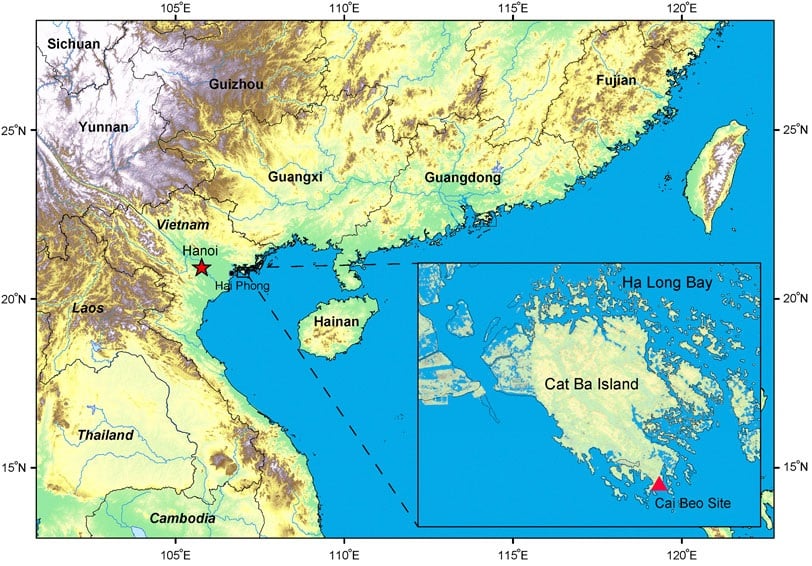
The Cai Beo area (N 20°43′8″, E 107°3′2″), situated nearly 4 meters above sea level, is located on Cat Ba Island—the largest island in Ha Long Bay, within the jurisdiction of Hai Phong City (Figure 1). Cai Beo was first reported by the French archaeologist Madeleine Colani, who conducted a small preliminary excavation in 1938. Subsequently, in 1972, 1973, 1981, 1986, and 2006, Vietnamese archaeologists excavated the site five times, covering a total area of 449 m². The known distribution area of Cai Beo spans approximately 18,000 square meters.
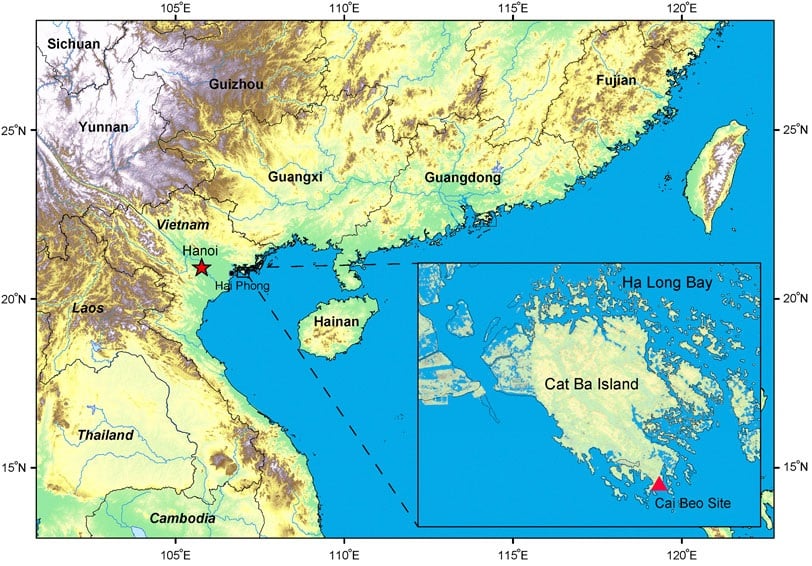
FIGURE 1. Location of the Cai Beo area. The site is indicated by a red triangle.
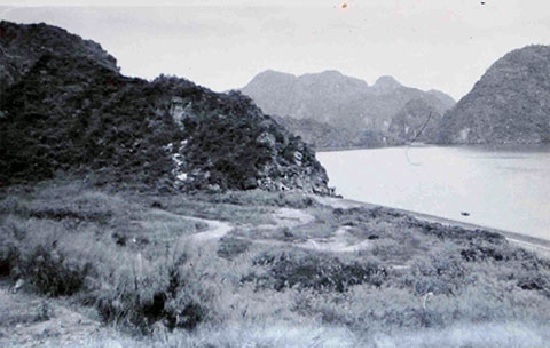
Figure 1: The Cai Beo archaeological site area
Hundreds of kilograms of large fish bones and marine shells recovered from excavations at Cai Beo point to a distinctly maritime-oriented economy. In addition, numerous terrestrial animal remains—including masked palm civets, brown bears, deer, stags, wild boars, elephants, and monkeys—have been documented, illustrating a thriving ancient forest ecosystem during that era.
During the 1973 excavation, the Cai Beo strata were classified into three cultural layers: Early Neolithic, Late Neolithic, and the Ha Long Culture. However, since the 1981 excavation, it has been generally proposed that the site’s sediment comprises a local “Cai Beo phase” (subdivided into Cai Beo phases 1 and 2) followed by a later “Ha Long phase” (Figure 2). The two lower cultural layers of Cai Beo—phases 1 and 2—date approximately from 7,000 to 5,000 years ago. This estimation is based on radiocarbon dating (ZK-328-0, see below) and comparisons with similar discoveries across five other Cai Beo cultural sites in Ha Long Bay.
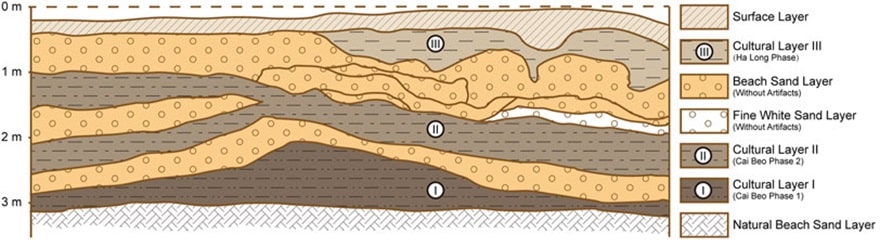
FIGURE 2. Trench profile of the south wall of H3, Cai Beo site (1973 excavation).
The lowest layer (Cai Beo Phase 1, see Figure 2: Cultural Layer I) represents the earliest human settlement of the area. This layer, 2.4–3.2 meters deep, consists of sand strata mixed with rounded gravel, pottery fragments, marine fish bones, oysters, and various sea shells. A large quantity of stone tools was discovered, including numerous ground implements (Figure 3A), all bearing clear signs of use-wear. Most of these stone tools are flake choppers produced via direct percussion. Other items include disc tools, pointed tools, quarter-pebble tools, stone hammers, stone anvils, and more. The stone artifacts categorized as “ground stone tools” excavated from this stratum are sharpened exclusively along the blade edge. Pottery sherds found here are small in quantity and size, characterized by thickness and coarseness. The middle cultural layer (see Figure 2: Cultural Layer II / Cai Beo Phase 2) lies at a depth of 1.2–2.4 meters, marking the appearance of polished stone adzes.
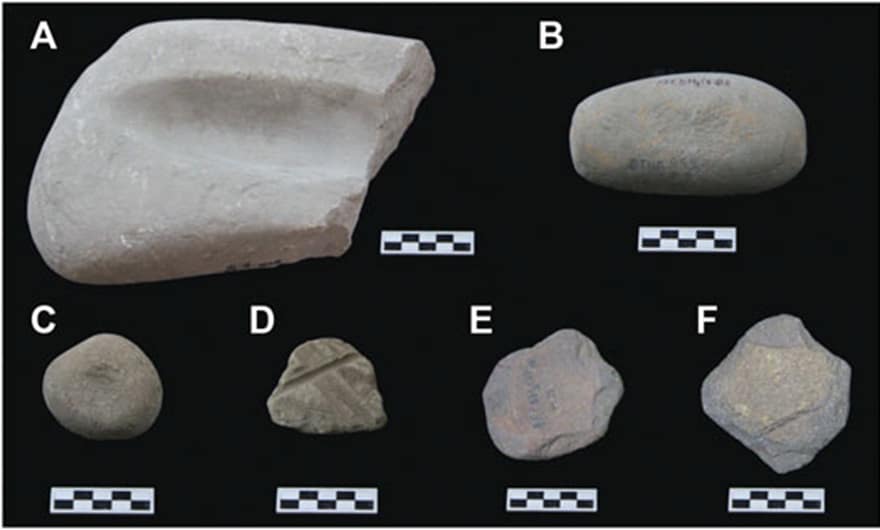
FIGURE 3. Typical stone tools collected from the Cai Beo site (Scale: 5 cm). (A) Ground stone, (B) Grinder/Muller, (C) Pitted stone, (D) Stone tool with “Ha Long” characteristics, (E) Scraper, (F) Pointed tool.
Radiocarbon dating (ZK-328-0) yielded an age of 6,893–6,391 BC (5,810 ± 115 uncalibrated BC, half-life: 5,730 years) (or 5,645 ± 115 uncalibrated BC, half-life: 5,570 years) obtained from fish bones (Laboratory of the Institute of Archaeology, 1977) excavated from the Cai Beo cultural strata. Additional chronological indicators include human burial practices, craniometric measurements, pottery, and lithic artifacts. For instance, lithic tools similar to those of Haolizhuo have been discovered in widespread Cai Beo cultural strata along the southern coastal regions of China in Fujian, Guangdong, and Guangxi dating from 7,000 to 5,000 years ago. A flexible (secondary) burial custom excavated from the Cai Beo cultural phase was identified by Nguyễn Lân Cường as exhibiting close affinities with Australo-Papuan populations. Both the flexible burial custom and Australo-Papuan affinities serve as significant cultural markers of prehistoric hunter-gatherers in southern China and Southeast Asia.
During the 1981 excavation, the lowest cultural layer was discovered underlying—and thus predating—a marine transgression layer (approximately 20 cm thick, consisting of sterile gravel) appearing at a depth of 2.4 meters below the square surface. Consequently, the earliest occupation at this site must predate the marine transgression that occurred around 6,000 to 5,500 years ago in the Ha Long Bay region. This chronological constraint further supports the proposed age of Cai Beo cultural phase 1 as predating approximately 6,000–5,500 cal. BP.
The upper layer of the Cai Beo site represents the Ha Long culture phase (Figure 2: Cultural Layer III), generally considered to have begun around 4,500 years ago. Specifically at this site, the associated layer lies at a depth of 0.2–1.2 meters. Novel fully polished stone tool forms include meticulously polished shouled axes and quadrangular axes. Other stone objects include chisels, hammers, sandstone artifacts bearing Ha Long characteristics, and stone rings. Compared to findings from earlier Cai Beo cultural strata, pottery in the Ha Long cultural layer appears in much larger quantities with greater diversity in form and decoration, including the use of fast-wheel throwing techniques.
Over 38 sites surrounding Ha Long Bay have been classified under the Ha Long Culture based on artifact associations and temporal ranges. Among Ha Long cultural relics, radiocarbon dating indicates an age postdating the older “Cai Beo” context. Available C14 dates from several Ha Long cultural sites cluster between 4,500 and 3,500 BC. For example, one C14 sample from the Bà Vùng site dates to 4,727–4,517 BC (4,100 ± 40 uncalibrated BC, charcoal sample), while another Ha Long cultural site, Hòn Hải Cổ Tiên, dates to 4,381–3,926 BC (3,755 ± 60 uncalibrated BC, human bone sample). At the Cai Beo site, pottery and other artifacts from the Ha Long stratum generally align with the expectations of early Ha Long Culture assemblages.
Scientists submitted 12 samples from Cai Beo—including a human skull, a deer antler, a deer tooth, five mammalian bones, and four marine fish bones—to Beta Analytic for AMS dating. Regrettably, reliable collagen could not be isolated and purified from any of these samples. As a result, the bone materials could not be successfully dated. Nevertheless, the foundational chronology and the two main cultural phases of the site have been reliably reconstructed through multiple independent lines of evidence as outlined herein.
Hai Phong Museum: Exhibiting Artifacts of the Cai Beo Culture
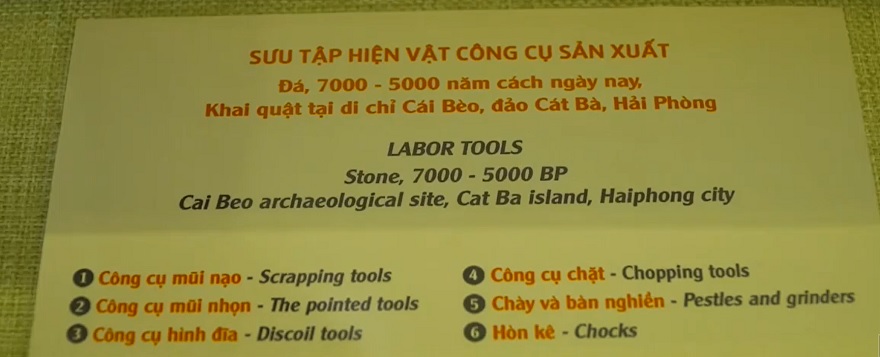
The lower layer is Cai Beo 1, belonging to the pre-Ha Long culture dating back 7,000 – 5,000 years
Hai Phong Museum is a specialized institution dedicated to the history and culture of Hai Phong City, featuring an extensive exhibition of artifacts excavated from the Cai Beo site. These artifacts are categorized into three distinct periods: Period I (7,500 – 6,000 BC), Period II (6,000 – 5,000 BC), and Period III (5,000 – 4,000 BC). Within the museum, visitors can admire stone axes, tubular grooved abraders, net sinkers, porous pottery, thin hard pottery, and stone bracelets crafted by the ancient Cai Beo people. These relics highlight the remarkable advancements in manufacturing technology and maritime subsistence strategies achieved by the Cai Beo inhabitants. Hai Phong Museum is open daily from 8:00 AM to 11:30 AM and from 1:30 PM to 4:30 PM, except on Mondays and Sundays. Admission is 20,000 VND for adults and 10,000 VND for students and children. Address: No. 66 Điện Biên Phủ, Hồng Bàng District, Hai Phong.