Quan Lan Communal House is an ancient temple situated on Quan Lan Island and a significant relic within the historic Van Don trading port complex, serving as a spiritual anchor for the island’s inhabitants. Built during the Later Le Dynasty, the structure features a harmonious blend of intricate architectural patterns and carvings. The communal house serves as a place of worship for the village guardian spirits and acts as a central hub for village meetings. However, the most unique aspect of its architecture lies in the rich and sophisticated dragon carvings, which vividly portray the artistic styles of the Ly, Tran, and Nguyen dynasties. But what is the reason behind this remarkable architectural convergence?
See more: Discover Van Don Tourism
Introduction to Quan Lan Communal House
Quan Lan Communal House was first constructed during the Later Le Dynasty in the 17th century at Cai Lang wharf, which was once the heart of the ancient Van Don trading port. This port served as a pivotal hub for the nation’s first maritime Silk Road, connecting Dai Viet to distant lands. Following seven centuries of prosperity, the Van Don trading port eventually lost its prominence as trade routes shifted further inland. Consequently, the residents of Cai Lang relocated and changed their livelihoods, leading to the dismantling and rebuilding of the communal house at a new site.
Quan Lan Communal House – A unique architectural marvel and spiritual sanctuary for local fishermen
Later, during the 12th year of the Thanh Thai reign (1890-1900) of the Nguyen Dynasty, the communal house was relocated to its current site in Doai village and renamed Quan Lan Communal House 2. The site’s location is considered geomantically ideal, described as “Front Three Peaks, Rear Five Peaks.” The front facade faces three mountains (Sao Trong, Sao Ngoai, and Sao On), while the rear is shielded by five mountains (Lieu Mountain), creating a natural, robust defensive screen rarely found elsewhere.
What distinguishes Quan Lan Communal House from many others is that, while most houses worship a village guardian spirit (Thanh Hoang) or local deities, this site is dedicated to royalty. The king worshipped here is Ly Anh Tong, who established the Van Don trading port in 1149. Consequently, the villagers revere him both as their king and as the patron deity of the land. Beyond the monarch, the communal house also honors General Tran Khanh Du, who played a crucial role in defending the Van Don border and securing a monumental victory against the Yuan-Mongol supply fleet. Additionally, the house enshrines Duong Khong Lo and the “Four Holy Mothers” (Tu vi Thanh nuong), deities long believed to protect those who venture out to sea.
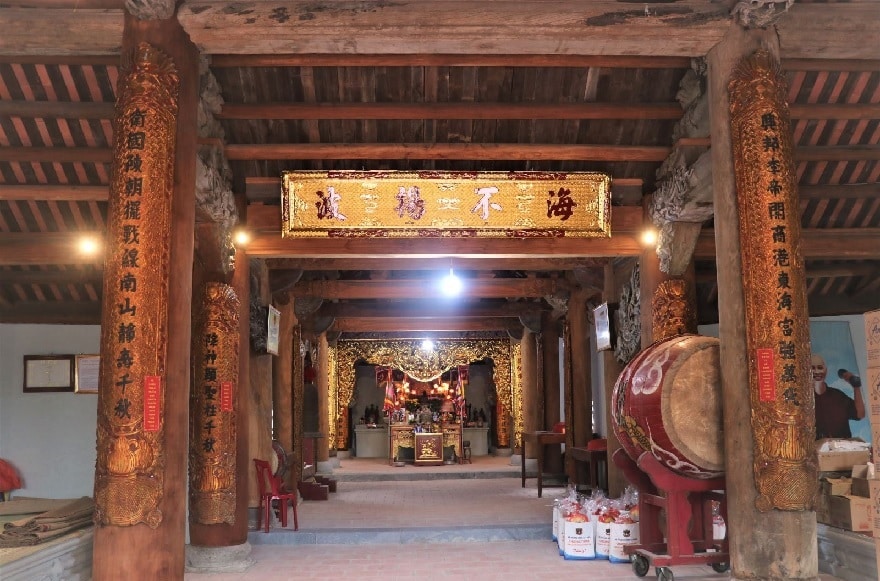
Quan Lan Communal House honors Emperor Ly Anh Tong and other revered deities,
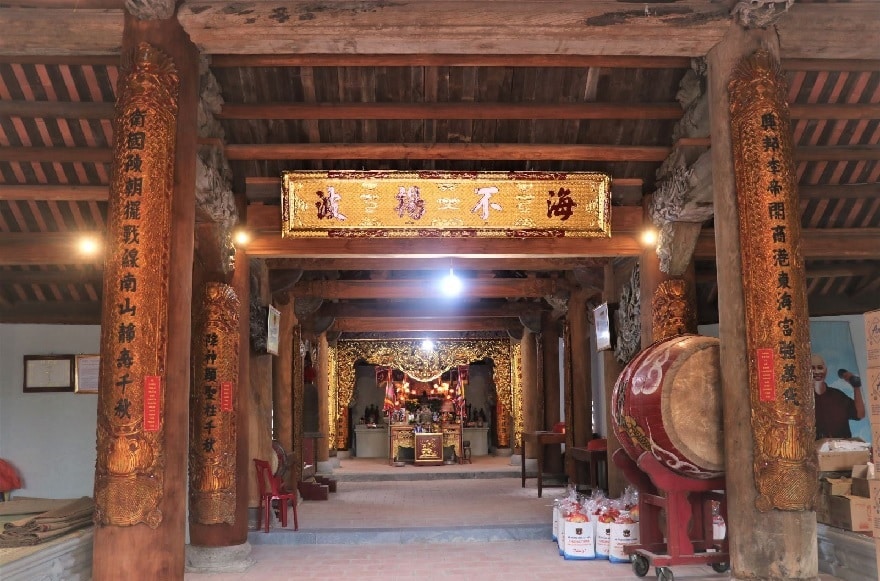
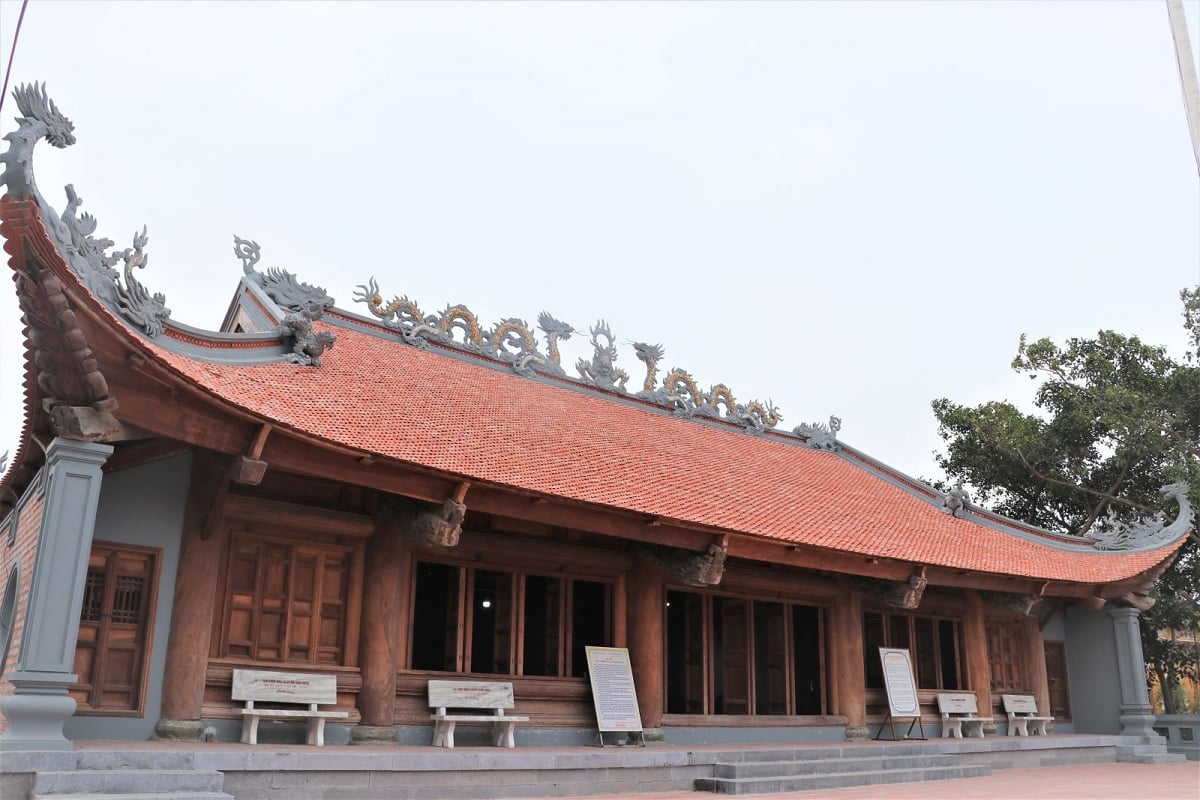
The architecture consists of a main ceremonial hall connected to the sanctuary by three “ong muong” corridors. The roof is adorned with a “two dragons worshiping the moon” motif, and the curved eaves are striking. At the entrance, four bold, embossed characters read “Quoc thinh dan hung” (The country flourishes, the people prosper), reflecting the aspirations of the local community. Inside, the intricate and meticulous carvings form a magnificent artistic masterpiece. Notably, each of the beam ends is carved into unique dragon heads, no two of which are identical. The wooden flooring is a design feature found only in Dinh Bang (Bac Ninh) and Tra Co (Mong Cai) communal houses. According to village elders, the house once contained the “Quan Tam” statue, symbolizing a woman sericulturist, and the “Quan Vo Bung” statue, representing men who went to sea for fishing.
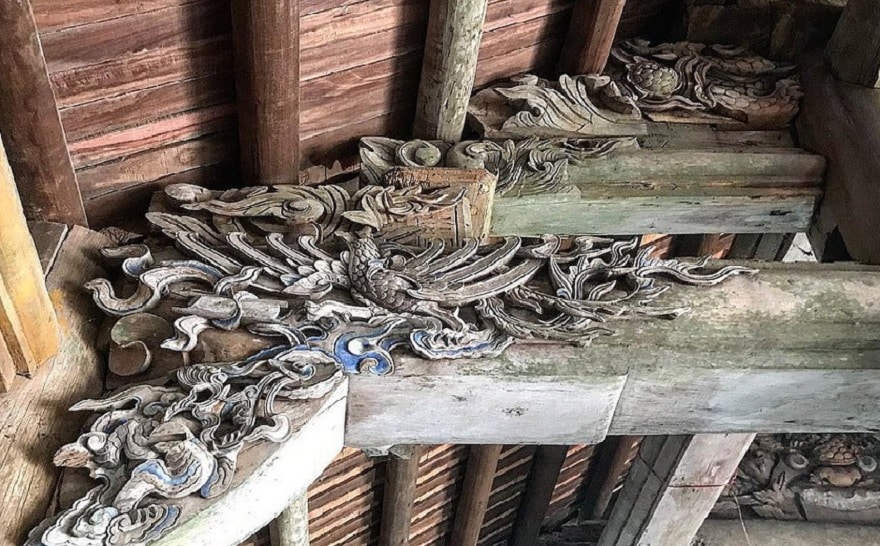
The roof is tiled with dark brown scales, topped with a decorative ‘two dragons worshiping the moon’ motif
Furthermore, the entire structure is supported by 32 main columns and 26 auxiliary columns, with the largest measuring 3.2 meters in circumference. Remarkably, these columns are crafted from “Man Lai” wood—a timber even more resilient than the legendary “four irons” woods—which remains solid and heart-rot resistant for over a millennium. This is likely the only communal house in Vietnam built with this rare timber, which grows exclusively on the rugged, perilous sea-facing cliffs of the Hai Van island region. With these massive wooden columns, Quan Lan Communal House is not only a grand traditional wooden structure but a one-of-a-kind national treasure. Its architectural features remain a subject of endless fascination.
Beyond its architectural and historical significance, the communal house serves as a spiritual anchor for the Van Don residents, who have guarded it for centuries. The house embodies many unique qualities that instill pride in every islander. Currently, it preserves 18 royal decrees issued from the first year of King Thieu Tri’s reign (1841) through to the reign of Emperor Bao Dai, all of which document the meritorious deeds of the ancestors.
Other architectural landmarks near Quan Lan Communal House
With the allure of a celebrated architectural landmark, Quan Lan Communal House is an unmissable destination for every traveler visiting the island. Adjacent to the left of the communal house stands Quan Lan Pagoda, an ancient sanctuary dating back to the 17th century. The pagoda features a refined yet majestic design, consisting of two main halls and two side chambers. Inside, the temple is adorned with vibrant paintings and intricately crafted Buddha statues. Quan Lan Pagoda serves as a place of devotion for island monks and nuns, as well as a serene space for visitors to explore and offer prayers.
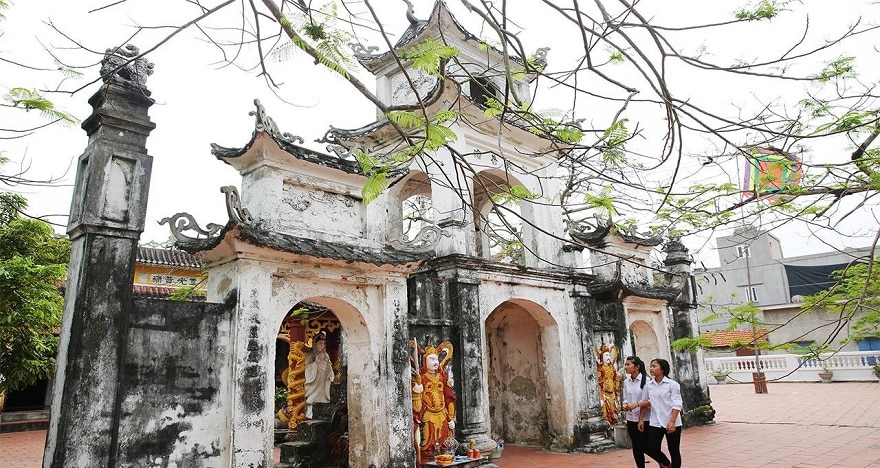
Quan Lan Pagoda, built in the 17th century.
To the left of the pagoda lies the Quan Lan Temple, dedicated to the three Pham brothers—Pham Ngu Lao, Pham Ngu Chieu, and Pham Ngu Dong—who were renowned generals of the Tran Dynasty. These brothers played a pivotal role in the resistance against the Mongol invaders, contributing significantly to the defense of the nation’s northern and eastern frontiers. The temple was established to honor and commemorate these heroic figures.
Located approximately 1 km from the Quan Lan Communal House is the Quan Lan Shrine, dedicated to Tran Khanh Du, a distinguished general of the Tran Dynasty. Tran Khanh Du (1228–1300) was one of the most brilliant military commanders of his era, instrumental in all three resistance wars against the Mongol Empire. Celebrated for his maritime victories, he earned the titles of “Overseas General” and “Grand General of the Navy.” The shrine was built to pay tribute to his legacy. On July 14, 1990, the entire complex—comprising the Communal House, Pagoda, Temple, and Shrine—was officially recognized as a National Historical and Cultural Relic.
Festivals at Quan Lan Communal House
The “Village Lockdown” (Khoa Lang) and “Deity Robe Changing” (Cai Tich) ceremonies are two vital cultural and spiritual traditions of the Quan Lan people, held annually during the Quan Lan Communal House Festival from the 10th to the 20th of the sixth lunar month. This festival commemorates the historic Van Don victory on the Mang River in 1288, where Tran dynasty forces commanded by Tran Khanh Du successfully annihilated the Mongol Yuan supply fleet, a pivotal contribution to the nation’s monumental Bach Dang victory.
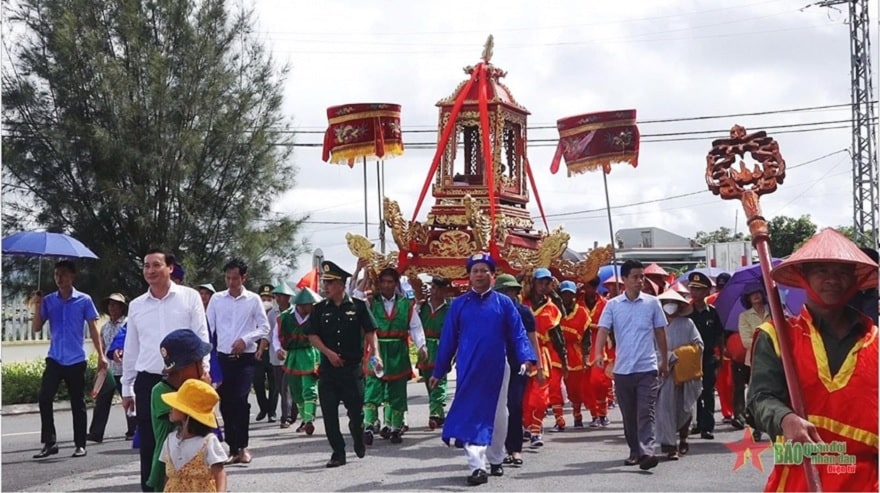
The “Village Lockdown” and “Deity Robe Changing” ceremonies. (Photo: People’s Army Newspaper)
The “Village Lockdown” ceremony entails a temporary prohibition on villagers leaving the community during the festival, ensuring everyone remains focused on religious observances and cultural or sporting activities. This ritual begins on the morning of the 10th day of the sixth lunar month, marked by the hoisting of a festival flag at the communal house gate. The red flag symbolizes the passion and heroism of the Quan Lan people. Residents are strictly required to remain within the village unless an emergency arises or official permission is granted by the organizers; violations are punishable by fines or expulsion. The purpose of this ceremony is to preserve the sanctity and solemnity of the festival while fostering communal unity and connection.
The “Deity Robe Changing” ceremony involves dressing the worshipped deities in new garments, serving as a profound expression of reverence and a prayer for blessings. This rite takes place at noon on the 10th day of the sixth lunar month, following the completion of the ritual honoring the Guardian Deity. The Guardian Deity, who protects the village, is identified as Tran Khanh Du—a distinguished general of the Tran dynasty. The deities honored with new robes include King Ly Anh Tong,, General Tran Khanh Du, and General Pham Cong Chinh. These figures were instrumental in defending the northern and eastern frontiers against the 13th-century Mongol invaders. During the ceremony, the deity statues are brought out from the communal house, cleansed, and dressed in new robes hand-sewn by local families. These garments are crafted from silk, typically in shades of green or blue, symbolizing the purity and majesty of the deities. Once dressed, the statues are returned to their sacred places for ongoing worship. The “Village Lockdown” and “Deity Robe Changing” ceremonies are profoundly meaningful activities that reflect the deep-rooted respect the Quan Lan people hold for their ancestors, as well as the community’s spirit of solidarity and adherence to tradition.Beyond these rituals, the Quan Lan Communal House also hosts community gatherings featuring traditional arts such as Ca Tru, Cheo, and Tuong during holidays and weekends, which help preserve and promote the cultural heritage of the island’s inhabitants.
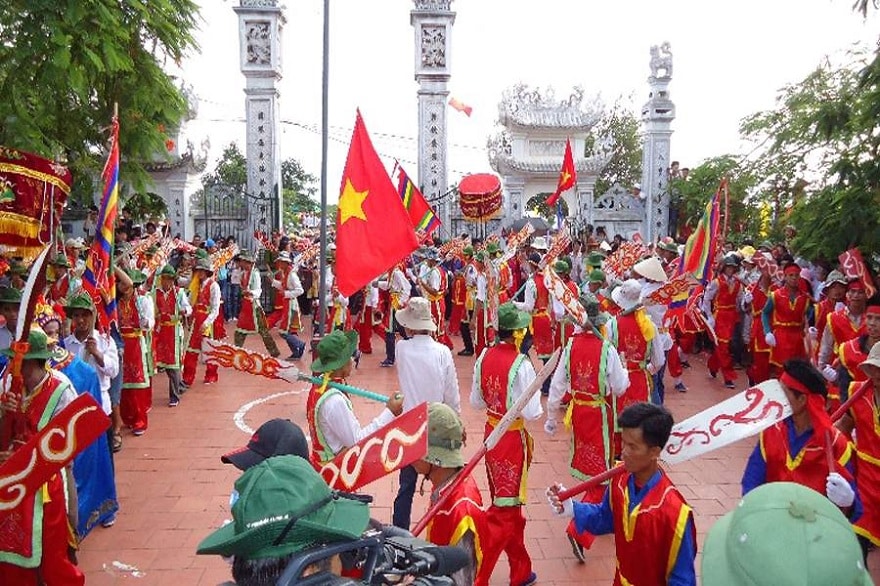
The unique Quan Lan rowing festival
Over five centuries, despite several relocations, the Quan Lan Communal House has retained its unique architectural integrity, standing resilient against the coastal elements. This longevity is a testament to the remarkable creativity and dedication of the ancestors and the community of Quan Lan Island, Quang Ninh Province, in preserving their heritage. Beyond its material value, the communal house serves as a sanctuary for the spiritual values passed down through generations—a spirit of martial prowess in defense of our seas and islands, and the industrious nature of our people in harvesting the bounty of the ocean to enrich the homeland. The Quan Lan Communal House is more than just a centerpiece of village life; it is an enduring cultural landmark that affirms the eternal sovereignty of the Vietnamese nation over its islands and seas.