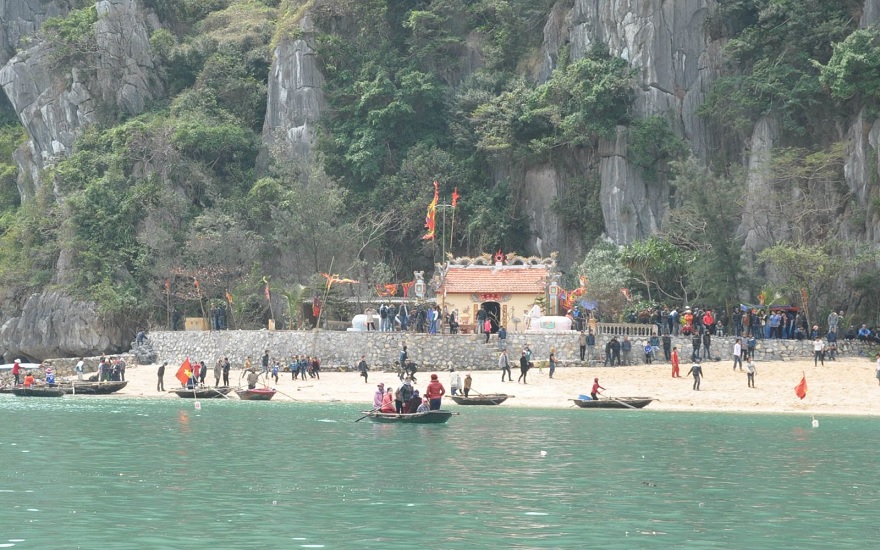
Ba Men Temple is a sacred spiritual site revered by the local fishermen of Ha Long Bay and Cat Ba Island. It is situated on a spacious sandy beach at the foot of Dau Be Island, located in the border waters between Ha Long Bay and Lan Ha Bay, Cat Ba (Hai Phong). The temple was officially recognized as a provincial-level heritage site by Quang Ninh province in 2015, and the area lies within the strictly protected zone of the Ha Long Bay World Heritage site.
The Origin of Ba Men Temple
Ba Men Temple, also known as Duc Chua Ba, boasts a history spanning over 200 years. It was constructed to honor one of six women who tragically drowned while traveling on a raft. According to legend, in 1818, nine women from Van Yen village (now in Van Don district) were traveling on a raft to sell goods among the islands. During their journey, they were struck by a fierce storm; the raft capsized, and the waves swept both the women and their vessel into the sea. These women are believed to have “ascended” during a sacred hour, and their bodies were washed ashore at various locations across the Ha Long Bay and Cat Ba archipelago, where locals subsequently buried them and erected shrines at six different sites. Among them, the eldest woman, named Men, had her body washed up on Dau Be Island, where the local community built a shrine and venerated her as a protective deity for those who make their living at sea.
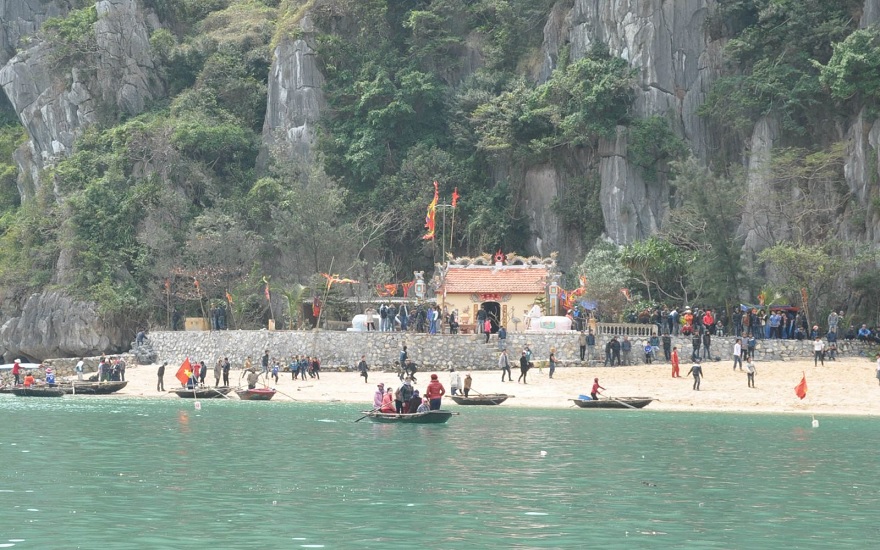
Ba Men Temple
Ba Men Temple is located approximately 25km from the Ha Long International Cruise Port. To reach this site, visitors must purchase a Ha Long Bay sightseeing ticket (Route 3) and charter a private boat (as this route does not accommodate shared boat tours), or preferably, book an overnight luxury cruise for a more comfortable and leisurely experience. The journey from the port to Dau Be Island typically takes 2 to 2.5 hours by private boat; if you are on an overnight cruise, this stop is often scheduled for the second day of the itinerary. Upon arriving at the island, you can take an electric cart to travel directly to Ba Men Temple.
Architecture of Ba Men Temple
The current temple follows a T-shaped architectural layout, measuring 70m in length and 20m in width, with its entrance facing a sheltered lagoon. The temple houses statues of Ba Men and various “Goddesses,” “Mother Goddesses,” and “Water Deities” inherent to Vietnamese folk beliefs, with later additions incorporating Buddhist worship. Before 1983, the temple was merely a thatched-roof shrine at the foot of the mountain, containing a 40cm-tall female figurine wearing a pale yellow headscarf, accompanied by a porcelain incense burner. Behind the mountain, the original tomb of Ba Men remains in its place despite various renovations. The temple has been meticulously restored by local fishermen on several occasions: 1983, 1987, 2006, and a major renovation took place in 2018.
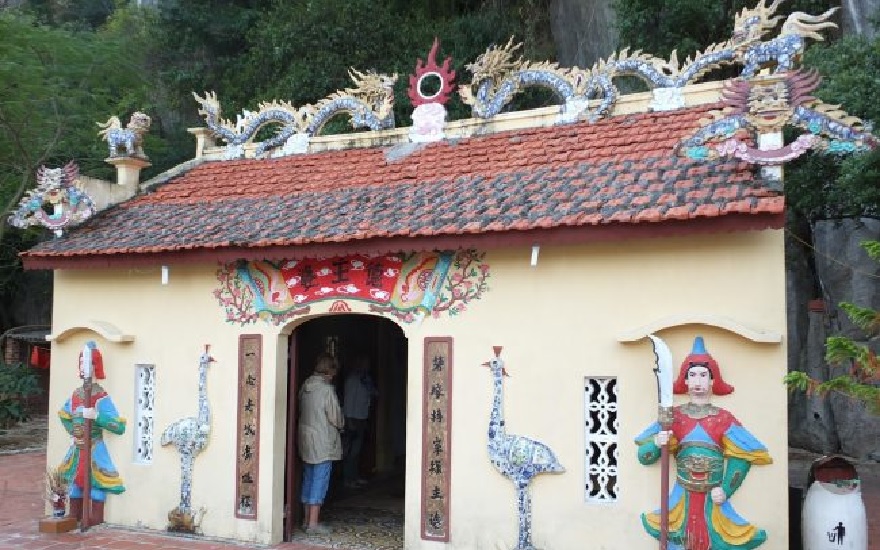
Worship area at Ba Men Temple
In 2015, the temple was officially recognized as a historical-cultural relic and scenic spot of Quang Ninh province. Ba Men Temple is a compelling destination for travelers eager to delve into the local culture and spiritual traditions. Beyond its role as a place of worship, the temple serves as a hub for cultural and spiritual activities, including the Ba Men Festival on the 15th day of the first lunar month, the Whale Festival on the 16th day of the first lunar month, and various Ca Tru performances during festive holidays. Ba Men Temple remains an enduring symbol of the deep, ancestral bond between the people of Quang Ninh and the sea.
Festivals at Ba Men Temple
The Ba Men Temple Festival, held on the 19th and 20th days of the first lunar month, marks the transition between spring and summer—a time when local fishermen prepare to set sail after a period of rest. The festival is composed of two primary parts: the ceremonial rites and the festive celebrations.
The ceremonial portion consists of traditional rituals, including offerings of incense and flowers at the temple to pray for a year of favorable weather, calm seas, and prosperity, while expressing gratitude to Ba Men for her protection over the past year. The ceremonies begin early on the morning of the 19th, when various fishing boats from Halong Bay and Cat Ba Island gather to prepare for the boat racing competition. After these preparations, the crews return to the harbor for the solemn main ceremony. This event is conducted with great formality, attended by local government officials, Buddhist monks, cultural scholars, and performing arts groups. The rites blend Buddhist and Taoist traditions in a unique, harmonious display of local faith. Following the processions, the crews return to the temple to continue the rituals. The ceremony concludes on the evening of the 19th, as the crews once again ready their vessels for the race the following day.
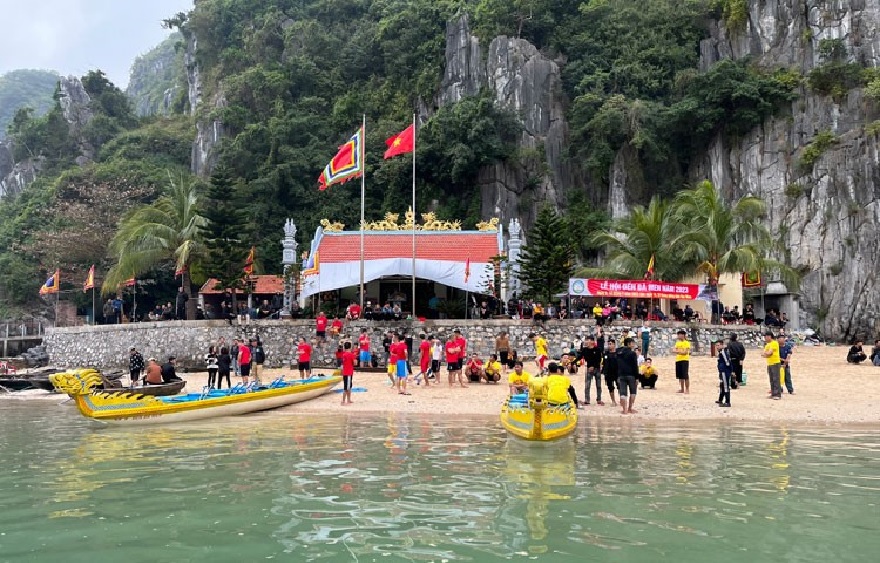
Typically there are 4 racing teams, though sometimes only 2 participate if other fishing villages lack sufficient crew members.
The festival portion features lively entertainment and cultural exchanges, highlighted by the boat racing competition between the bay’s fishing villages. This is a thrilling and highly anticipated event, as local belief holds that the winning village will be blessed with good fortune and successful fishing throughout the coming year. The race takes place at dawn on the 20th of the lunar month. Traditionally, four teams compete: Cong Dam, Vung Vieng, Cua Van, along with Ha Nam (Ba Ham Lake) and Cao Minh (Cat Ba). Each boat consists of 14 rowers and one helmsman. The course covers approximately 500 meters, starting in front of the temple. The teams race two laps, and the first to cross the finish line is declared the winner.
The boats are powered by strong, skilled oarsmen, while supporters line the route on various vessels, waving flags, beating drums, and cheering loudly. The race stretches from the shore out into the heart of Halong Bay and back. The atmosphere is vibrant and electric, fueled by the cheers of thousands of locals and tourists. The competition concludes around 10:00 AM on the 20th of the lunar month when the winner is confirmed. The awards ceremony takes place at the temple courtyard, with a prize of 4 million VND for the winners and 3 million VND for the runners-up. The oarsmen from both sides then shake hands, celebrating together and promising a rematch in the next year’s festival.
We hope this information regarding Ba Men Temple has been useful to you. If you are interested in chartering a cruise in Halong Bay to visit this destination, please contact us for further details.